
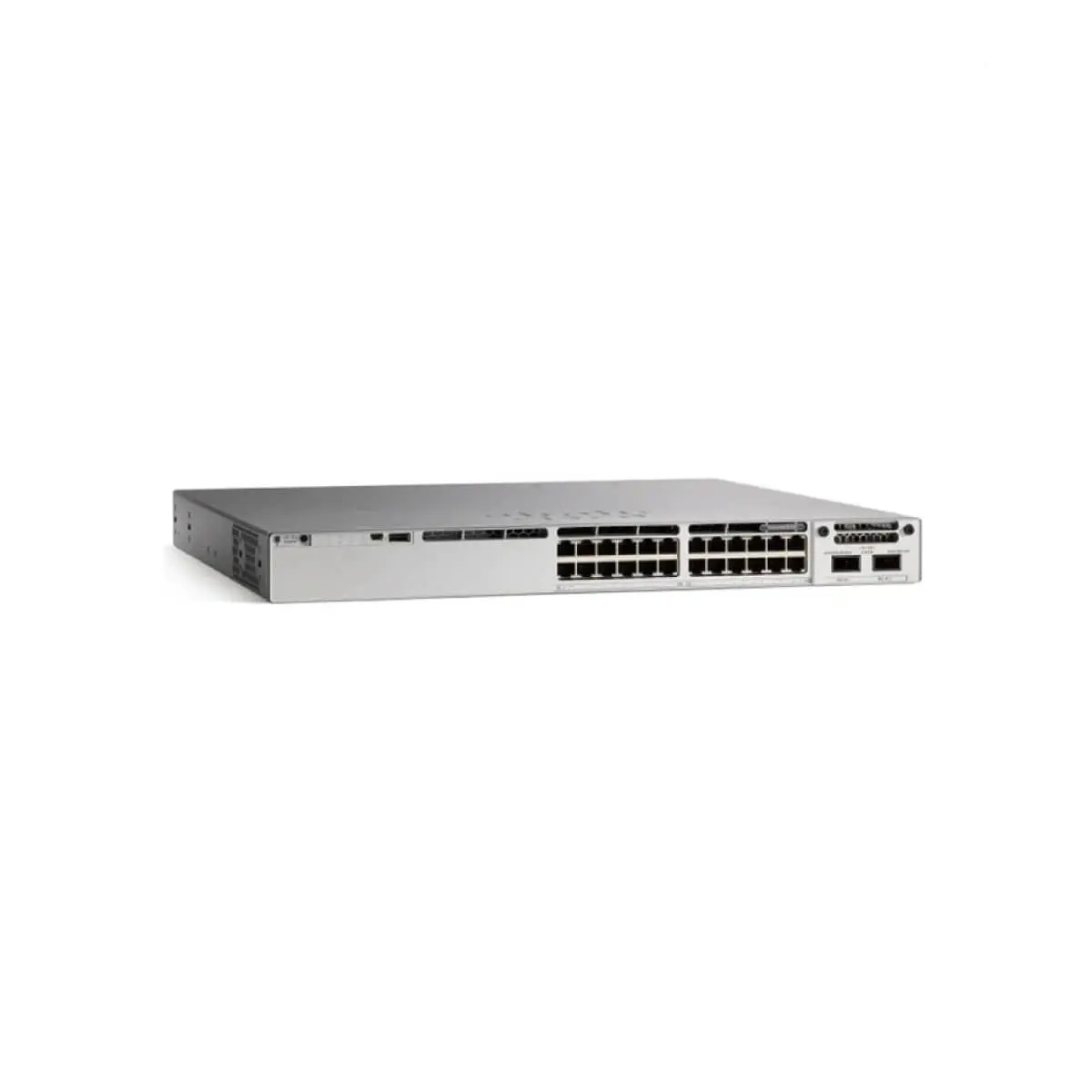
Cisco Catalyst C9300L-24P-4G-E — The Enterprise-Class 24-Port Gigabit PoE+ Switch That Sits at the Pinnacle of Access Layer Switching Excellence
There is a category of network infrastructure that merely connects. And then there is a category that commands, secures, automates, and transforms everything it touches. The Cisco Catalyst C9300L-24P-4G-E unquestionably belongs to the latter. As the flagship access layer platform in Cisco’s industry-defining Catalyst 9000 family, the C9300L is purpose-engineered for organizations that consider their network a strategic competitive asset — not a commodity utility. Delivering 24 ports of full Gigabit PoE+, 4 x 1G SFP uplinks, industry-leading StackWise-480 stacking architecture, and the full power of Cisco Network Essentials software, this switch doesn’t just raise the bar for access layer performance — it completely redefines what the access layer is capable of in the modern, cloud-first, security-obsessed, automation-driven enterprise.
If the Catalyst 9200L is the intelligent access layer switch, the C9300L is the intelligent access layer switch on an entirely different level — more powerful, more scalable, more secure, and more deeply integrated into the Cisco enterprise ecosystem than any access layer platform that has come before it.
What Is the Cisco Catalyst C9300L-24P-4G-E and Where Does It Sit in the Cisco Portfolio?
The Cisco Catalyst C9300L-24P-4G-E is a fixed-configuration, enterprise-grade Layer 3 managed switch belonging to Cisco’s Catalyst 9300 Series — the world’s best-selling enterprise access layer switching platform and the strategic core of Cisco’s intent-based networking architecture. The 9300 Series sits definitively above the 9200L in Cisco’s switching hierarchy, offering greater processing power, superior stacking bandwidth, deeper programmability, more advanced security, and expanded routing capabilities that make it the natural choice for high-demand enterprise access layer and distribution layer deployments.
Decoding the full model designation:
- C9300L — Catalyst 9300 Lite variant — fixed uplink configuration optimized for cost-effective enterprise access deployment
- 24P — 24 x 10/100/1000 Mbps full Gigabit PoE+ downlink ports, IEEE 802.3at compliant
- 4G — 4 x 1G SFP fixed uplink ports for fiber or copper backbone connectivity
- E — Network Essentials software tier — Cisco’s modern subscription-based licensing model unlocking advanced security, automation, and Cisco DNA Center integration
The C9300L Was Built For:
- Large enterprise and corporate headquarters environments requiring maximum access layer performance and resilience
- Higher education campuses deploying high-density Wi-Fi 6 and Wi-Fi 6E at massive scale across hundreds of access points
- Healthcare systems and hospital networks demanding five-nines uptime, rock-solid security, and zero-compromise PoE+ power for life-critical communication devices
- Financial services institutions requiring hardware-enforced MACsec encryption, comprehensive audit trails, and rigorous compliance capabilities
- Manufacturing and industrial campuses deploying IoT sensors, IP cameras, and operational technology devices at scale
- Government agencies and defense contractors demanding FIPS 140-2 validated cryptography, stringent access controls, and platform integrity verification
- Network architects and senior IT engineers who specify the best available Cisco platform for environments where network performance directly impacts business outcomes
The Critical Distinction — How the C9300L Surpasses the C9200L
Before diving into features, the most important question deserves a direct answer: if the C9200L is already exceptional, why choose the C9300L?
| Capability | C9300L-24P-4G-E | C9200L-24P-4G-E |
|---|---|---|
| Switching Capacity | 256 Gbps | 128 Gbps |
| Forwarding Rate | 190.5 Mpps | 95.2 Mpps |
| Stacking Technology | StackWise-480 (480 Gbps) | StackWise-160 (160 Gbps) |
| MAC Address Table | 32,000 entries | 32,000 entries |
| Layer 3 Routing (Essentials) | ✅ Full Static + RIP | ✅ Static + RIP |
| ASIC Generation | UADP 2.0 Mini | UADP 2.0 Mini |
| Modular Power Supply | ✅ Field-Replaceable | ❌ Fixed |
| Network Module Slot | ✅ Optional Uplink Module | ❌ Fixed Only |
| USB 3.0 Storage | ✅ Yes | ❌ No |
| Platform Positioning | Distribution-capable Access | Access Layer |
| Scalability Ceiling | Significantly Higher | Standard Enterprise |
The C9300L delivers double the switching capacity and double the forwarding rate of the C9200L — a difference that becomes profoundly significant in environments with high-density wireless deployments, unified communications at scale, or network segments where traffic aggregation demands are intense. When your network truly cannot afford bottlenecks, the C9300L is the answer.
Core Hardware Capabilities That Define Enterprise-Class Performance
⚡ 24 x Full Gigabit PoE+ Ports With a 505W Power Budget Option — Industry-Leading PoE Density
The foundation of the C9300L-24P-4G-E is its 24 x 10/100/1000 Mbps Gigabit PoE+ downlink ports — every one delivering simultaneous line-rate Gigabit data and up to 30W of IEEE 802.3at PoE+ power. With a standard 370W PoE budget and the option to upgrade to a higher-capacity power supply delivering up to 505W for maximum device density, the C9300L gives you the power headroom to support your most demanding PoE+ device ecosystem without compromise:
- Cisco Catalyst 9130, 9136, and 9166 Wi-Fi 6/6E Access Points — the current generation of enterprise wireless requiring PoE+ power levels that previous-generation switches could not always fully deliver
- Cisco IP phones, video endpoints, and Webex devices — including high-definition color display phones, Webex Desk Pros, and room system endpoints drawing significant PoE+ power
- PTZ surveillance cameras with integrated IR, heaters, and analytics processors — outdoor and indoor security cameras increasingly draw PoE+ power levels that standard 802.3af cannot support
- PoE-powered thin client workstations and VDI endpoints — simplify desktop deployments with single-cable data and power delivery
- Smart LED PoE lighting systems — the backbone of intelligent building automation and energy management
- Industrial IoT sensors, RFID readers, and environmental monitoring systems — the operational technology that drives modern facility management
Every port is simultaneously a data highway and a power delivery system — eliminating power adapter clutter, simplifying cable management, and dramatically reducing the cost and complexity of device deployments across your facility.
🔗 4 x 1G SFP Uplink Ports — Fiber-Ready, Infrastructure-Agnostic Backbone Connectivity
The four dedicated 1G SFP uplink ports provide the backbone connectivity flexibility that enterprise network architects demand, supporting the full range of Cisco SFP optic modules:
- GLC-SX-MMD (Multi-mode fiber, 850nm) — full Gigabit uplinks up to 550 meters across buildings and floors
- GLC-LH-SMD (Single-mode fiber, 1310nm) — long-reach connectivity up to 10km between buildings and campus locations
- GLC-T (1000BASE-T copper SFP) — standard Gigabit connectivity over Cat5e/Cat6 cabling for short-range uplinks
- Redundant active/standby uplink configuration — eliminate the access layer as a single point of failure with automatic failover between SFP uplink ports
- LACP/EtherChannel port bundling — aggregate multiple uplink ports for combined bandwidth and seamless link redundancy with upstream distribution switches
The SFP uplink architecture ensures the C9300L integrates cleanly into any existing fiber or copper backbone infrastructure — protecting the value of your installed cabling plant while providing a clear upgrade path to higher-speed connectivity as your bandwidth requirements grow.
Cisco StackWise-480 — The Most Powerful Stacking Architecture in Enterprise Access Switching
📦 480 Gbps of Dedicated Stacking Bandwidth — Three Times the Capacity of the C9200L
If there is a single technical differentiator that most dramatically separates the C9300L from the C9200L and from every competing enterprise access switch on the market, it is Cisco StackWise-480. This is not an incremental improvement over previous stacking technologies — it is a categorical leap in stacking architecture that fundamentally changes the ceiling of what an access layer stack can deliver:
- 480 Gbps dedicated stacking ring bandwidth — 3x the capacity of the C9200L’s StackWise-160, ensuring the stacking interconnect never becomes a performance bottleneck even in the most traffic-intensive deployments
- Up to 8 switches per stack — creating a single logical unit of up to 192 Gigabit PoE+ ports managed as one unified system
- Single IP address, single management console, single IOS XE instance — the operational simplicity of managing one switch, regardless of how many physical units are stacked
- Cross-stack EtherChannel — bond ports from physically separate switches in the stack into a single logical link for maximum redundancy, load balancing, and active/active uplink utilization
- Stateful Switchover (SSO) with sub-second failover — when the stack master fails, a pre-synchronized standby master takes over with zero impact to active voice calls, video sessions, or data transfers
- In-Service Software Upgrade (ISSU) — upgrade the IOS XE operating system across the entire stack without dropping a single packet or interrupting a single connection — the definitive solution for environments that cannot afford maintenance windows
- Hot-add and hot-remove stack members — physically add new switches to a live, running stack or replace a failed unit without touching a configuration file, rebooting the stack, or interrupting network service
- Unified policy enforcement — QoS, security ACLs, spanning tree, and VLAN configurations are enforced consistently across all stacked units from a single policy definition
StackWise-480 transforms the C9300L from a 24-port access switch into a massively scalable 192-port access layer system that grows non-disruptively alongside your organization — with stacking performance that ensures the interconnect between physical switches never limits what the stack as a whole can deliver.
Security at the Silicon Level — MACsec, TrustSec, and Beyond
🛡️ Hardware-Enforced Security That Operates at Line Rate Without Compromise
The Cisco Catalyst C9300L represents the most advanced security implementation available in the enterprise access layer switching market. Security is not a software feature layer bolted onto the C9300L — it is woven into the hardware ASIC itself, operating at full forwarding speed with zero performance penalty:
MACsec (IEEE 802.1AE) — Encrypt Everything, Lose Nothing
- Hardware-accelerated MACsec encryption at line rate on every switch port — encrypt all traffic flowing between your switch and every connected device, protecting against eavesdropping and data tampering even on your internal LAN
- 256-bit AES-GCM encryption — the same cryptographic strength used by financial institutions and government agencies for their most sensitive communications
- MACsec Key Agreement (MKA) protocol — automated, standards-based key negotiation and rotation without manual intervention
- Hop-by-hop encryption — protect traffic at every link in the network path, not just at the perimeter
Cisco TrustSec — Identity-Driven Segmentation at Scale
- Security Group Tagging (SGT) — assign every user, device, and application an identity-based security group tag at the point of network entry, and enforce access policy based on who is communicating, not just where they are connected
- SGT-based Access Control Lists (SGACLs) — define segmentation policy centrally in Cisco ISE and push it automatically to every switch in the network without per-device ACL management
- Dynamic segmentation — replace static VLAN-based segmentation with dynamic, identity-aware microsegmentation that adapts automatically as users and devices move across the network
- TrustSec across the stack — unified SGT policy enforcement across all stacked C9300L units as a single, consistent security domain
Comprehensive Port-Level Security
- IEEE 802.1X Multi-Domain Authentication — simultaneously authenticate a Cisco IP phone and the computer connected behind it on the same physical port, placing each on its appropriate network segment automatically
- MAC Authentication Bypass (MAB) — seamlessly onboard devices that lack 802.1X supplicants — printers, cameras, IoT sensors — through MAC address-based authentication
- Cisco Identity Services Engine (ISE) full integration — context-aware network access control based on user identity, device type, security posture assessment, location, and time of day
- Dynamic ARP Inspection (DAI) — block ARP poisoning and man-in-the-middle attacks before they can intercept internal communications
- DHCP Snooping with binding table enforcement — eliminate rogue DHCP servers and prevent IP address spoofing at the hardware level
- IP Source Guard (IPSG) — validate source IP addresses on every packet at every port with ASIC-enforced hardware rules
- Port Security with violation actions — lock ports to authorized MAC addresses with configurable violation responses including shutdown, restrict, and protect modes
- Control Plane Policing (CoPP) — protect the switch CPU and management plane from denial-of-service attacks targeting control traffic
- Encrypted Traffic Analytics (ETA) — detect malware, command-and-control traffic, and advanced threats hiding inside TLS-encrypted flows without decryption, using behavioral analysis and telemetry data processed by Cisco DNA Center’s AI/ML engine
- FIPS 140-2 compliance — cryptographic module validation for government, defense, and regulated industry deployments requiring certified security implementations
In an environment where the average enterprise breach now costs well north of $4 million in direct losses before accounting for reputational damage and regulatory penalties, deploying a switch with this depth of hardware-enforced security is not an operational luxury — it is a fiduciary responsibility.
Cisco IOS XE and Cisco DNA Center — The Intelligence Layer That Transforms Your Network
🧠 Intent-Based Networking Built Into Every Port, Every Packet, Every Policy
The C9300L-24P-4G-E runs Cisco IOS XE — the modern, modular network operating system that powers the entire Catalyst 9000 platform — and is natively designed for deep integration with Cisco DNA Center, Cisco’s enterprise network management, automation, and AI analytics platform:
Zero-Touch Provisioning and Network Automation
- Cisco Network Plug and Play (PnP) Agent — ship C9300L switches directly to remote branch locations, plug them into the network, and watch them self-configure automatically from DNA Center without a single technician CLI interaction
- Template-based day-zero and day-N configuration — define configuration templates in DNA Center and apply them consistently across your entire switch fleet with a single click
- Ansible, Python, and Terraform integration — manage the C9300L programmatically through NETCONF/YANG and RESTCONF APIs as infrastructure-as-code, integrating seamlessly with modern DevOps workflows and CI/CD pipelines
- On-box Python scripting with Guest Shell — execute Python automation scripts directly on the switch without an external automation server, enabling powerful event-driven network responses
- gNMI/gRPC streaming telemetry — push real-time operational state data from every switch to your analytics platform at sub-second intervals, providing visibility that SNMP polling cannot approach
Cisco DNA Assurance — AI-Powered Network Intelligence
- AI/ML-driven anomaly detection — DNA Center continuously analyzes telemetry from the C9300L to identify performance anomalies, security incidents, and configuration drift before they impact users
- Proactive issue identification — predict network failures and performance degradations before they occur, shifting your operations team from reactive firefighting to proactive optimization
- Guided remediation — when issues are detected, DNA Assurance provides step-by-step remediation guidance, dramatically reducing mean time to resolution (MTTR)
- Client 360 and Device 360 — complete contextual visibility into every connected client and network device, including historical performance data, connectivity events, and onboarding experience metrics
- Application experience monitoring — correlate access layer performance metrics with application response times to pinpoint whether user experience issues originate in the network, the application, or the WAN
SD-Access — Software-Defined Network Segmentation at Enterprise Scale
- Cisco SD-Access fabric integration — the C9300L functions as a native fabric edge node in a Cisco SD-Access deployment, enforcing intent-based policies across the entire network fabric
- Automated endpoint onboarding — new devices connecting to the network are automatically identified, authenticated, and placed in the correct policy group without manual VLAN or ACL configuration
- Policy-based microsegmentation — replace complex, manually managed VLAN topologies with software-defined policy that travels with users and devices as they move across the campus
Advanced Quality of Service — Every Application Gets Exactly What It Needs
🎯 8-Queue Hardware QoS Architecture for Uncompromising Application Performance
The C9300L implements 8 egress queues per port with hardware ASIC enforcement — providing the most granular traffic prioritization available in the enterprise access switching market:
- Strict Priority (PQ) for voice traffic — Cisco IP phone and Webex voice packets are always transmitted first, regardless of congestion level, guaranteeing the sub-50ms latency that voice quality demands
- Weighted Round Robin (WRR) for remaining classes — fair, configurable bandwidth allocation across video, business applications, and background traffic classes
- DSCP, CoS, and NBAR2 classification — classify traffic based on IP DSCP markings, 802.1p CoS values, or application-layer deep packet inspection identifying over 1,400 applications by name
- Auto QoS for Unified Communications — a single command automatically configures optimal QoS policy for all Cisco voice and video endpoints connected to the switch
- Hierarchical QoS (HQoS) — apply QoS policies simultaneously at the physical port level, VLAN level, and individual flow level for maximum policy granularity
- Ingress policing and egress shaping — enforce per-port, per-VLAN, or per-application bandwidth limits with hardware precision
- Weighted Random Early Detection (WRED) — intelligent, proactive congestion management that begins selectively dropping lower-priority packets before queues fill completely, protecting latency-sensitive traffic from the worst effects of congestion
When your executive team is conducting a critical board video call, your contact center agents are handling customer escalations, and your development team is pulling massive code repositories simultaneously — the C9300L ensures every application gets precisely the network resources it needs, and not one megabit less.
Layer 3 Routing Capabilities — Intelligence Beyond Layer 2
🗺️ Routed Access Made Possible With Network Essentials
Unlike pure Layer 2 access switches, the C9300L with Network Essentials supports Layer 3 IP routing — enabling routed access layer deployments that simplify network architecture and improve performance:
- Static IP routing — define explicit routing policies for specific network destinations with complete administrative control
- RIP v1 and v2 — lightweight dynamic routing protocol support for smaller, simpler routing environments
- Inter-VLAN routing — route traffic between network segments directly on the switch without requiring a separate router, reducing latency and infrastructure complexity
- OSPF and EIGRP — available with upgrade to Network Advantage license for full enterprise dynamic routing protocol support
- Policy-Based Routing (PBR) — route specific traffic flows based on source address, application type, or other criteria beyond standard destination-based routing
- IPv6 routing support — future-ready dual-stack IPv4/IPv6 routing for organizations transitioning to next-generation addressing
- Virtual Routing and Forwarding (VRF) — maintain multiple independent routing tables on a single switch for multi-tenant environments or segmented network architectures
Routed access with the C9300L enables a flatter, more efficient network architecture — eliminating the traditional three-tier hierarchy dependency and simplifying operations for organizations ready to embrace modern network design principles.
Comprehensive VLAN and Network Segmentation Architecture
🗂️ Sophisticated Layer 2 Control for the Most Complex Enterprise Environments
- Up to 1,024 active VLANs — accommodate the most granular network segmentation requirements across complex multi-department, multi-tenant enterprise environments
- IEEE 802.1Q trunking — industry-standard VLAN tagging with full interoperability across any vendor’s distribution and core switching infrastructure
- Cisco Voice VLAN with automatic CDP detection — automatically identify Cisco IP phones via CDP and place them on the dedicated voice VLAN without any administrator action required
- Rapid Per-VLAN Spanning Tree Plus (RPVST+) — per-VLAN topology optimization with sub-second convergence after link failures
- Multiple Spanning Tree Protocol (MST / IEEE 802.1s) — map groups of VLANs to shared spanning tree instances for efficient, load-balanced redundant topology utilization
- VLAN Trunking Protocol (VTP) v3 — centralized VLAN database management across your entire switch infrastructure with enhanced security features and extended VLAN range support
- Private VLAN (PVLAN) and Protected Ports — prevent direct Layer 2 communication between devices on the same VLAN — critical for IoT isolation, PCI-DSS compliance, and guest network security
- Flex Links — configure redundant Layer 2 uplinks with rapid, deterministic failover as a simplified alternative to spanning tree in specific topological scenarios
- VXLAN support — extend Layer 2 network segments across Layer 3 boundaries, enabling seamless workload mobility across distributed campus and data center environments
Platform Integrity and Trust — Security Starts Before the OS Even Boots
🔐 Hardware Root of Trust — Cisco’s Commitment to Trustworthy Infrastructure
In an environment where supply chain attacks and hardware tampering represent real and growing threats to enterprise infrastructure, the C9300L implements Cisco’s Trust Anchor Module (TAm) technology — a hardware-based security foundation that provides:
- Secure Boot with hardware root of trust — cryptographically verify the integrity of the IOS XE image at every boot, preventing the execution of tampered or unauthorized software even if an attacker has physical access to the switch
- Runtime image signing verification — continuously validate the integrity of the running operating system during normal operation, not just at boot time
- Hardware-based cryptographic identity — every C9300L is provisioned with a unique, hardware-protected cryptographic identity that verifies its authenticity to Cisco DNA Center and network management systems
- Anti-counterfeiting protection — Cisco Secure Unique Device Identifier (SUDI) certificate stored in tamper-resistant hardware, enabling verification that the device is genuine Cisco hardware
- Image signing and verification — all IOS XE software images are digitally signed by Cisco, ensuring only authenticated operating system versions can be installed and executed
This level of platform integrity is not window dressing — it is the foundation upon which every other security capability in the switch is built. If the platform itself cannot be trusted, no security feature above it can be fully relied upon.
Management and Operational Flexibility
🖥️ Every Management Model, Every Operational Workflow, Fully Supported
| Management Method | Capability | Best For |
|---|---|---|
| Cisco DNA Center | Intent-based automation, AI analytics, SD-Access, ZTP | Enterprise IT teams adopting modern NetOps |
| IOS XE CLI (SSH/Console) | Full feature access, expert-level troubleshooting | Cisco-certified network engineers |
| NETCONF / YANG / RESTCONF | Programmatic configuration via structured data models | DevOps and network automation teams |
| gNMI / gRPC Streaming Telemetry | Real-time operational data streaming | Analytics platforms and observability pipelines |
| SNMP v1/v2c/v3 | Integration with SolarWinds, PRTG, Zabbix, Nagios | Existing NMS platforms and NOC operations |
| Embedded Web GUI | Browser-based point-and-click management | Teams without deep CLI expertise |
| Cisco Network PnP | Automated zero-touch deployment | Remote and branch site provisioning |
| TACACS+ / RADIUS / AAA | Centralized management authentication and audit trails | Compliance and access control requirements |
| USB 3.0 Storage Port | Local IOS image storage, configuration backup | Disaster recovery and rapid platform replacement |
| Embedded Packet Capture (EPC) | On-switch traffic capture for deep troubleshooting | Advanced network diagnostics without SPAN |
Technical Specifications at a Glance
| Specification | Detail |
|---|---|
| Model | Cisco Catalyst C9300L-24P-4G-E |
| Switch Series | Catalyst 9300L |
| Downlink Ports | 24 x 10/100/1000 Mbps Gigabit |
| Uplink Ports | 4 x 1G SFP |
| PoE Standard | IEEE 802.3at (PoE+) |
| PoE Power Per Port | Up to 30W |
| Total PoE Budget | 370W (upgradeable to 505W) |
| Switching Capacity | 256 Gbps |
| Forwarding Rate | 190.5 Mpps |
| Operating System | Cisco IOS XE |
| Software License | Network Essentials |
| Layer | Layer 3 |
| Stacking | Cisco StackWise-480 (up to 8 units, 480 Gbps) |
| MAC Address Table | 32,000 entries |
| VLANs Supported | Up to 1,024 |
| Routing Protocols | Static, RIP (OSPF/EIGRP with Advantage) |
| Spanning Tree | RPVST+, MST (802.1s) |
| Security | MACsec AES-256, TrustSec SGT, 802.1X, DAI, DHCP Snooping, IPSG, ETA, FIPS 140-2 |
| Platform Integrity | Cisco Trust Anchor Module (TAm), Secure Boot, SUDI |
| Management | DNA Center, CLI, NETCONF, RESTCONF, gNMI, SNMP v3 |
| USB | USB 3.0 Type-A storage port |
| Power Supply | Internal, field-replaceable, 100–240V AC |
| Form Factor | 1U Rack-mountable |
| MTBF | 609,756 hours |
| Operating Temperature | 0°C – 45°C |
| Warranty | Cisco Limited Lifetime Hardware Warranty |
Frequently Asked Questions About the Cisco C9300L-24P-4G-E
❓ What is the practical difference between the C9300L and the C9200L for a 24-port deployment?
For a standalone single-switch deployment in a low-traffic environment, both will deliver excellent performance. The C9300L becomes the clear choice when you need higher stacking bandwidth (480 Gbps vs 160 Gbps) for large stacks, greater forwarding capacity (190.5 Mpps vs 95.2 Mpps) for high-traffic environments, Layer 3 routing in the access layer, hardware-enforced MACsec for compliance-sensitive environments, USB storage for rapid disaster recovery, or a field-replaceable power supply for environments requiring maximum hardware serviceability. For growing enterprise environments, the C9300L’s higher ceiling consistently justifies the incremental investment.
❓ What is the difference between the C9300L and the full C9300 (non-L)?
The C9300L features fixed uplink ports — four 1G SFP ports in this model — at a more accessible price point. The full C9300 features a modular network module slot that accepts field-replaceable uplink modules including 4x1G, 4x10G, 2x25G, and 8x1G options, providing long-term uplink flexibility as backbone requirements evolve. For environments where uplink requirements are stable and well-defined, the C9300L delivers outstanding value. For environments where uplink speed requirements may evolve significantly, the full C9300 with modular uplinks offers superior long-term adaptability.
❓ Can the C9300L-24P-4G-E stack with existing C9300 switches?
Yes. The C9300L is fully compatible with the C9300 family in a mixed stack configuration using StackWise-480. You can stack C9300L 24-port and 48-port units alongside full C9300 switches — mixing port densities and uplink configurations within a single logical stack. This gives network architects exceptional flexibility in designing right-sized access layer stacks without being constrained to a single port density or uplink configuration.
❓ Does the Network Essentials license include Cisco DNA Center?
The Network Essentials license enables native Cisco DNA Center integration and unlocks the full suite of DNA Center management, automation, and assurance capabilities on the C9300L. However, Cisco DNA Center itself is a separate platform that requires its own licensing — either as a physical appliance or virtual appliance deployment. The Network Essentials license on the switch is the access layer component of the broader DNA Center ecosystem licensing model. Organizations not yet ready for DNA Center can manage the C9300L fully through traditional IOS XE CLI and SNMP-based tools.
❓ Is the C9300L power supply field-replaceable?
Yes — and this is a meaningful operational advantage over the C9200L. The C9300L features a field-replaceable power supply module, allowing a failed PSU to be swapped in the field without returning the entire switch for service. For organizations running the C9300L in high-availability environments where maximizing hardware serviceability is critical, this capability significantly reduces potential downtime associated with power supply failures.
❓ How does Cisco’s Limited Lifetime Hardware Warranty apply to the C9300L?
Cisco backs the Catalyst 9300L with a Limited Lifetime Hardware Warranty covering manufacturing defects for as long as the original end customer owns the product, including next-business-day advance hardware replacement for covered failures. This warranty commitment, combined with the platform’s exceptional 609,756-hour MTBF rating, reflects the engineering confidence Cisco has in the C9300L’s hardware reliability and long-term operational integrity.
The Cisco Catalyst 9300L in the Broader Enterprise Architecture
The C9300L-24P-4G-E does not exist in isolation — it is a precisely engineered component within Cisco’s comprehensive Catalyst 9000 enterprise networking architecture:
- Cisco Catalyst 9400/9500/9600 Series Core and Distribution Switches — the hierarchical layers above the C9300L access tier, completing a fully integrated Catalyst 9000 campus fabric
- Cisco Catalyst 9100 Series Wi-Fi 6/6E Access Points — wireless infrastructure architecturally paired with the C9300L’s PoE+ capabilities and SD-Access integration
- Cisco Identity Services Engine (ISE) — the policy engine that drives 802.1X, MAB, TrustSec, and SD-Access authorization working in concert with the C9300L
- Cisco DNA Center — the unified management, automation, and AI analytics platform that transforms the C9300L from a managed switch into an intent-based network node
- Cisco Secure Network Analytics (Stealthwatch) — behavioral threat detection platform consuming NetFlow data from the C9300L to identify advanced threats and anomalous behavior within your network
- Cisco Catalyst Center Assurance — AI/ML-driven network performance and user experience monitoring correlating C9300L telemetry with application and infrastructure data
- Cisco Umbrella — cloud-delivered DNS security that integrates with C9300L deployments for comprehensive threat protection extending beyond the campus perimeter
- Cisco ThousandEyes — end-to-end visibility platform correlating access layer performance with application experience and internet path quality
Every product in the Catalyst 9000 ecosystem amplifies the value of every other, creating a network architecture that is dramatically more intelligent, more secure, and more automated than any collection of best-of-breed components from disparate vendors could ever achieve.
The Bottom Line — When Your Network Demands the Absolute Best, There Is Only One Answer
The Cisco Catalyst C9300L-24P-4G-E is not for everyone — and that is precisely the point. It is for the organizations that understand their network is not a cost center to be minimized but a strategic platform to be optimized. It is for the IT leaders who refuse to accept “good enough” when the consequences of network failure or security compromise are measured in lost revenue, violated compliance obligations, and damaged reputations. It is for the network architects who want to deploy an access layer platform that will remain fully capable, fully supported, and fully relevant for a decade — not one that will require replacement the moment Wi-Fi 7, 2.5G PoE, or the next wave of IoT devices arrives.
With 256 Gbps of switching capacity, 190.5 Mpps forwarding rate, 480 Gbps StackWise stacking, hardware MACsec AES-256 encryption, Cisco TrustSec identity-based segmentation, hardware root of trust platform integrity, native Cisco DNA Center integration, and the programmability of IOS XE — the C9300L-24P-4G-E doesn’t simply connect your organization to the network. It secures it at the hardware level, accelerates it at line rate, automates it at enterprise scale, and future-proofs it for the next decade of enterprise networking evolution.
This is the switch that serious networks are built on. Make yours one of them.
The pinnacle of access layer switching starts here. Deploy the Cisco Catalyst C9300L.

 No products in the cart.
Reviews
There are no reviews yet.