
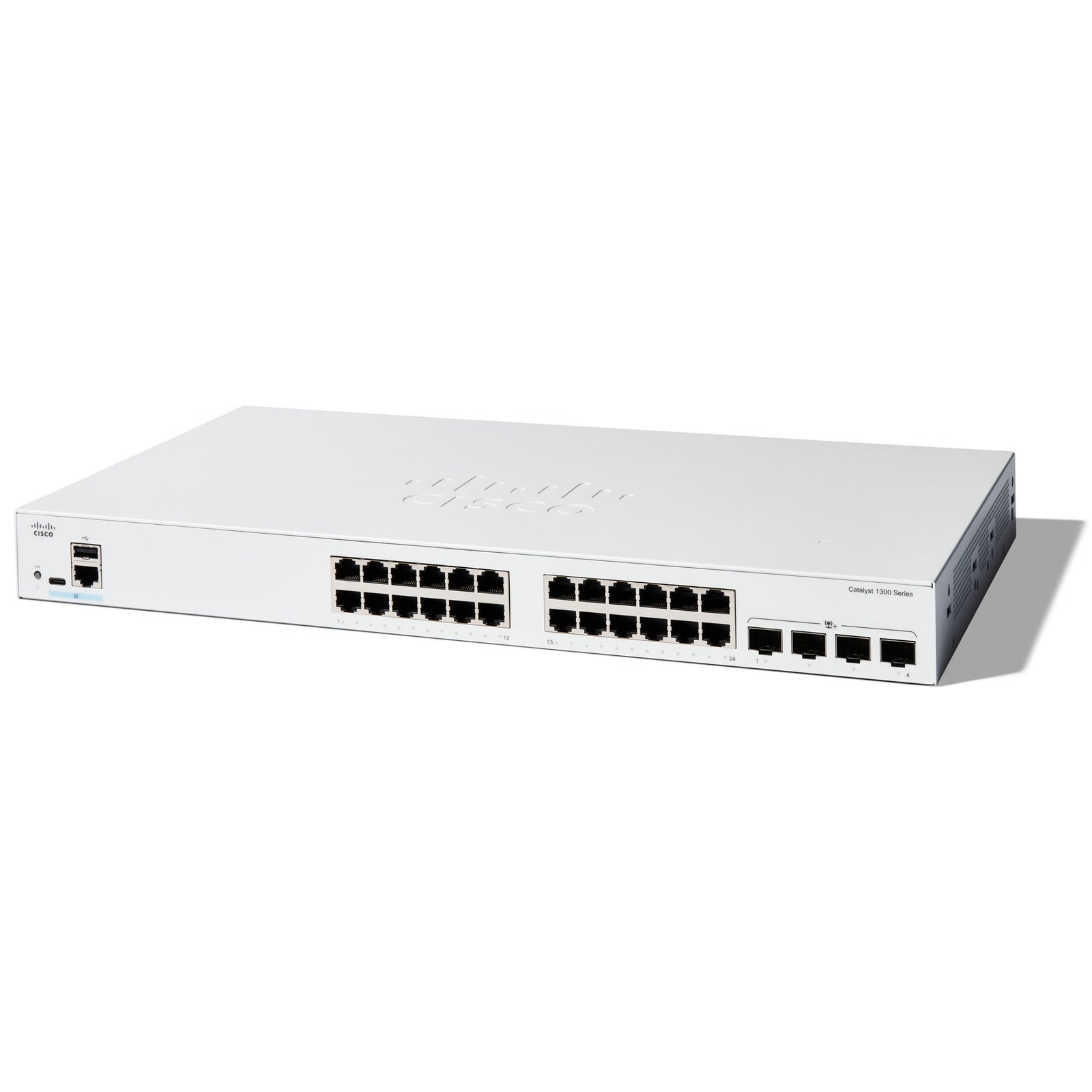
Cisco Catalyst C1300-24P-4X — 24-Port Gigabit PoE Managed Switch with 4x10G SFP+ Uplinks | When Your Network Demands Ten Times More
The Switch That Breaks the Gigabit Uplink Barrier — Permanently
Every network has a ceiling. For most small and medium business switches, that ceiling is defined by their uplinks — the connections that carry aggregated traffic from access layer devices up to core switching, server infrastructure, and WAN gateways. When those uplinks are limited to 1 Gigabit, your entire network’s performance is ultimately constrained by that bottleneck, regardless of how powerful the switch beneath it is.
The Cisco Catalyst C1300-24P-4X shatters that ceiling entirely.
By equipping the same enterprise-grade 24-port Gigabit PoE+ access layer platform that defines the Catalyst 1300 Series with four dedicated 10-Gigabit SFP+ uplink ports, Cisco has engineered a switch that does not merely close the performance gap between SMB and enterprise networking — it eliminates it. Where a 4x1G uplink configuration delivers a maximum of 4 Gbps of aggregate upstream bandwidth, the C1300-24P-4X delivers 40 Gbps of dedicated 10G uplink capacity — ten times more throughput, ten times more headroom, ten times more future-proofing in every uplink connection this switch makes.
This is the Cisco Catalyst 1300 platform at its most powerful expression — 24 ports of full Gigabit PoE+ access layer connectivity, the complete Catalyst enterprise security architecture including MACsec hardware encryption, comprehensive Layer 2+ managed intelligence, and four 10G SFP+ uplinks that connect your business network to the performance tier that enterprise organisations depend on — available, for the first time, at a scale and investment level that ambitious small and medium businesses can confidently embrace.
Your network deserves uplinks that will never become your bottleneck. The C1300-24P-4X delivers exactly that — today, and for every year of growth your business achieves.
Cisco Catalyst C1300-24P-4X — Complete Technical Specifications
The specifications of the Catalyst 1300-24P-4X tell a story of engineering ambition that extends well beyond the typical SMB switching category:
- 24 x 10/100/1000 Mbps PoE+ RJ45 Downlink Ports — IEEE 802.3at compliant, up to 30W per port
- 4 x 10G SFP+ Dedicated Uplink Ports — full 10-Gigabit fiber or DAC cable uplink connectivity
- Total PoE Power Budget: 195W — intelligent simultaneous multi-device power delivery
- Switching Capacity: 128 Gbps — massively expanded non-blocking fabric driven by 10G uplinks
- Forwarding Rate: 95.23 Mpps — near line-rate packet processing at maximum traffic density
- MAC Address Table: 16,000 entries — handles large, complex, device-rich network topologies
- Jumbo Frame Support: 9,000 bytes — optimised for 10G-attached NAS, iSCSI, and high-throughput server workloads
- VLAN Support: Up to 4,096 VLANs — enterprise-scale logical network segmentation
- Layer 2+ Managed — complete VLANs, QoS, ACLs, STP/RSTP/MSTP, SNMP, 802.1X, and beyond
- MACsec Hardware Encryption — IEEE 802.1AE line-rate cryptographic link security on every port
- Web-Based GUI Management — intuitive browser interface requiring zero CLI expertise
- SSH v2 & HTTPS Encrypted Management — every administrative session secured end-to-end
- IPv4 & IPv6 Dual-Stack Support — complete next-generation network addressing readiness
- IEEE 802.3ad LACP Link Aggregation — bond uplinks for redundancy and bandwidth multiplication
- LLDP & LLDP-MED — automatic device discovery, topology mapping, and VoIP configuration
- Cisco Business Dashboard Compatible — free centralised multi-device management and monitoring
- 1U Rackmountable Form Factor — standard 19-inch rack deployment ready with included hardware
- Cisco Limited Lifetime Hardware Warranty — the gold standard of network hardware investment protection
The 10G SFP+ Difference — Why Uplink Speed Changes Everything About Network Performance
Ten Times the Bandwidth. Ten Times the Headroom. Ten Times the Future-Proofing.
To truly understand what makes the Cisco Catalyst C1300-24P-4X fundamentally different from every other switch in its density tier, you need to understand the mathematical reality of network traffic aggregation — and why 1-Gigabit uplinks create an invisible ceiling that silently constrains the performance of even the most capable access layer switch.
The Aggregation Problem That 1G Uplinks Cannot Solve
Consider a 24-port Gigabit switch with 1G uplinks serving a mixed environment of workstations, VoIP phones, wireless access points, IP cameras, and shared storage. Under normal operating conditions, each device generates traffic that must traverse the uplink to reach servers, cloud services, NAS storage, or the internet gateway. When multiple devices transmit simultaneously — as they always do in any active business environment — their combined traffic competes for the finite bandwidth of the uplink connection.
A single 1G uplink handles a theoretical maximum of 1 Gbps of upstream traffic. A 4x1G LACP-bonded uplink extends this to 4 Gbps. But consider: a modern office with 20 active workstations, each capable of sustained Gigabit throughput, theoretically demands 20 Gbps of upstream capacity during peak activity. Four 1G uplinks providing 4 Gbps aggregate create a 5:1 oversubscription ratio at the uplink — a ratio that manifests as latency spikes, throughput degradation, and application performance inconsistency precisely when your business needs the network most.
How 4x10G SFP+ Uplinks Transform the Equation
The C1300-24P-4X replaces this constraint with 40 Gbps of aggregate 10G uplink capacity — delivering a fundamentally different performance relationship between access layer connectivity and upstream bandwidth. Even under the most demanding simultaneous traffic scenarios across all 24 access ports, the 10G uplink capacity provides headroom that 1G alternatives categorically cannot:
- A 2x10G LACP aggregate delivers 20 Gbps of bonded upstream bandwidth with automatic failover redundancy — matching the theoretical maximum traffic demand of 20 simultaneously active Gigabit workstations with zero oversubscription
- Four independent 10G uplinks enable simultaneous high-bandwidth connections to core switching, dedicated server segments, 10G NAS arrays, and high-availability network paths without any single connection becoming a bottleneck
- 128 Gbps switching fabric — made possible by 10G uplinks — delivers a switching capacity that comfortably accommodates every conceivable traffic pattern across all 28 ports simultaneously at full line rate
The consequence for your network users is immediate and tangible: file transfers to shared storage complete at true Gigabit speeds, cloud application performance matches what the application provider designed it to deliver, video collaboration platforms operate without the artefacting and latency spikes that uplink congestion causes, and NAS-based workflows that previously experienced inexplicable slowdowns during peak periods perform consistently at the speeds their hardware advertises.
128 Gbps Switching Fabric — The Performance Architecture That 10G Uplinks Make Possible
Non-Blocking Performance at a Scale That Redefines the SMB Category
The headline specification that most dramatically illustrates the C1300-24P-4X’s departure from conventional SMB switching performance is its 128 Gbps non-blocking switching fabric — a number that demands context to be fully appreciated.
The C1300-24P-4G — the 1G uplink variant of this switch — delivers a 56 Gbps switching fabric. The C1300-24P-4X, by equipping four 10G SFP+ ports in place of four 1G SFP ports, achieves 128 Gbps — more than doubling the switching capacity of an already high-performing platform. This expansion reflects the mathematical reality that 10G ports contribute ten times the port bandwidth to the switching fabric, enabling a non-blocking architecture at a performance tier that places this switch in direct competition with enterprise access layer hardware at a fraction of the enterprise price point.
What 128 Gbps Non-Blocking Actually Guarantees
Non-blocking architecture means that every port on the switch — all 24 x 1G downlink ports and all 4 x 10G uplink ports — can simultaneously transmit and receive at their full rated speed without any port waiting for another to complete its transmission. The 128 Gbps switching fabric provides sufficient internal bandwidth to service every port at maximum line rate simultaneously with zero internal congestion.
In practice, this means:
- 24 workstations simultaneously transferring files to a 10G-connected NAS array experience no throughput degradation from switch congestion
- Multiple HD and 4K IP camera streams flowing simultaneously to an NVR connected via 10G uplink do not compete with or degrade office user traffic
- VoIP calls remain perfect quality even when the data network is under maximum load, protected by hardware QoS queuing that operates within the non-blocking fabric
- Wireless access points backhaul at full Gigabit capacity simultaneously, ensuring Wi-Fi performance limitations originate in the wireless medium — not the switching infrastructure
With a forwarding rate of 95.23 million packets per second, the C1300-24P-4X processes network traffic at near-maximum theoretical line rate — ensuring that even the most packet-intensive application workloads, including high-frequency VoIP signalling, multicast video streams, and high-connection-count cloud application traffic, are forwarded without processing delay or packet loss.
4 x 10G SFP+ Uplinks — Architectural Flexibility at Enterprise Uplink Speed
One Switch. Four 10G Paths. Infinite Network Architecture Possibilities.
The four dedicated 10-Gigabit SFP+ uplink ports of the C1300-24P-4X are the defining feature that elevates this switch to a category of its own within the small and medium business managed switching market. Each port accepts standard SFP+ form factor transceivers and Direct Attach Copper (DAC) cables, providing extraordinary flexibility in how you connect this switch to your wider network infrastructure:
10G Fiber Optic Uplinks — Speed, Distance, and Signal Integrity Combined
Short-Range Multi-Mode Fiber (MMF) Install Cisco SFP-10G-SR or compatible 850nm short-range SFP+ transceivers for 10-Gigabit connections over OM3 multi-mode fiber at distances up to 300 metres, or OM4 multi-mode at up to 400 metres. This covers virtually every in-building scenario — floor-to-floor connections, runs between adjacent buildings, and connections to centralised data closets and server rooms — at full 10G speed with complete immunity to electrical interference.
Long-Range Single-Mode Fiber (SMF) Install Cisco SFP-10G-LR or compatible 1310nm long-range SFP+ transceivers for 10-Gigabit connections over single-mode fiber at distances of up to 10 kilometres — enabling 10G connectivity between buildings, across campus environments, or over existing leased or owned long-haul fiber infrastructure, bringing enterprise-grade uplink performance to geographically distributed deployments.
Extended Range Single-Mode Fiber For even greater distances using single-mode fiber plant, extended range SFP+ options support 10G connectivity at ranges exceeding 40 kilometres — making the C1300-24P-4X deployable as a remote access switch connected to a central core network over long-haul metro fiber, dramatically expanding the physical deployment scenarios where 10G access layer performance is achievable.
Direct Attach Copper (DAC) Cables — Cost-Effective 10G for Short Distances
For 10G connections within the same rack or between adjacent racks — particularly for connections to directly-attached servers, core switches, or firewall appliances in the same telecommunications room — 10G SFP+ Direct Attach Copper (DAC) twinax cables provide a cost-effective alternative to optical transceivers at distances up to 5-7 metres, with the same 10-Gigabit throughput and near-zero latency.
DAC cables are particularly compelling for:
- Direct server connections — connect high-performance application servers or database servers directly to a C1300-24P-4X SFP+ port for dedicated 10G server access bandwidth
- NAS storage uplinks — connect 10G-capable network-attached storage arrays directly to the switch for 10G-speed shared storage access across your entire user base
- Core switch interconnects — connect to 10G ports on a distribution or core switch in the same rack with minimal cost and maximum performance
10G Uplink Architecture Scenarios — Building Networks That Scale
The four SFP+ ports enable sophisticated uplink architectures that deliver both performance and resilience simultaneously:
Dual 10G LACP Aggregate + Dual Independent Uplinks Configure two SFP+ ports as a 20 Gbps LACP-bonded aggregate to your primary core switch — delivering doubled upstream bandwidth with automatic failover redundancy — while simultaneously using the remaining two ports as independent 10G uplinks to a secondary distribution switch and a directly-connected 10G NAS storage array. This topology delivers high-availability core connectivity, dedicated storage access bandwidth, and distribution redundancy from a single switch.
Quad 10G LACP Aggregate Bond all four SFP+ ports into a single 40 Gbps LACP aggregate to a high-capacity core switch — eliminating uplink as a performance consideration entirely and providing four-path redundancy for maximum uplink resilience in environments where network availability is mission-critical.
Dedicated Server and Storage Uplinks Allocate individual SFP+ ports as dedicated 10G connections to specific high-demand infrastructure: one port to your primary application server, one to your NAS storage array, one to your core switch LACP bundle, and one to a secondary distribution switch for resilience — creating a bespoke uplink architecture precisely matched to your specific infrastructure topology.
High-Availability Dual-Core Connectivity Connect two SFP+ ports to your primary core switch and two to a secondary core switch — with spanning tree managing primary/secondary path selection and automatic failover in the event of core switch failure — implementing dual-homed access layer resilience that eliminates the core switch as a single point of failure for your entire access layer.
195W PoE+ Power Budget — Energising Your Complete Device Ecosystem
Every Device Connected. Every Device Powered. Every Cable Carrying Both.
With IEEE 802.3at PoE+ delivering up to 30 watts across all 24 downlink ports and a total managed budget of 195 watts, the C1300-24P-4X eliminates the need for separate power infrastructure for your entire connected device ecosystem — delivering both data connectivity and device power through a single Ethernet cable per device, from a single rackmounted switch.
Maximising Your 195W PoE Budget
Understanding real-world device power consumption reveals the genuine capacity of the 195W budget for typical business deployments. A representative mixed deployment across 24 ports might include:
- Six Wi-Fi 6 access points at 15-18W each: 90-108W
- Eight VoIP IP desk phones at 5-7W each: 40-56W
- Six IP security cameras at 7-10W each: 42-60W
- Four access control devices at 5-8W each: 20-32W
This representative deployment consumes between 192W and 256W — with intelligent per-port priority management ensuring that mission-critical devices always maintain power within the available budget. For deployments with lower-draw devices — standard VoIP phones, basic IP cameras, and compact access points — the 195W budget comfortably accommodates full simultaneous device operation across all 24 ports.
The Complete PoE Device Ecosystem
Enterprise Wireless Access Points Power Wi-Fi 6 and Wi-Fi 6E access points from Cisco Business, Cisco Meraki, Ubiquiti UniFi, Aruba Instant, and any IEEE 802.3at compliant vendor — delivering both 10G-capable backhaul connectivity and clean PoE+ power from a single Ethernet cable, with centralised power management and remote reboot capability from the switch management interface.
VoIP and Unified Communications Endpoints Deploy a complete business telephony system powered entirely through Ethernet — SIP desk phones from Yealink, Poly, Cisco IP Phone, Grandstream, Fanvil, and Snom draw 3-8W each, enabling comprehensive telephony deployments while preserving substantial power headroom for concurrent wireless and surveillance devices.
IP Surveillance and Physical Security Infrastructure Connect HD, 4K, and PTZ IP cameras throughout your premises without running dedicated power circuits — centralising both data connectivity and power management for your complete surveillance infrastructure with remote device reboot capability through the PoE management interface.
Smart Building IoT and Access Control Power electronic door locks, card reader controllers, biometric terminals, visitor management systems, environmental sensors, occupancy monitors, and building automation endpoints — creating a unified, centrally managed powered device infrastructure from a single switch.
Catalyst-Grade PoE Intelligence: Real-time per-port consumption monitoring, configurable power allocation limits, and priority-based power management ensure mission-critical devices always maintain power. The switch’s management interface provides complete visibility into budget utilisation, per-port wattage, and device power consumption history — transforming PoE management from guesswork into precision engineering.
Layer 2+ Managed Intelligence — Complete Orchestration at 10G Uplink Performance
The Same Catalyst Intelligence. At Ten Times the Uplink Throughput.
The Cisco Catalyst C1300-24P-4X delivers the complete Layer 2+ management platform of the Catalyst 1300 Series — every feature, every capability, every security control — now operating over a 128 Gbps switching fabric that ensures management policy enforcement never creates performance constraints, regardless of traffic volume or complexity:
VLAN Architecture — Logical Network Engineering at Enterprise Depth
With 4,096 VLAN support configurable through an intuitive visual web interface, the C1300-24P-4X enables sophisticated network segmentation serving simultaneously as your most effective performance isolation tool and your most powerful security control architecture:
- High-Performance Data VLAN — dedicated segment for workstations, application servers, and business-critical computing resources with QoS-prioritised access to 10G uplink bandwidth
- Voice VLAN with Auto-Detection — automatic VoIP traffic identification and VLAN assignment with hardware-enforced priority queuing, guaranteeing call quality under any concurrent data traffic condition
- 10G Storage VLAN — dedicated high-speed segment for iSCSI, NFS, or SMB storage traffic flowing between workstations and 10G-connected NAS arrays, ensuring storage traffic receives full bandwidth allocation without competing with user data
- Wireless Guest VLAN — provide visitor internet access through PoE-powered access points with absolute isolation from internal corporate resources and business data systems
- IoT Isolation VLAN — contain smart building devices and sensors in a segmented environment with restricted routing policies that limit attack surface exposure
- Surveillance VLAN — dedicated bandwidth allocation for IP camera streams flowing to 10G-connected NVR storage infrastructure
- Server Access VLAN — isolate server-to-client and server-to-server traffic from general user data, improving both performance and security of your compute infrastructure
- Management VLAN — completely segregate switch administration traffic from all user data planes
- 802.1Q Trunking — carry multiple VLANs simultaneously across 10G SFP+ uplink connections to core switches, routers, and wireless controllers
- Private VLAN (PVLAN) — isolate individual access ports within the same VLAN for enhanced security in shared-access environments
Quality of Service — Guaranteeing Performance Across a 128 Gbps Fabric
The C1300-24P-4X’s QoS implementation takes on enhanced significance in the context of 10G uplinks — because when uplink bandwidth is abundant, intelligent traffic classification and prioritisation ensures that every application class consistently receives the quality of service its performance requirements demand, not merely during periods of low utilisation:
- 8 Hardware Priority Queues Per Port — maximum granularity of hardware traffic classification across all 28 ports simultaneously
- 802.1p Class of Service (CoS) — tag, remark, and honour Layer 2 priority markings across your complete switching infrastructure and through 10G uplink trunks to core switching
- DSCP Differentiated Services — full support for Layer 3 QoS markings from upstream routers, next-generation firewalls, SD-WAN appliances, and cloud UCaaS platforms
- Strict Priority Queuing — absolute bandwidth and latency guarantee for real-time VoIP and interactive video traffic across the 128 Gbps fabric
- Weighted Round Robin (WRR) — equitable distribution across lower-priority queues preventing application class starvation
- Ingress Rate Limiting — per-port bandwidth controls preventing individual devices from consuming disproportionate uplink bandwidth
- Egress Shaping — smooth outbound bursts to protect downstream device buffers and WAN interface quality
- Auto-VoIP Classification — automatic detection and priority assignment for VoIP signalling and media streams without manual DSCP or CoS configuration
- 10G Uplink QoS Trust — honour and propagate QoS markings from access layer devices through 10G uplinks to core infrastructure, maintaining end-to-end quality of service across the complete network path
Spanning Tree — Loop Prevention Optimised for 10G Topologies
- IEEE 802.1D STP — foundational loop prevention for multi-switch topologies involving 10G interconnects
- IEEE 802.1w RSTP — sub-second convergence particularly critical in 10G environments where traffic volumes make extended convergence periods operationally impactful
- IEEE 802.1s MSTP — per-VLAN spanning tree instance optimisation for complex multi-VLAN topologies using 10G inter-switch links
- BPDU Guard — automatic port shutdown on detection of unexpected BPDUs at access ports
- Root Guard — prevent rogue switches from assuming the STP root bridge role in 10G-interconnected topologies
- Loop Guard — supplementary protection against indirect link failures in complex 10G uplink architectures
Link Aggregation — Multiplying 10G Bandwidth With Resilience
- IEEE 802.3ad LACP — dynamic link aggregation for intelligent bonded 10G uplink creation with automatic member negotiation and failure detection
- Static LAG — manual 10G link aggregation for upstream devices without LACP support
- Flexible Load Balancing Algorithms — configurable distribution across aggregated 10G links based on source/destination MAC, IP, or TCP/UDP port for optimal traffic distribution
- Up to 40 Gbps LACP Aggregate — bond all four 10G SFP+ ports into a single logical 40 Gbps uplink with four-path redundancy
MACsec Hardware Encryption — Catalyst-Grade Cryptographic Security at 10G Line Rate
Link-Level Encryption That Scales to 10 Gigabits. With Zero Performance Cost.
The IEEE 802.1AE MACsec hardware encryption of the Cisco Catalyst C1300-24P-4X delivers a security capability that is remarkable not only for its presence in an SMB-class switch, but for its performance characteristic at 10G uplink speeds — encryption that operates at full 10-Gigabit line rate with mathematically zero throughput penalty or latency addition.
MACsec at 10G — Why Speed Matters for Link Encryption
Many software-based encryption implementations impose measurable throughput penalties — particularly at high packet rates where encryption/decryption processing demands compete with forwarding throughput for CPU resources. The C1300-24P-4X eliminates this constraint entirely by implementing MACsec encryption in dedicated hardware ASIC silicon that operates independently of and in parallel with the forwarding engine.
The practical consequence: your 10G SFP+ uplink connections carry fully AES-128 or AES-256 encrypted Ethernet frames at complete 10-Gigabit line rate — protecting every byte of data traversing your most bandwidth-intensive network paths against physical interception, passive tapping, and frame injection attacks — with no throughput reduction, no latency addition, and no CPU utilisation impact whatsoever.
Critical Protection for High-Value 10G Traffic Paths
The traffic flows that traverse 10G uplinks represent the highest-value, highest-sensitivity data movements across your entire network infrastructure. Storage traffic between workstations and NAS arrays contains your business’s most confidential data. Server-to-switch traffic includes authentication credentials, database content, and application session data. Core switch uplinks carry aggregated traffic from your entire user population including financial transactions, client communications, and strategic business data.
MACsec encrypts every one of these flows at the physical link level — ensuring that regardless of physical access to your network infrastructure, cable runs, patch panels, or switching equipment, an attacker captures only mathematically indecipherable ciphertext. For businesses subject to UK GDPR, PCI-DSS, HIPAA, ISO 27001, or any regulatory framework requiring demonstrable cryptographic protection of sensitive data in transit, MACsec provides auditable, hardware-implemented compliance evidence that satisfies the most stringent technical security control requirements.
Comprehensive Security Architecture — Enterprise Defence in Depth
Every Layer Protected. Every Threat Anticipated. Every Connection Secured.
The complete Cisco Catalyst 1300 security architecture operates across every port, every VLAN, and every management session of the C1300-24P-4X — delivering a defence-in-depth posture that comprehensively addresses the network threat landscape facing modern SMB environments:
Identity-Based Access Control
- IEEE 802.1X Port-Based Authentication — authenticate every device identity before network access using RADIUS-integrated policy enforcement with dynamic VLAN assignment
- Multi-Domain Authentication (MDA) — simultaneously authenticate VoIP phones and workstations on shared access ports with automatic correct VLAN assignment for each device type
- MAC Authentication Bypass (MAB) — authenticate non-802.1X capable devices including IoT sensors, cameras, and legacy equipment via RADIUS-managed MAC address database
- Guest VLAN — automatically redirect failed authentication devices to restricted internet-only access
Layer 2 Attack Prevention
- Dynamic ARP Inspection (DAI) — validate ARP packets against DHCP snooping bindings, preventing ARP spoofing and man-in-the-middle attacks across all 24 access ports
- IP Source Guard (IPSG) — hardware-validate IP-to-MAC bindings at line rate, blocking IP spoofing before forged packets traverse the 10G uplinks to core infrastructure
- DHCP Snooping — protect against rogue DHCP servers across all access and uplink port designations
- Port Security — MAC address learning limits, port binding, and configurable violation responses including automatic port shutdown
Access Control Lists — Policy at 128 Gbps
- IP ACLs — permit and deny traffic based on Layer 3 and Layer 4 criteria at full 128 Gbps switching fabric throughput
- MAC ACLs — hardware address-based access control for non-IP and device-identity enforcement
- Time-Based ACLs — time-of-day and day-of-week access scheduling for automated policy management
- VLAN ACLs (VACLs) — intra-VLAN access control extending security policy within VLAN boundaries
- IPv6 ACLs — comprehensive access control extending to IPv6 traffic in dual-stack environments
Storm and Flood Protection
- Broadcast, Multicast, and Unknown Unicast Storm Control — automatic hardware-rate-limiting of traffic floods before they impact the 10G uplink paths and core infrastructure
- Hardware DoS Prevention — silicon-level protection against Layer 2 and Layer 3 denial-of-service attack patterns
Management Security
- SSH v2 and HTTPS/TLS — encrypted management access for every administrative session
- SNMPv3 — authenticated and encrypted network monitoring
- Role-Based Access Control — granular administrator permission profiles for operational security
- Management ACLs — restrict management interface access to authorised IP addresses and subnets exclusively
- Dedicated Management VLAN — complete isolation of switch administration traffic from user data
Network Visibility — Complete Operational Insight at 10G Scale
Monitoring Infrastructure Worthy of 10G Performance
The operational visibility tools of the Catalyst C1300-24P-4X are designed to provide comprehensive insight into network behaviour at both the access layer and across the 10G uplink paths that define this switch’s performance character:
10G Uplink Performance Monitoring
- Per-Port Traffic Statistics on SFP+ Ports — real-time and historical bandwidth utilisation graphs for each 10G uplink, providing immediate visibility into uplink congestion patterns, LACP load distribution efficiency, and capacity planning intelligence
- SFP+ Transceiver Digital Diagnostics (DDM/DOM) — monitor optical transceiver health parameters including transmit power, receive power, temperature, voltage, and laser bias current — enabling proactive identification of degrading optics before link failures occur
- LACP Aggregate Statistics — view traffic distribution across bonded 10G links and detect imbalanced load distribution requiring algorithm adjustment
Access Layer Monitoring
- SNMP v1/v2c/v3 — integration with PRTG, SolarWinds, Zabbix, Nagios, LibreNMS, ManageEngine, and all standards-based NMS platforms
- RMON Groups 1, 2, 3, 9 — detailed per-port statistics, history buffers, event triggers, and threshold alarms
- Port Mirroring (SPAN) — mirror traffic from any port or VLAN to a monitoring port — including the ability to mirror 10G uplink traffic to a 1G analysis port for packet capture and IDS sensor feeds
- sFlow — hardware-level traffic sampling for high-performance network analytics across both access and 10G uplink ports
- PoE Dashboard — real-time per-port power consumption monitoring across all 24 PoE+ downlink ports
- Cable Diagnostics (TDR) — remote copper cable fault diagnosis from the management GUI
- Syslog — real-time event streaming to external servers for audit trail and SIEM integration
- LLDP and LLDP-MED — automatic topology discovery and device identification across both access and 10G uplink ports
Cisco Business Dashboard — Unified Management With 10G Network Awareness
One Interface. Every Device. Complete 10G Infrastructure Control.
The Cisco Catalyst C1300-24P-4X integrates fully with Cisco Business Dashboard — delivering centralised management capabilities that extend naturally to the 10G infrastructure tier this switch introduces to your network:
10G Topology Visualisation The Dashboard’s live network topology map displays the C1300-24P-4X’s 10G SFP+ uplink connections with accurate link capacity indication — providing immediate visual clarity on which network paths carry 10G traffic and enabling rapid identification of topology issues affecting high-speed uplink performance.
Unified Firmware and Configuration Management Manage firmware updates across every Cisco Catalyst and CBS350 device from a single interface — ensuring consistent software versions across mixed 1G and 10G capable switch deployments. Deploy standardised configuration templates incorporating 10G-optimised QoS policies, LACP aggregation settings, and MACsec parameters across multiple C1300-24P-4X units simultaneously.
Multi-Site 10G Infrastructure Management For organisations deploying C1300-24P-4X switches across multiple locations — each with its own 10G uplink architecture connecting to regional or central core infrastructure — the Dashboard provides unified visibility and management across all sites from a single operational interface.
Proactive Performance Alerting Configure alert policies for 10G uplink utilisation thresholds, LACP member link failures, SFP+ transceiver health warnings, and PoE budget consumption events — receiving proactive notifications that enable response before network issues escalate to user-impacting outages.
Zero-Touch 10G Switch Provisioning Pre-configure C1300-24P-4X switches — including SFP+ port assignments, LACP aggregation configuration, and 10G-optimised QoS policies — as Dashboard templates for zero-touch deployment at remote locations, enabling complex 10G network configurations to be applied automatically without on-site IT expertise.
Who Is the Cisco Catalyst C1300-24P-4X Built For?
The 10G Uplink Access Switch for Organisations Whose Networks Demand More
Data-Intensive Professional Studios and Creative Agencies Video production companies, architecture firms, game development studios, and creative agencies working with multi-gigabyte project files, 4K video assets, and high-resolution design content connect workstations, editing suites, and render nodes through 24 Gigabit PoE+ access ports while accessing shared NAS storage and render farm infrastructure over dedicated 10G SFP+ uplinks — ensuring file transfer speeds match the creative team’s production pace.
Technology Companies and Software Development Organisations Fast-growing software development teams and technology businesses connect engineering workstations, CI/CD build servers, test environment infrastructure, and VoIP communication endpoints through PoE-powered access ports while connecting dedicated build servers, development NAS arrays, and hypervisor hosts directly via 10G SFP+ uplinks — creating a development network infrastructure that eliminates storage and server access as performance bottlenecks in software delivery pipelines.
Financial Services and Trading Environments Financial services firms, trading operations, and fintech companies requiring both comprehensive network security — including MACsec encryption protecting sensitive financial data at the wire level — and high-throughput, low-latency connectivity to market data servers, trading platforms, and financial database infrastructure benefit from the C1300-24P-4X’s unique combination of enterprise-grade security and 10G uplink performance.
Healthcare Facilities With Imaging and Telehealth Infrastructure Multi-practitioner medical centres and specialist healthcare facilities connecting clinical workstations, electronic health record terminals, medical imaging workstations — where DICOM file transfers demand high-throughput network paths — telehealth conferencing infrastructure, and PoE-powered clinical IoT devices — with MACsec protecting patient data at the link level and 10G uplinks ensuring imaging data transfers complete rapidly without impacting clinical workflow responsiveness.
Education Institutions With High-Performance Computing Requirements Universities, colleges, and research institutions deploying high-performance computing clusters, research data repositories, and collaborative data science infrastructure alongside standard access layer connectivity for student and staff workstations benefit from dedicated 10G uplinks to HPC and storage infrastructure while serving conventional network access from the same physical switch.
Enterprise Branch Offices and Regional Headquarters Organisations deploying enterprise-standard network infrastructure at regional headquarters and large branch offices — connecting to a 10G capable WAN gateway, SD-WAN appliance, or regional core switch over 10G SFP+ uplinks while serving 24 PoE+ connected endpoint devices from the same switch chassis — benefit from the C1300-24P-4X’s ability to match branch access layer performance to the capacity of modern enterprise WAN connections.
Managed Service Providers and IT Infrastructure Specialists MSPs and IT infrastructure specialists deploying standardised 10G-capable access layer switches across enterprise client environments benefit from the C1300-24P-4X’s combination of Cisco Catalyst brand credibility, comprehensive 10G uplink architecture flexibility, MACsec security compliance capability, and Cisco Business Dashboard multi-client management support — delivering enterprise-calibre infrastructure at SMB-appropriate investment levels.
Media and Broadcasting Operations Broadcast facilities, production studios, and media companies distributing high-bandwidth video content across IP infrastructure — connecting production workstations, playout servers, and media asset management systems via 10G uplinks while supporting PoE-powered studio communications and IP-connected broadcast equipment from the same switch chassis — benefit from the C1300-24P-4X’s combination of 10G throughput and intelligent multicast management for IP video distribution.
Frequently Asked Questions About the Cisco Catalyst C1300-24P-4X
Q: What is the fundamental difference between the C1300-24P-4X and the C1300-24P-4G? The defining difference is uplink speed and switching capacity. The C1300-24P-4G provides 4 x 1G SFP uplinks and a 56 Gbps switching fabric. The C1300-24P-4X replaces those with 4 x 10G SFP+ uplinks and a dramatically expanded 128 Gbps switching fabric — delivering ten times the per-uplink bandwidth, more than double the total switching capacity, and the ability to connect directly to 10G-capable core switches, servers, and storage arrays. All other capabilities — PoE+ power delivery, Layer 2+ management features, MACsec security, and Cisco Business Dashboard integration — are identical between the two models.
Q: What types of cables and transceivers work in the 10G SFP+ uplink ports? The SFP+ ports accept the full range of standard 10G SFP+ form factor options — including Cisco SFP-10G-SR (multi-mode fiber, up to 300-400m depending on fiber grade), Cisco SFP-10G-LR (single-mode fiber, up to 10km), extended-range single-mode SFP+ transceivers for distances beyond 10km, and 10G SFP+ Direct Attach Copper (DAC) twinax cables for short-distance connections within the same rack or adjacent racks. Cisco-branded transceivers and DAC cables are recommended for guaranteed compatibility, full warranty coverage, and complete DDM/DOM transceiver health monitoring.
Q: Can I connect the C1300-24P-4X directly to a server with a 10G NIC? Yes — this is one of the most compelling deployment scenarios for this switch. A server equipped with a 10G SFP+ or SFP+ DAC-compatible NIC can connect directly to any SFP+ uplink port on the C1300-24P-4X, providing dedicated 10-Gigabit access to that server for all 24 connected access layer users simultaneously. This architecture is particularly valuable for NAS storage servers, application servers, virtualisation hosts, and database servers where high-throughput client access from multiple simultaneous users is critical.
Q: Does the 10G switching fabric affect the PoE power budget? No. The 195W PoE budget is determined by the power supply architecture for PoE delivery — it is independent of and unaffected by the switch’s data plane switching fabric capacity. The 128 Gbps switching fabric represents the data forwarding performance of the switch, while the 195W PoE budget governs the electrical power available for delivery to connected PoE devices. Both specifications operate independently.
Q: Does MACsec operate on the 10G SFP+ uplink ports as well as the access ports? Yes. MACsec IEEE 802.1AE hardware encryption is implemented in the switch’s forwarding ASIC and operates across all switch ports — including the 10G SFP+ uplinks. This means that 10G inter-switch links, 10G server connections, and 10G NAS uplinks can all be MACsec-encrypted at full 10-Gigabit line rate with zero performance penalty — providing comprehensive cryptographic link protection across your entire switching infrastructure, not only at the access layer.
Q: Is the C1300-24P-4X compatible with existing CBS350 infrastructure in a mixed deployment? Yes. The Catalyst 1300 implements industry-standard Layer 2 protocols — including 802.1Q VLAN trunking, IEEE 802.3ad LACP, RSTP, LLDP, 802.1X, and SNMP — ensuring complete interoperability with CBS350 switches, other Catalyst 1300 models, and third-party networking equipment in mixed-vendor environments. Both Catalyst 1300 and CBS350 devices are managed cohesively through Cisco Business Dashboard within unified network topology views.
Q: How many VLANs does the C1300-24P-4X support, and can they span across 10G uplinks to core switches? The C1300-24P-4X supports up to 4,096 VLANs — and all configured VLANs can be trunked across the 10G SFP+ uplink ports using IEEE 802.1Q VLAN tagging to core distribution switches, routers, and wireless controllers. A single 10G trunk port can carry all 4,096 VLANs simultaneously with bandwidth allocation governed by QoS priority policies — enabling sophisticated multi-VLAN network architectures across high-speed inter-switch connections.
Q: What warranty protection does the Catalyst C1300-24P-4X carry? Cisco provides a Limited Lifetime Hardware Warranty — covering manufacturing defects under normal operating conditions for the operational lifetime of the product — supported through Cisco’s global partner, distributor, and Technical Assistance Centre (TAC) network. The warranty covers the switch chassis and all factory-installed components, with Cisco-branded SFP+ transceivers carrying their own separate warranty terms.
Q: Does this switch require any ongoing software subscription or licensing fees to access its full feature set? No. The complete Layer 2+ management feature set — including all VLAN, QoS, security, multicast, monitoring, and Cisco Business Dashboard integration capabilities — is fully included in the hardware purchase price with no ongoing subscription, licensing tier, or feature unlock fees required. Firmware updates are provided by Cisco at no additional charge throughout the supported lifetime of the product.
The Bottom Line — Why the Cisco Catalyst C1300-24P-4X Is the Definitive 10G Uplink Access Switch for Businesses That Mean Business
There is a moment in every ambitious organisation’s network evolution when Gigabit uplinks become the single most significant constraint on network performance, application responsiveness, and infrastructure scalability. When that moment arrives — and for data-intensive, fast-growing, and technology-forward businesses, it arrives sooner than most network plans anticipate — only one response is adequate: 10-Gigabit uplinks.
The Cisco Catalyst C1300-24P-4X delivers that response in the most compelling form factor available in the SMB managed switching market. Twenty-four ports of full Gigabit PoE+ access layer connectivity serving your complete device ecosystem with simultaneous wire-speed performance. Four 10-Gigabit SFP+ uplinks connecting your access layer to core infrastructure, storage arrays, and server resources at speeds that eliminate uplink as a performance consideration permanently. A 128 Gbps non-blocking switching fabric that handles every conceivable traffic pattern across all 28 ports simultaneously at full line rate. MACsec hardware encryption protecting every link — including 10G uplinks — at full throughput with zero latency penalty. And the complete Cisco Catalyst 1300 enterprise security and management platform, backed by a Limited Lifetime Hardware Warranty from the organisation that invented enterprise networking.
This is not the switch you buy because it is adequate. This is the switch you buy because you understand that your network’s uplink performance defines the ceiling of every application, every workflow, and every user experience across your entire organisation — and you refuse to let that ceiling be defined by Gigabit limitations in a world that has moved to 10 Gigabits.
- ✅ 24 x PoE+ Gigabit ports — connect and power your complete access layer device ecosystem
- ✅ 4 x 10G SFP+ uplinks — forty gigabits of upstream capacity that eliminates uplink as a bottleneck
- ✅ 128 Gbps non-blocking switching fabric — the performance architecture that 10G uplinks make possible
- ✅ 195W intelligent PoE budget — access points, cameras, VoIP, and IoT running concurrently
- ✅ MACsec IEEE 802.1AE at 10G line rate — hardware encryption with zero throughput penalty
- ✅ Full Layer 2+ Catalyst managed platform — VLANs, QoS, ACLs, 802.1X, MSTP, SNMP and beyond
- ✅ Up to 4,096 VLANs across 10G trunks — enterprise-scale segmentation on an SMB-accessible platform
- ✅ LACP aggregation up to 40 Gbps — bond all four 10G ports for maximum bandwidth and resilience
- ✅ SFP+ DDM/DOM transceiver monitoring — proactive optical health visibility for every uplink
- ✅ Cisco Business Dashboard — free unified multi-device management and 10G topology visualisation
- ✅ 1U rackmount chassis — professional rack deployment ready with included mounting hardware
- ✅ IPv4 and IPv6 dual-stack — complete readiness for next-generation network addressing
- ✅ Cisco Limited Lifetime Warranty — the ultimate assurance on your highest-performance network investment
Order the Cisco Catalyst C1300-24P-4X today — and build your network on the switch that refuses to let uplink bandwidth define the limits of your business’s potential. Enterprise uplink performance. Catalyst-grade intelligence. SMB-accessible investment. The network ceiling just moved to 10 Gigabits.

 No products in the cart.
Reviews
There are no reviews yet.