
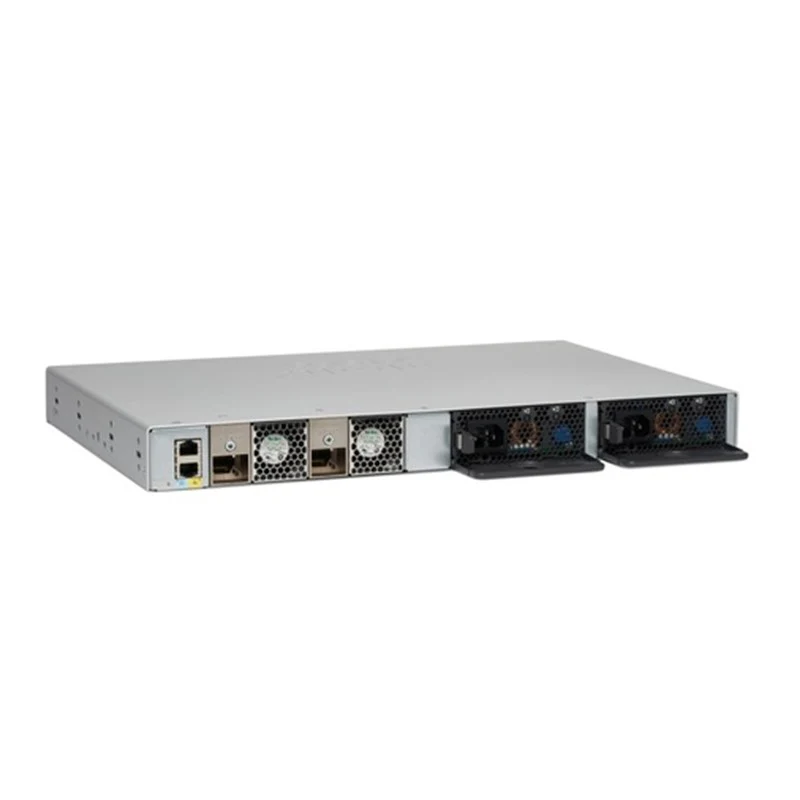
Cisco Catalyst C9200L-48P-4G-E | 48-Port PoE+ Network Switch for the Enterprise-Ready Modern Workplace
Every modern network has a moment of truth — the moment when the infrastructure holding everything together either proves it was built for what the business has become, or reveals it was only ever adequate for what the business used to be. IP phones ringing simultaneously across every desk. Wireless access points delivering gigabit Wi-Fi to every corner of the building. IP cameras securing every entrance and corridor. Video conferencing systems demanding uncompromising bandwidth in every meeting room. IoT sensors and smart building systems drawing power and data from the same network fabric that every laptop, every tablet, and every critical business application depends on.
That moment of truth demands infrastructure that does not merely survive the test — it defines the standard against which everything else is measured.
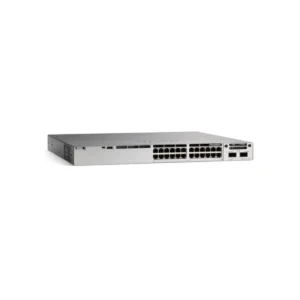
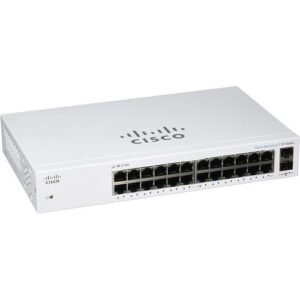
The Cisco Catalyst C9200L-48P-4G-E is that standard. A professionally engineered, enterprise-grade access layer switch that delivers 48 ports of PoE+ power, four 1G uplink connections, and the full intelligence of Cisco’s Network Essentials feature set in a purpose-built platform designed to power, connect, and intelligently manage the complete modern enterprise network edge. Not just another 48-port switch. The access layer foundation that Cisco’s most trusted enterprise network architecture is built upon — at a capacity, a feature depth, and a total cost of ownership that makes it the definitive choice for organizations that refuse to compromise on network reliability, security, or operational intelligence.
What Is the Cisco Catalyst C9200L-48P-4G-E?
The Cisco Catalyst C9200L-48P-4G-E is a fixed-configuration, enterprise-class Layer 2/Layer 3 access switch belonging to Cisco’s acclaimed Catalyst 9200 Series — the entry point to Cisco’s next-generation Catalyst 9000 switching platform and the direct successor to the enormously successful Catalyst 3850 and 3650 series that defined enterprise access switching for a decade.
Breaking down the model designation reveals exactly what this switch delivers:
- C9200L — Catalyst 9200 Series, L-variant (fixed uplink configuration, optimized price-performance for access layer deployment)
- 48P — 48 downlink ports with PoE+ (IEEE 802.3at) Power over Ethernet, delivering up to 30W per port and 740W total PoE budget
- 4G — Four 1G (SFP) fixed uplink ports for fiber or copper uplink connectivity to distribution layer switches
- E — Network Essentials software license tier — Cisco’s foundational enterprise feature set delivering the switching intelligence, security capability, and management tools that professional network deployments require
Together, these specifications define a switch that is simultaneously purpose-built for the power-hungry, device-dense modern access layer and architecturally positioned within Cisco’s most forward-looking enterprise switching platform — ensuring that the investment made today is protected by Cisco’s commitment to the Catalyst 9000 series as their primary enterprise switching architecture for the years ahead.
The Cisco C9200L-48P-4G-E Is the Definitive Access Switch For:
- Enterprise offices and corporate campuses deploying PoE+ powered IP phones, wireless access points, and IP cameras across high-density access layer environments
- Education institutions — schools, colleges, and universities — powering classroom technology, campus Wi-Fi infrastructure, and IP intercom systems from a unified PoE network
- Healthcare facilities — hospitals, clinics, and medical centers — requiring the security, reliability, and PoE capacity to support medical IoT devices, nurse call systems, and clinical workflow technology
- Hospitality environments — hotels, resorts, and conference centers — powering high-density guest Wi-Fi, IP telephony, digital signage, and building management systems
- Government and public sector facilities requiring the compliance certifications, security architecture, and long-term vendor support commitment that Cisco’s enterprise platform provides
- Retail and commercial environments deploying POS systems, digital signage, IP cameras, and customer Wi-Fi from a unified PoE-powered network infrastructure
- Manufacturing and industrial facilities integrating IoT devices, IP cameras, industrial control systems, and operational technology networking
- Data centers and server rooms requiring a reliable, manageable access-layer switch for out-of-band management, console server connectivity, and infrastructure device networking
- Network administrators and IT teams managing complex, multi-VLAN enterprise environments requiring sophisticated QoS, security, and automation capabilities
- Organizations standardizing on Cisco’s SD-Access architecture who need access layer switches fully compatible with Cisco DNA Center and Intent-Based Networking
Cisco Catalyst 9200L C9200L-48P-4G-E Core Specifications
| Specification | Detail |
|---|---|
| Platform | Cisco Catalyst 9200L Series |
| Downlink Ports | 48 × 10/100/1000 Mbps RJ45 (PoE+) |
| Uplink Ports | 4 × 1G SFP fixed uplinks |
| PoE Standard | IEEE 802.3af (15.4W) and IEEE 802.3at (30W) |
| Total PoE Budget | 740W |
| Switching Capacity | 176 Gbps |
| Forwarding Rate | 130.95 Mpps |
| MAC Address Table | 16,000 entries |
| VLAN Support | 4,094 VLANs |
| Jumbo Frame Support | Up to 9,198 bytes |
| Routing | Static routing, RIP (Network Essentials) |
| QoS | 4 queues per port, DSCP, CoS, 802.1p |
| Security | IEEE 802.1X, MACsec (optional), DHCP Snooping, DAI, IP Source Guard |
| Stacking | Up to 8 switches via Cisco StackWise-160 (cable required) |
| Management | Cisco DNA Center, IOS XE CLI, SNMP, Netconf/YANG |
| Software | IOS XE with Network Essentials license |
| High Availability | Redundant power supply slot (RPS 2300 compatible) |
| Form Factor | 1U rack-mount |
| Dimensions | 1U — standard 19-inch rack |
| MTBF | High — enterprise-grade component reliability |
| Certifications | UL, CE, FCC, RoHS |
| Warranty | Cisco Limited Lifetime Hardware Warranty |
Cisco C9200L-48P-4G-E Key Features — Enterprise Intelligence at the Network Edge
⚡ 48-Port PoE+ With 740W Budget — Power Everything the Modern Workplace Demands
The defining operational capability of the C9200L-48P-4G-E — the feature that makes it the correct choice for virtually every modern enterprise access layer deployment — is its 48-port PoE+ architecture with a 740W total power budget. This is not merely a convenience feature. In the modern enterprise network, Power over Ethernet has become the primary power delivery mechanism for an extraordinary range of business-critical devices — and the C9200L-48P-4G-E provides the capacity, the budget, and the intelligent power management to handle all of them simultaneously.
What the 48 PoE+ Ports Power in a Typical Enterprise Deployment:
- 🔊 IP Phones — every Cisco, Yealink, Fanvil, Polycom, and SNOM IP desk phone in the office draws PoE power — typically 3-10W per device depending on model. Forty-eight PoE ports means forty-eight desk phones powered and connected from one switch without a single power adapter cluttering a single desk.
- 📡 Wireless Access Points — enterprise Wi-Fi 6 and Wi-Fi 6E access points from Cisco, Aruba, Ubiquiti, Meraki, and others draw 15-25W via PoE+ — within the 30W per-port maximum the C9200L-48P-4G-E delivers on every port simultaneously.
- 📷 IP Cameras — security and surveillance cameras draw 6-15W via PoE, making the C9200L-48P-4G-E the ideal distribution switch for IP camera networks where running separate power to every camera location is impractical.
- 📞 Video Conferencing Endpoints — Cisco Webex Desk devices, Polycom and Poly video endpoints, and compact conferencing units increasingly draw power via PoE+ — the 30W per-port budget accommodates even the most power-hungry conference room endpoints.
- 🔒 Access Control Systems — electronic door locks, card readers, biometric access devices, and intercoms draw PoE power — enabling complete building access control without separate power infrastructure at every door.
- 📟 IoT Devices — smart building sensors, environmental monitors, digital signage players, nurse call systems, and industrial IoT endpoints increasingly leverage PoE for both power and data from a single cable.
The 740W PoE Budget — Understanding Real-World Capacity:
740W total PoE budget across 48 ports means an average available power of approximately 15.4W per port simultaneously — enough to power a fully deployed mix of IP phones, standard PoE access points, and IP cameras across all 48 ports concurrently. For deployments mixing high-power PoE+ devices (Wi-Fi 6 APs at 25W) with lower-power devices (IP phones at 6W), the C9200L-48P-4G-E’s intelligent Cisco Dynamic Power Management allocates available PoE budget dynamically based on actual device power consumption rather than worst-case reservation — maximizing usable PoE capacity across mixed-device deployments.
Cisco PoE+ Power Management Intelligence:
- Perpetual PoE — maintains power to connected PoE devices during switch software upgrades — eliminating the disruptive power interruption to all PoE devices that traditional switch reboots cause. During IOS XE upgrade events, connected IP phones, access points, and cameras maintain power continuity — a capability that transforms planned maintenance from a disruptive event into a transparent background operation.
- Fast PoE — delivers power to connected PoE devices immediately upon switch power-up, before the full IOS XE software stack has completed loading — minimizing device downtime during switch power cycles.
- PoE power prioritization — configure PoE power priority per port (critical, high, low) — ensuring that when total PoE demand approaches budget limits, critical devices (IP phones, emergency communication endpoints) maintain power while lower-priority devices are managed accordingly.
🔗 Four Fixed 1G SFP Uplinks — Flexible, High-Speed Distribution Connectivity
The C9200L-48P-4G-E’s four fixed 1G SFP uplink ports provide the distribution layer connectivity that anchors the switch within the broader enterprise network architecture — offering the SFP transceiver flexibility to match virtually any upstream connectivity requirement:
SFP Transceiver Options for Every Uplink Scenario:
- GLC-SX-MMD — 1G multimode fiber (850nm, up to 550m) — the standard choice for within-building fiber uplinks between access switches and distribution layer switches in the same building or campus
- GLC-LX-SM-RGD / GLC-LH-SMD — 1G single-mode fiber (1310nm, up to 10km) — ideal for uplinks between buildings across a campus, to a remote distribution switch, or to a data center fiber termination point
- GLC-T — 1G copper (RJ45) — for installations where fiber is not available or Cat5e/Cat6 copper is the preferred uplink medium to a nearby distribution switch
- GLC-BX-U/D — 1G BiDi single-mode fiber — single-fiber bidirectional uplinks for environments with limited fiber strand availability
Four Uplinks — Strategic Deployment Flexibility:
Four uplink ports provide meaningful architectural options beyond simple upstream connectivity:
- Dual uplink redundancy — connect two uplinks to the distribution switch using LACP port-channel (802.3ad) for active/active load-balanced uplink with automatic failover if one uplink fails — the standard enterprise resilience configuration
- Dual-switch redundancy — connect two uplinks to two different distribution switches — maintaining full connectivity if either distribution switch fails entirely
- LACP 802.3ad port-channel bonding — aggregate two or more uplinks into a single logical high-bandwidth channel, doubling or quadrupling effective uplink throughput for bandwidth-intensive deployments
🔄 Cisco StackWise-160 — Physical Stacking for Unified Multi-Switch Management
One of the most operationally significant architectural capabilities of the Cisco Catalyst 9200L series is its support for Cisco StackWise-160 physical stacking — a technology that enables up to 8 C9200L switches to be combined into a single, unified logical switch managed as one network element:
What StackWise-160 Delivers:
- Single management plane — all stacked switches managed through one IP address, one CLI session, one SNMP instance, and one DNA Center managed device record — dramatically reducing management overhead for multi-switch deployments
- 160 Gbps stack interconnect bandwidth — high-speed ring topology connecting all stack members with sufficient bandwidth for full cross-stack traffic flow without bottlenecks
- Up to 384 access ports in a single stack — combine 8 × 48-port switches for a logical 384-port switching entity managed as one device
- Stack-wide high availability — if the active stack master fails, a standby switch assumes mastership automatically within seconds without traffic interruption to non-affected ports
- Hot-add and hot-remove — add new switches to a running stack or remove failed switches without disrupting traffic on remaining stack members
- Unified QoS and security policy — quality of service and security configurations applied at the stack level propagate consistently across all member switches automatically
For enterprise deployments where wiring closets house multiple access switches serving the same floor or zone, StackWise-160 stacking transforms the management complexity of 4-8 individual switches into the simplicity of a single logical network element — reducing configuration effort, accelerating troubleshooting, and eliminating the inter-switch consistency management burden that un-stacked multi-switch environments impose.
🛡️ Network Essentials Security Architecture — Enterprise Protection at the Access Layer
The C9200L-48P-4G-E’s Network Essentials software license delivers a comprehensive access layer security framework that addresses the threat vectors targeting modern enterprise network edges — where diverse, often unmanaged or IoT devices connect to the network and where the security posture of every connected endpoint directly influences the security of the entire organization:
Identity and Access Control
- IEEE 802.1X Port-Based Authentication — the industry standard for network access control. Devices connecting to 802.1X-enabled ports must authenticate with valid credentials — via username/password, digital certificate, or MAC address — before receiving network access. Unauthenticated devices are isolated to a restricted guest VLAN or denied access entirely. The C9200L-48P-4G-E supports multi-auth mode — allowing multiple authenticated devices per port — and integrates natively with Cisco ISE (Identity Services Engine) for centralized authentication policy management.
- MAC Authentication Bypass (MAB) — for IoT devices, printers, and other endpoints that cannot perform 802.1X authentication, MAB authenticates the device based on its MAC address against a centralized authentication server — extending access control coverage to non-802.1X-capable endpoints without excluding them from the network entirely.
- Flexible Authentication (FlexAuth) — intelligently sequences 802.1X and MAB authentication methods based on endpoint capability, eliminating the administrative complexity of manually configuring different authentication methods per port type.
Data Plane Protection
- DHCP Snooping — builds and maintains a trusted DHCP binding table on the switch — recording the mapping between MAC address, IP address, VLAN, and port for every authenticated DHCP client. Rogue DHCP servers advertising illegitimate default gateway or DNS server addresses are blocked. DHCP starvation attacks — where malicious devices exhaust the DHCP address pool — are rate-limited and detected.
- Dynamic ARP Inspection (DAI) — uses the DHCP snooping binding table to validate ARP packets — the mechanism targeted by ARP poisoning and man-in-the-middle attacks. ARP responses that don’t match the binding table are dropped, protecting the network from address resolution spoofing that enables traffic interception.
- IP Source Guard — filters IP packets at the access port level based on DHCP snooping bindings — preventing IP address spoofing attacks where devices attempt to masquerade as trusted network hosts by using someone else’s IP address.
- Storm Control — rate-limits broadcast, multicast, and unicast storm traffic per port — preventing network storms from consuming switching bandwidth and degrading connectivity for legitimate traffic.
Port-Level Security Controls
- Port Security — limit the number of MAC addresses permitted on each access port — preventing unauthorized devices from connecting to the network by plugging into an occupied switch port or by using a hub or unmanaged switch to connect multiple unauthorized devices through a single authenticated port.
- Private VLAN Edge (Protected Ports) — prevents direct communication between devices on the same switch — the primary security measure for guest networks, shared workspaces, and hotel or hospitality environments where device-to-device isolation is required despite shared VLAN assignment.
- BPDU Guard and Root Guard — protect the spanning tree topology from rogue switches connecting to access ports and attempting to modify the network’s spanning tree root bridge assignment — a common attack vector that can cause catastrophic network topology disruption.
📊 Advanced Quality of Service — Protecting What Matters Most Across 48 Ports
In a network where IP voice traffic, video conferencing streams, security camera feeds, business application data, and general internet browsing all compete for bandwidth on the same switching fabric, Quality of Service is the mechanism that ensures critical traffic always receives the priority treatment it requires regardless of overall network load. The C9200L-48P-4G-E delivers enterprise-grade QoS across all 48 access ports and four uplinks:
QoS Mechanisms:
- 4 egress queues per port — traffic is classified into four priority queues per port, ensuring high-priority traffic (voice, video conferencing) dequeues ahead of lower-priority traffic (bulk data transfer, background updates) even during congestion events
- DSCP (Differentiated Services Code Point) marking and remarking — classify inbound traffic by DSCP value and remark outbound traffic to ensure consistent QoS treatment as packets traverse the network
- CoS (Class of Service) / 802.1p — Layer 2 QoS marking based on 802.1p priority bits in the VLAN tag — the primary QoS mechanism for voice VLAN traffic from IP phones that mark their own traffic
- Auto QoS — Cisco’s simplified QoS configuration tool that automatically applies appropriate QoS policies for Cisco IP phones and access points based on device detection — significantly reducing the expertise and time required to deploy effective QoS across large port counts
- Weighted Tail Drop (WTD) and Shaped Round Robin (SRR) scheduling — sophisticated queue management algorithms that prevent queue monopolization by high-volume traffic while ensuring low-latency treatment for delay-sensitive voice and video streams
- Trust boundaries — define which devices are trusted to mark their own traffic accurately — typically IP phones that mark voice packets with DSCP EF (Expedited Forwarding) — and which devices’ markings should be overridden by the switch’s own classification policy
For deployments combining IP telephony, video conferencing, and data traffic — which describes virtually every modern enterprise access layer — proper QoS configuration is the difference between voice calls that are crisp and intelligible and calls that are plagued by jitter, latency, and packet loss that undermines communication quality.
🌐 IOS XE Software Platform — The Foundation of Enterprise Network Intelligence
The C9200L-48P-4G-E runs Cisco IOS XE — the modern, Linux-based evolution of Cisco’s industry-defining Internetwork Operating System that has powered enterprise network infrastructure for decades. IOS XE brings a fundamentally modernized software architecture to the Catalyst 9200L platform — delivering capabilities that extend well beyond the traditional command-line configuration management model:
Programmability and Automation:
- NETCONF/YANG — industry-standard network configuration protocol enabling programmatic, model-driven switch configuration and state retrieval — the foundation of network automation workflows using Ansible, Python, Terraform, and other infrastructure-as-code tools
- RESTCONF — HTTP-based YANG data model access enabling RESTful API interaction with the switch configuration and operational state — accessible from any programming language or automation platform with HTTP client capability
- gRPC Telemetry (gNMI) — model-driven streaming telemetry that pushes real-time operational data — interface counters, CPU utilization, PoE power consumption, spanning tree state — from the switch to centralized monitoring and analytics platforms at configurable streaming intervals, replacing the polling-based SNMP model with push-based real-time intelligence
- Python scripting on-box — execute Python scripts directly on the switch’s IOS XE runtime — enabling custom automation, event-driven response scripts, and local intelligence without external automation infrastructure
- Ansible and Terraform integration — native IOS XE support for infrastructure-as-code configuration management using industry-standard automation tools
DNA Center Integration:
- Cisco DNA Center compatibility — the C9200L-48P-4G-E is a fully supported DNA Center managed device, enabling deployment within Cisco’s Software-Defined Access (SD-Access) architecture — Cisco’s Intent-Based Networking framework that automates network segmentation, policy enforcement, and device onboarding across the enterprise campus
- Network plug-and-play (PnP) — zero-touch provisioning through DNA Center — new switches connect to the network, contact DNA Center automatically, download their configuration, and join the managed infrastructure without any manual CLI interaction
- Encrypted Traffic Analytics (ETA) — analyze encrypted network traffic for malware signatures and security threats without decryption — using machine learning and behavioral analysis to identify threats that traditional signature-based inspection cannot detect in encrypted traffic streams
- Assurance monitoring — DNA Center’s AI-powered network health monitoring continuously analyzes telemetry from all managed devices including the C9200L-48P-4G-E — proactively identifying configuration issues, performance degradation, and security anomalies before they impact users
🔌 Modular Redundant Power Supply Support — Resilience for Always-On Operations
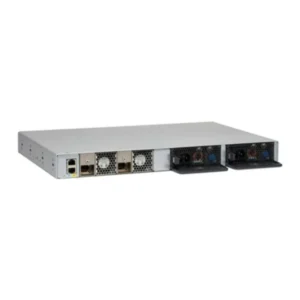
For access switches in environments where PoE device downtime carries operational consequence — hospital nursing stations, emergency services facilities, hotel front desks, trading floor environments — the C9200L-48P-4G-E supports connection to a Cisco Redundant Power System (RPS 2300) providing power supply redundancy:
- In normal operation, the switch draws power from its internal AC power supply
- If the internal power supply fails, the RPS 2300 immediately assumes power delivery — maintaining PoE to all connected devices and preventing the switch downtime that an unprotected power supply failure would cause
- The RPS 2300 supports multiple switches simultaneously — one RPS unit provides power supply redundancy for up to six connected switches from a single external redundancy unit
- For critical deployments where both switch hardware failure and power supply failure must be addressed, StackWise-160 stacking combined with RPS 2300 support provides multi-layer hardware resilience
Network Essentials vs. Network Advantage — Understanding the License Tiers
The C9200L-48P-4G-E ships with the Network Essentials software license — Cisco’s foundational enterprise feature set that addresses the complete requirements of the vast majority of enterprise access layer deployments. Understanding what Network Essentials includes — and what Network Advantage adds — clarifies whether the E suffix specification meets your deployment requirements or whether an upgrade should be considered:
| Feature Category | Network Essentials | Network Advantage |
|---|---|---|
| Layer 2 Switching | ✅ Full | ✅ Full |
| Layer 3 Static Routing | ✅ Yes | ✅ Yes |
| RIP Dynamic Routing | ✅ Yes | ✅ Yes |
| OSPF / EIGRP / BGP | ❌ | ✅ Advanced routing |
| 802.1X / MAB Authentication | ✅ Full | ✅ Full |
| DHCP Snooping / DAI / IPSG | ✅ Full | ✅ Full |
| QoS / Auto QoS | ✅ Full | ✅ Full |
| StackWise-160 | ✅ Yes | ✅ Yes |
| NETCONF / YANG / gRPC | ✅ Yes | ✅ Yes |
| DNA Center Management | ✅ Basic | ✅ Advanced |
| MACsec 128-bit Encryption | ❌ | ✅ Yes |
| Flexible NetFlow | ❌ | ✅ Yes |
| SGT / TrustSec | ❌ | ✅ Yes |
| SD-Access Full Integration | ⚠️ Limited | ✅ Full |
| LISP / VXLAN | ❌ | ✅ Full SD-Access |
Network Essentials is the right choice when: the deployment requires comprehensive Layer 2 switching, 802.1X security, DHCP snooping, QoS, StackWise stacking, and IOS XE programmability without advanced routing protocols, MACsec encryption, or full SD-Access fabric integration.
Consider Network Advantage when: the deployment requires OSPF or EIGRP dynamic routing at the access layer, MACsec link-layer encryption, full Cisco TrustSec SGT policy enforcement, complete Flexible NetFlow traffic analysis, or full SD-Access fabric node functionality within a DNA Center-managed campus.
Network Essentials licenses can be upgraded to Network Advantage at any time through Cisco’s software license upgrade process — protecting the hardware investment while allowing software capability expansion as organizational requirements evolve.
C9200L vs. C9200 — Choosing Between the Two 9200 Series Variants
The Catalyst 9200 series offers two form factor variants that are frequently compared in access layer switch procurement decisions:
| Dimension | C9200L | C9200 |
|---|---|---|
| Uplink Configuration | Fixed (4G or 4X depending on SKU) | Modular — field-swappable uplink module |
| Uplink Flexibility | Specified at purchase | Changeable post-deployment |
| Price Point | Lower — fixed configuration efficiency | Higher — modularity premium |
| PoE Availability | Yes (P variants) | Yes (P variants) |
| Stacking | StackWise-160 | StackWise-160 |
| Feature Parity | Full IOS XE feature set | Full IOS XE feature set |
| Best For | Stable deployments with known uplink requirements | Environments where uplink type may change |
The C9200L is the optimal choice when uplink requirements are known at deployment time — which describes the vast majority of access layer switch deployments where the distribution switch uplink type is defined by the existing fiber plant or copper infrastructure. The fixed uplink configuration of the C9200L delivers identical feature capability to the C9200 at a more accessible price point — making it the volume access layer switch of choice for most enterprise campus deployments.
Cisco Catalyst 9200L vs. Competing Enterprise Access Switches
🆚 C9200L-48P-4G-E vs. Cisco Catalyst 2960-X / 2960-XR
The Catalyst 2960 series was Cisco’s previous-generation access switch — a platform that served enterprise networks excellently for many years but has reached end of sale and end of support milestones that make new deployments difficult to justify. The C9200L represents a fundamental generational advancement:
- IOS XE vs. IOS — the C9200L’s Linux-based IOS XE platform delivers programmability, NETCONF/YANG, gRPC telemetry, and on-box Python scripting that the 2960’s traditional IOS cannot approach
- DNA Center compatibility — the C9200L is a fully supported DNA Center managed platform; the 2960 series has limited DNA Center support and no SD-Access capability
- StackWise-160 vs. FlexStack — C9200L’s StackWise-160 provides higher stack bandwidth and more sophisticated high availability than the 2960’s FlexStack technology
- Perpetual PoE and Fast PoE — C9200L innovations unavailable on the 2960 platform
- Long-term support commitment — Cisco’s Catalyst 9000 series is their current-generation platform with an active development roadmap; the 2960 series has entered end-of-life transition
🆚 C9200L-48P-4G-E vs. HPE Aruba / Juniper / Extreme Access Switches
Competing enterprise access switches from HPE Aruba, Juniper, and Extreme Networks offer capable hardware at competitive price points — but the C9200L-48P-4G-E’s integration advantages within Cisco-standardized environments are significant and practically meaningful:
- Native Cisco DNA Center integration — for organizations running DNA Center or planning SD-Access adoption, native integration eliminates the compromise of managing mixed-vendor access switches through third-party management overlays
- Cisco ISE deep integration — 802.1X, TrustSec SGT, and MAB authentication with Cisco ISE delivers a depth of identity-based policy integration that competing vendors achieve only through custom configuration
- Cisco TAC support — for enterprise networks where support response time and technical depth matter, Cisco’s Technical Assistance Center provides access to the world’s largest network engineering support organization
- IOS XE ecosystem — the breadth of third-party management, automation, and monitoring tools with proven, tested IOS XE integration exceeds what alternative platforms can match
- Unified warranty and lifecycle commitment — Cisco’s Limited Lifetime Hardware Warranty and predictable software lifecycle management reduce long-term ownership risk relative to vendors with less established enterprise access market positions
Deployment Best Practices — Getting Maximum Value From the C9200L-48P-4G-E
🏗️ Access Layer Design Recommendations
PoE Budget Planning: Before deployment, calculate the expected PoE power draw for your device mix:
- IP phones: 4-10W each (typically IEEE 802.3af, 15.4W max)
- Wi-Fi 6 access points: 20-25W each (IEEE 802.3at PoE+)
- IP cameras: 6-15W each (IEEE 802.3af or PoE+)
- Video conferencing endpoints: 15-25W each (PoE+)
Sum the expected draw across all 48 ports and compare against the 740W budget. For mixed deployments, the C9200L-48P-4G-E’s dynamic power management typically supports higher device counts than worst-case reservation calculations suggest — but accurate planning prevents budget exhaustion at deployment time.
VLAN Segmentation Design: Deploy separate VLANs for voice traffic (with 802.1p/DSCP QoS marking), data traffic, wireless management, camera networks, IoT devices, and guest access. The C9200L-48P-4G-E’s 4,094 VLAN support and 16,000 MAC address table provide ample capacity for complex segmentation schemes.
Spanning Tree Configuration: Deploy Rapid PVST+ (the default on IOS XE) for sub-second topology convergence. Enable PortFast on all access ports connecting end devices. Enable BPDU Guard on all PortFast-enabled ports to protect against accidental switch connections. Configure Root Guard on uplink ports toward distribution to prevent unauthorized root bridge elections.
QoS Auto Deployment: Enable Auto QoS on ports connected to Cisco IP phones and Cisco access points — this single command applies a comprehensive QoS policy optimized for Cisco voice and wireless traffic without requiring manual DSCP classification configuration across every port.
🔒 Security Hardening Recommendations
- Enable DHCP Snooping globally and configure trusted ports only on uplinks toward the distribution layer — all access ports connecting end devices should be untrusted
- Enable Dynamic ARP Inspection on all VLANs after DHCP Snooping is established — in the correct sequence to avoid legitimate ARP traffic disruption
- Deploy 802.1X with MAB fallback for comprehensive port authentication across both 802.1X-capable endpoints and IoT devices
- Enable Storm Control on all access ports at appropriate threshold levels to prevent broadcast storm propagation
- Disable unused ports and place them in an isolated VLAN — unconnected ports should not be in VLAN 1 or any production VLAN
- Change the native VLAN on all trunk ports from the default VLAN 1 to a dedicated unused VLAN — eliminating VLAN hopping attack vectors
Full Deployment Scenarios — The C9200L-48P-4G-E Powering Real Enterprise Networks
🏢 Corporate Office — Unified PoE Access Layer
A 200-person corporate office across two floors deploys four C9200L-48P-4G-E switches — two per floor — stacked in StackWise-160 pairs. Each stack presents as a single managed network element. All 200 desk phones draw PoE power. All Wi-Fi 6 access points draw PoE+. All IP cameras draw PoE. The network team manages four switches as two logical devices from a single DNA Center instance. Auto QoS ensures voice calls are always crisp. 802.1X with Cisco ISE ensures every device authenticates before receiving network access.
🏥 Hospital Nursing Station — Critical PoE Availability
A hospital deploys C9200L-48P-4G-E switches at nursing stations throughout the facility — each switch connected to a Cisco RPS 2300 for power supply redundancy. Perpetual PoE ensures nurse call systems, patient monitoring endpoints, and VoIP phones maintain power continuity during planned IOS XE upgrades. Fast PoE minimizes device downtime during any switch power cycle. PoE port prioritization ensures clinical devices maintain power precedence over administrative workstation peripherals during any power budget constraints.
🏫 University Campus — High-Density Student Access
A university deploys C9200L-48P-4G-E switches in student residence buildings and classroom blocks — each switch providing PoE+ power to dense wireless access point deployments delivering gigabit Wi-Fi 6 to hundreds of concurrent student devices per switch location. DHCP Snooping and Dynamic ARP Inspection protect the student network from the rogue device attacks and ARP poisoning attempts that high-density shared network environments regularly encounter. 802.1X authentication ensures only enrolled students and authorized staff receive network access.
🏨 Hotel — Guest Experience and Building Management
A full-service hotel deploys C9200L-48P-4G-E switches across guest floors, back-of-house areas, and conference facilities. Guest floor switches power in-room IP phones, Wi-Fi access points, and smart room control systems from a unified PoE infrastructure. VLAN segmentation isolates guest Wi-Fi traffic from property management system traffic and building control networks. Private VLAN Edge (Protected Ports) prevents guest devices from communicating directly with other guest devices on the same switch.
🏭 Manufacturing Facility — OT/IT Network Convergence
A manufacturing facility deploys C9200L-48P-4G-E switches in the production area — providing network connectivity and PoE power for industrial IoT sensors, IP cameras monitoring production lines, IP intercom and paging systems, and barcode scanner access points. VLAN segmentation strictly isolates operational technology (OT) traffic from corporate IT traffic. 802.1X MAB authentication controls which operational devices can access which network segments. gRPC streaming telemetry delivers real-time switch performance data to the operations center monitoring platform.
Frequently Asked Questions About the Cisco C9200L-48P-4G-E
What is the total PoE budget and how many PoE+ devices can I simultaneously power?
The C9200L-48P-4G-E provides a 740W total PoE budget across all 48 ports. The practical number of simultaneously powered PoE+ devices depends entirely on the power draw of your specific devices. A deployment of 48 IP phones drawing 6W each totals 288W — well within the 740W budget. A deployment of 24 Wi-Fi 6 APs drawing 25W each totals 600W — also within budget. A deployment mixing 20 IP phones (6W each = 120W), 12 Wi-Fi 6 APs (25W each = 300W), 10 IP cameras (10W each = 100W), and 6 other devices (10W each = 60W) totals 580W — comfortably within the 740W budget. Cisco’s dynamic power management optimizes actual power allocation against real device consumption rather than worst-case per-port reservation.
What is the difference between the C9200L-48P-4G-E and the C9200L-48P-4X-E?
The distinction is the uplink port type. The C9200L-48P-4G-E features four 1G SFP fixed uplinks — appropriate for uplinks to distribution switches over existing gigabit fiber or copper infrastructure. The C9200L-48P-4X-E features four 10G SFP+ fixed uplinks — appropriate for deployments where the distribution layer switch uplinks support 10 Gigabit Ethernet, providing significantly higher uplink throughput for bandwidth-intensive access layers. For most access layer deployments where the switch serves standard office users and PoE devices, 4 × 1G uplinks provide adequate uplink bandwidth. For high-density wireless deployments with many Wi-Fi 6 APs generating substantial upstream traffic, the 4X variant’s 10G uplinks may be warranted.
Can I stack the C9200L-48P-4G-E with other Catalyst 9200 series switches?
Yes — StackWise-160 stacking is supported across compatible Catalyst 9200 series models, enabling mixed-model stacks combining C9200L switches of different port counts and uplink configurations within the same stack. The C9200L-48P-4G-E can be stacked with C9200L-24P or C9200L-48T models within the same StackWise-160 stack ring. Note that C9200L and C9200 (non-L) models use different stacking cable types — verify cable compatibility when mixing C9200 and C9200L models within a planned stack. Up to 8 switches in a single stack is the platform maximum.
Does the C9200L-48P-4G-E support Cisco DNA Center management?
Yes — the C9200L-48P-4G-E is a fully supported Cisco DNA Center managed device running IOS XE. With DNA Center, the switch can be onboarded via Network Plug-and-Play (PnP) for zero-touch provisioning, managed through DNA Center’s graphical policy and configuration interface, monitored via DNA Assurance for network health analysis, and — with Network Advantage license — deployed as a fabric edge node within a Cisco SD-Access campus fabric. Network Essentials license provides basic DNA Center management capability; Network Advantage unlocks full SD-Access fabric integration.
What Cisco SFP transceivers are compatible with the 1G uplink ports?
The four SFP uplink ports on the C9200L-48P-4G-E are compatible with Cisco-branded 1G SFP transceivers including the GLC-SX-MMD (multimode fiber, 550m), GLC-LH-SMD (single-mode fiber, 10km), GLC-T (1000BASE-T copper RJ45), GLC-BX-U/D (BiDi single-fiber), and other Cisco-branded 1G SFP modules. Cisco IOS XE includes transceiver authentication that verifies Cisco-branded optics — third-party SFPs may trigger authentication warnings. The service unsupported-transceiver IOS XE command allows operation with third-party optics where cost optimization is prioritized over manufacturer warranty compliance.
What is Cisco’s hardware warranty and support commitment for the C9200L-48P-4G-E?
The C9200L-48P-4G-E is covered by Cisco’s Limited Lifetime Hardware Warranty — providing hardware replacement coverage for the lifetime of the product with next business day advance replacement available. For enhanced support including software updates, technical assistance center access, hardware replacement guarantees, and DNA Center management entitlements, Cisco’s SMART Net Total Care or DNA Subscription support contracts provide the appropriate service level. Contact your Cisco partner or authorized reseller for current support pricing and contract options aligned to your organization’s support requirements.
Is the Cisco C9200L-48P-4G-E compatible with third-party network management systems?
Yes. Beyond Cisco DNA Center, the C9200L-48P-4G-E is compatible with industry-standard network management platforms including SolarWinds Network Performance Monitor, PRTG Network Monitor, ManageEngine OpManager, Nagios, Zabbix, and any SNMP-based NMS that supports standard MIBs. NETCONF/YANG and RESTCONF API access enable integration with automation platforms including Ansible, Terraform, Python scripts, and custom management applications. gRPC streaming telemetry integrates with modern observability platforms including Grafana, InfluxDB, and Elastic Stack. The C9200L-48P-4G-E’s comprehensive management interface coverage ensures compatibility with virtually any enterprise network management architecture.
The Investment Case — Why the Cisco Catalyst C9200L-48P-4G-E Is the Right Access Switch Decision
Every access switch purchasing decision involves a calculation that extends well beyond the initial hardware cost — encompassing the total cost of ownership across the device’s operational lifetime, the support costs associated with managing the infrastructure, the risk costs associated with choosing platforms from vendors with uncertain enterprise access market commitment, and the opportunity costs of choosing a platform that cannot grow with the organization’s evolving network requirements.
Across every dimension of that calculation, the Cisco Catalyst C9200L-48P-4G-E delivers a compelling case:
Platform Longevity — As Cisco’s current-generation enterprise access switch platform, the Catalyst 9200 series carries Cisco’s full development commitment — active feature development, regular IOS XE software updates, DNA Center integration advancement, and a support lifecycle that extends well into the next decade. The investment made today in C9200L hardware is not approaching an end-of-life transition. It is positioned at the beginning of a supported product lifecycle.
Operational Efficiency — StackWise-160 stacking, DNA Center management, NETCONF/YANG automation, and zero-touch PnP provisioning collectively reduce the IT labor required to deploy, manage, and maintain enterprise access layer infrastructure — translating hardware capability into operational cost savings that compound across the device’s lifetime.
Security Posture — 802.1X, DHCP Snooping, DAI, IP Source Guard, and IOS XE’s continuously updated threat response capabilities deliver an access layer security posture that protects the organization’s network from the endpoint-level threats that represent the primary attack surface in modern enterprise networks.
PoE Investment Protection — 740W of PoE+ budget across 48 ports eliminates the separate power infrastructure — individual power adapters, dedicated power circuits, UPS-protected power strips — that non-PoE access switches necessitate for every powered endpoint. The cost savings in power infrastructure and cable plant management justify a meaningful portion of the switch’s hardware cost independently of its networking capability.
Ecosystem Integration — for organizations standardized on Cisco infrastructure — Cisco Meraki wireless, Cisco Webex collaboration, Cisco ISE security, Cisco Umbrella DNS security — the C9200L’s native integration within that ecosystem delivers operational coherence and management simplicity that mixed-vendor access layer alternatives cannot match.
The Cisco Catalyst C9200L-48P-4G-E — Where Enterprise Network Architecture Begins
The access layer switch is not a glamorous component of enterprise network architecture. It does not generate the strategic conversations that next-generation firewalls inspire or the budget discussions that SD-WAN transformations provoke. It sits quietly in the wiring closet — powering phones, connecting laptops, feeding access points, and processing the millions of packets that every modern business day generates — invisible when it works perfectly and catastrophic when it fails.
The Cisco Catalyst C9200L-48P-4G-E is the switch that works perfectly. The platform that powers every PoE device reliably, routes every packet appropriately, enforces every security policy consistently, and operates within Cisco’s most trusted enterprise switching architecture for the duration of its decade-long operational lifetime. The switch that network administrators choose when they want their access layer to be something they never have to worry about — because they chose the right platform from the right vendor the first time.
Forty-eight PoE+ ports. Seven hundred and forty watts of power budget. Four gigabit uplinks. IOS XE intelligence. Network Essentials security. StackWise-160 scalability. Cisco DNA Center management readiness. Cisco Limited Lifetime Hardware Warranty.
This is not a compromise switch selected because the right product was too expensive. This is the right product — at the price point that enterprise access layer economics demand and the feature depth that enterprise network environments require.

 No products in the cart.
Reviews
There are no reviews yet.