
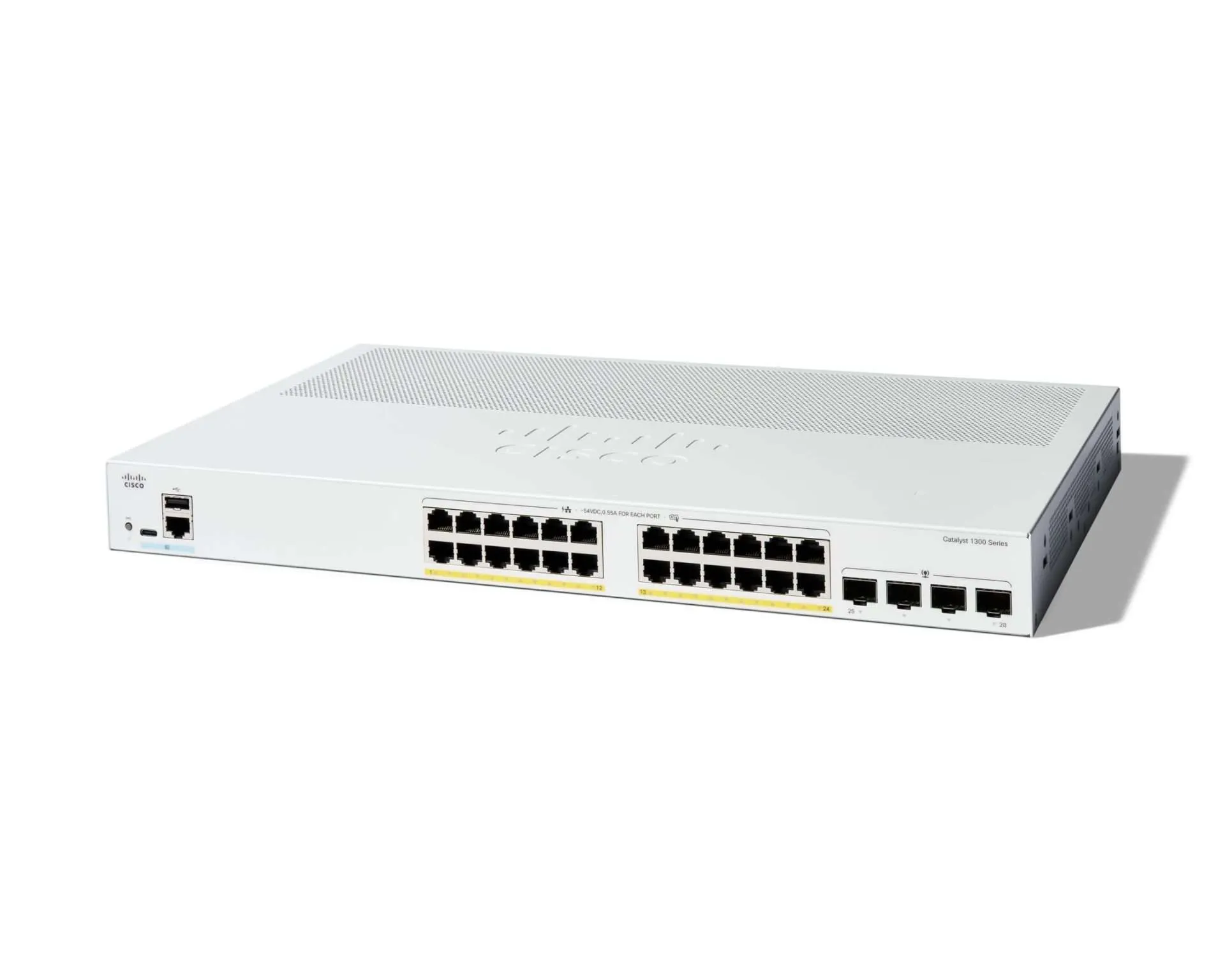
Cisco Catalyst 1300-24P-4G — 24-Port Gigabit PoE Managed Switch with 4x1G SFP Uplinks | The Enterprise-Calibre Network Core Your Business Has Been Building Toward
The Switch That Transforms Your Network From Infrastructure Into a Competitive Advantage
There is a category of business decision that defines the trajectory of an organisation — decisions that do not merely solve today’s problem but architect tomorrow’s capability. Choosing the network switch at the heart of your business infrastructure is one of those decisions. Choose too conservatively and your network becomes the ceiling that limits your growth. Choose with vision and your network becomes the foundation that accelerates it.
The Cisco Catalyst C1300-24P-4G is that visionary choice.
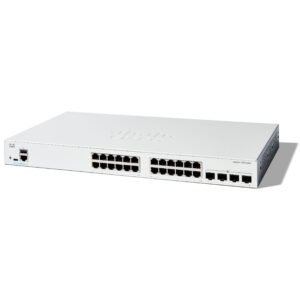
Twenty-four ports of full Gigabit PoE+ connectivity. Four dedicated 1G SFP uplinks for flexible, high-performance network integration. The complete Cisco Catalyst 1300 enterprise-derived management platform — including MACsec hardware encryption, comprehensive Layer 2+ intelligence, and the full depth of Cisco’s security architecture. All delivered in a rackmountable chassis that carries the Cisco Catalyst brand — the most trusted name in enterprise networking for over three decades — now accessible at the scale and investment level that ambitious small and medium businesses can confidently justify.
The C1300-24P-4G is not simply the logical step up from 16-port density. It is the switch that positions your network infrastructure at the precise intersection of capacity, capability, and cost-efficiency — powering and connecting an entire business operation from a single intelligent platform, with the management sophistication, security architecture, and uplink flexibility to serve as the genuine network core of organisations that take their connectivity seriously.
This is the switch your business grows into — and the switch your business grows with.
Cisco Catalyst C1300-24P-4G — Complete Technical Specifications
Engineering excellence begins with specifications that mean something in the real world. Here is the complete technical profile of the Catalyst 1300-24P-4G:
- 24 x 10/100/1000 Mbps PoE+ RJ45 Downlink Ports — IEEE 802.3at compliant, up to 30W per port
- 4 x 1G SFP Dedicated Uplink Ports — fiber or copper uplink flexibility via standard SFP transceivers
- Total PoE Power Budget: 195W — intelligent multi-device simultaneous power delivery
- Switching Capacity: 56 Gbps — true non-blocking wire-speed architecture across all 28 ports
- Forwarding Rate: 41.66 Mpps — line-rate packet processing under maximum concurrent traffic load
- MAC Address Table: 16,000 entries — supports large, complex, device-dense access layer environments
- Jumbo Frame Support: 9,000 bytes — optimised for NAS, iSCSI storage, and multimedia-intensive workflows
- VLAN Support: Up to 4,096 VLANs — enterprise-scale logical network segmentation capability
- Layer 2+ Managed — comprehensive VLANs, QoS, ACLs, STP/RSTP/MSTP, SNMP, 802.1X, and beyond
- MACsec Hardware Encryption — IEEE 802.1AE line-rate link-level cryptographic security on every port
- Web-Based GUI Management — intuitive browser interface requiring zero command-line expertise
- SSH v2 & HTTPS Encrypted Management — every administrative session secured end-to-end
- IPv4 & IPv6 Dual-Stack Support — complete next-generation network addressing readiness
- LLDP & LLDP-MED — automatic device discovery, topology mapping, and VoIP phone configuration
- IEEE 802.3ad LACP Link Aggregation — bonded uplinks for redundancy and bandwidth multiplication
- Cisco Business Dashboard Compatible — free centralised multi-device management and monitoring
- 1U Rackmountable Form Factor — standard 19-inch rack ready with included mounting hardware
- Cisco Limited Lifetime Hardware Warranty — industry-leading hardware investment protection
The Catalyst 1300 Difference — Why This Generation Redefines Small Business Managed Switching
Not an Upgrade. An Evolution. A Generational Leap.
Understanding the true value of the Cisco Catalyst C1300-24P-4G requires appreciating what the Catalyst 1300 Series represents as a platform — not just as a product. When Cisco chose to bring the Catalyst brand — the cornerstone of enterprise networking infrastructure globally — into the small business switching market, it was making an unambiguous commitment to a new standard of capability, security, and long-term platform investment for businesses that had previously been served by products positioned explicitly below that standard.
The Catalyst 1300 delivers four defining generational advances over preceding SMB switching platforms:
Catalyst Brand Engineering Standards Every hardware component, every ASIC selection, every thermal design decision, and every quality control process in the Catalyst 1300 is executed to Cisco’s enterprise Catalyst engineering standards — not adapted from them, but genuinely built to them. This is the same design rigour that governs Catalyst 9000 series switches deployed in the world’s most demanding enterprise environments, applied at the scale and density appropriate for small and medium business infrastructure.
MACsec Hardware Encryption as Standard The inclusion of IEEE 802.1AE MACsec hardware-accelerated encryption in the Catalyst 1300 platform represents a security capability that, until this generation, was exclusively available in enterprise switching products at significantly higher price points. For businesses handling sensitive client data, financial transactions, healthcare records, or confidential communications over wired infrastructure, MACsec provides cryptographic protection at the physical link level that no preceding SMB switch generation could offer.
Advanced Software Platform Depth The Catalyst 1300’s IOS-based software platform delivers greater feature richness across every dimension of network management — more sophisticated multicast handling, deeper QoS implementation, more granular access control capabilities, and superior Layer 2+ routing feature depth — compared to the CBS350 generation it succeeds. This software depth matters as your network requirements inevitably increase in complexity over the operational lifetime of your infrastructure investment.
Long-Term Active Development Platform As Cisco’s current-generation SMB switching platform, the Catalyst 1300 receives active, ongoing software development investment — including feature additions, security updates, and compliance enhancements delivered through firmware updates — ensuring that the switch you deploy today continues to meet your security and capability requirements for years into the future.
24-Port PoE+ Gigabit Density — The Business Network Core in a Single 1U Chassis
Every Desk Connected. Every Device Powered. Every Application Performing.
The 24-port configuration of the C1300-24P-4G represents the most strategically important port density tier in small and medium business networking — and the reasons are both mathematical and operational.
Twenty-four ports accommodate the complete wired device ecosystem of organisations ranging from 15 to 30 employees with comfortable headroom for growth, shared devices, and future technology additions. Consider the complete inventory of a modern, fully-connected business office:
A team of twenty people generates immediate connectivity demand across workstations or docking stations, VoIP desk phones, a wireless access point per office zone covering both staff and secure guest Wi-Fi, network-attached storage for shared file access and backup, a multifunction network printer, IP security cameras covering building entry and key operational areas, a smart display or conferencing system in the meeting room, a network time server, and a management workstation for IT administration. That inventory reaches 24 ports before a single growth device has been considered — validating the C1300-24P-4G as the switch that fits the moment of genuine business maturity without requiring compromise on any connected endpoint.
The switch’s non-blocking 56 Gbps switching fabric and 41.66 million packets per second forwarding rate guarantee that this 24-device ecosystem does not merely connect — it performs. Every workstation receives full Gigabit throughput simultaneously. Every VoIP phone delivers pristine call quality while file transfers and cloud backups compete for the same physical infrastructure. Every IP camera streams continuously at full resolution without dropped frames or storage gaps. And every wireless access point backhauls at full Gigabit speed, ensuring Wi-Fi performance is limited by the wireless medium — not the switch it connects through.
This is what non-blocking architecture actually means in practice: the mathematical guarantee that every port operates at full line rate simultaneously — not sequentially, not at reduced speed under load, but at the full 1 Gbps Gigabit specification every port advertises, continuously, under maximum concurrent utilisation.
195W PoE+ Power Budget — Intelligent Power Delivery Across 24 Ports
The Power to Run Your Entire Device Ecosystem. Delivered Through Ethernet.
The 195-watt total PoE+ power budget of the Cisco Catalyst C1300-24P-4G delivers intelligent, standards-compliant power delivery across all 24 downlink ports — transforming the economics and simplicity of deploying powered network devices at 24-port density.
Understanding the 195W Budget in Real-World Deployments
For businesses comparing the C1300-24P-4G’s 195W budget against higher-budget alternatives, context is essential. The 195W budget reflects a deliberate engineering balance — providing sufficient power capacity for the most common and realistic 24-port deployment scenarios while maintaining the compact thermal profile and cost efficiency that makes this switch exceptional value:
A typical mixed 24-port deployment connecting eight VoIP phones at 6W each (48W), four wireless access points at 15W each (60W), six IP cameras at 8W each (48W), and four access control devices at 7W each (28W) consumes a combined 184 watts — operating comfortably within the 195W ceiling with 11 watts of available headroom for additional devices. This calculation reflects real-world device power consumption, which consistently falls well below IEEE 802.3at’s 30W maximum per-port rating for the vast majority of business PoE devices.
For deployments that include multiple high-draw devices — such as Wi-Fi 6E access points drawing 25W each or high-performance PTZ cameras drawing 20W — the Catalyst 1300’s intelligent per-port PoE management allows precise power allocation and priority configuration to maximise the utility of the available budget:
Enterprise Wi-Fi Access Points Power Wi-Fi 6 and Wi-Fi 6E access points throughout your premises — delivering simultaneous Gigabit data backhaul and clean PoE power from a single cable, eliminating power injectors and centralising AP power management through the switch’s monitoring dashboard.
Complete Office VoIP Telephony Deploy a full business telephony system powered entirely through Ethernet — with modern SIP handsets from Cisco, Yealink, Poly, Grandstream, and Fanvil drawing 3-8W each, enabling a comprehensive desk phone deployment while preserving ample power headroom for wireless and surveillance devices running concurrently.
IP Surveillance and Physical Security Connect HD and 4K fixed and PTZ cameras throughout your premises — eliminating dedicated power circuit installation at camera mounting locations and enabling centralised power management and remote device reboot through the PoE management interface.
Building Access Control and Physical Security Systems Power electronic door locks, card reader controllers, biometric access terminals, visitor management kiosks, and video intercom systems directly from PoE ports — simplifying installation and enabling centralised power management of your entire physical access control infrastructure.
Smart Building and IoT Endpoints Connect the expanding ecosystem of intelligent workplace devices — occupancy and environmental sensors, smart lighting controllers, digital clock systems, building automation endpoints, and industrial IoT gateways — creating a unified, centrally managed powered device infrastructure from a single switch.
Digital Signage and Display Controllers Drive compact media players, signage controller appliances, and interactive kiosk systems from PoE — enabling display deployment at mounting locations without dedicated power circuit infrastructure requirements.
Catalyst-Grade PoE Intelligence: The C1300-24P-4G’s management interface provides real-time per-port PoE consumption monitoring, configurable maximum power allocation per port, and priority-based power management — guaranteeing that mission-critical devices including primary wireless access points and VoIP phones always maintain power during peak consumption conditions. Lower-priority ports gracefully yield power capacity before essential business services are ever interrupted.
4 x Dedicated 1G SFP Uplinks — Four Paths to Your Network Core
Four Uplinks. Four Times the Flexibility. One Switch That Connects to Everything.
The four dedicated 1G SFP uplink ports of the C1300-24P-4G represent a meaningful step beyond the dual-uplink configurations of smaller Catalyst 1300 models — providing both greater uplink bandwidth capacity and enhanced architectural flexibility for businesses building network topologies that demand redundancy, performance, and connectivity options simultaneously:
Dual-Link LACP Aggregation with Dual Independent Uplinks With four SFP ports available, the C1300-24P-4G enables sophisticated uplink architectures that smaller switches cannot achieve. Configure two ports as a 2Gbps LACP-bonded aggregate to your primary distribution switch for doubled upstream bandwidth with automatic failover redundancy — while simultaneously using the remaining two ports as independent uplinks to secondary distribution equipment, a dedicated server segment, or a directly-connected firewall or SD-WAN appliance.
Fiber Uplinks for Distance and Signal Integrity Install multi-mode fiber SFP transceivers — Cisco MGBSX1 or equivalent OM3/OM4 compatible modules — for clean Gigabit uplinks across building floors, between adjacent structures, or to a fiber-backbone distribution switch at distances up to 550 metres, with complete immunity to electrical interference, ground potential differences, and lightning-induced surge damage that affect copper Ethernet uplinks.
Single-Mode Fiber for Long-Distance Connectivity For connectivity spanning multiple buildings, campus environments, or connections over existing leased or owned fiber runs — single-mode SFP transceivers support uplink distances exceeding 10 kilometres, making the C1300-24P-4G deployable as a remote access switch connected to a distant core infrastructure over long-haul fiber.
Copper SFP Modules for Flexible Patch Integration Install Cisco MGBT1 or compatible RJ45 SFP modules for copper uplink connections to distribution switches, firewall uplink ports, router Ethernet interfaces, or structured cabling patch panels within standard 100-metre copper distance — providing complete compatibility with copper-based network infrastructure.
Dedicated Server or NAS Uplinks Utilise individual SFP ports as dedicated high-speed uplink connections to network-attached storage arrays, dedicated server network interfaces, or hypervisor host NICs — delivering full Gigabit dedicated bandwidth to storage and compute infrastructure without consuming downlink ports or competing with end-user device traffic.
The four-port SFP configuration transforms the C1300-24P-4G from a straightforward access switch into a genuinely versatile network node — capable of serving simultaneously as access layer connectivity, distribution-tier interconnect, server farm uplink, and high-availability redundant path management within a single physical device.
Layer 2+ Managed Intelligence — Complete Orchestration of Every Network Behaviour
Every Packet. Every Policy. Every Protection. Under Your Control.
The Cisco Catalyst 1300’s comprehensive Layer 2+ management platform delivers a level of network orchestration capability that, in previous technology generations, required enterprise-class hardware at multiples of the C1300-24P-4G’s investment level. Today, it is included in full — at no additional licensing cost — in every Catalyst 1300 purchase:
VLAN Architecture — Logical Network Design at Enterprise Scale
With support for up to 4,096 VLANs configurable through an intuitive web GUI, the Catalyst 1300-24P-4G enables sophisticated logical network segmentation that serves simultaneously as your most effective performance tool and your most powerful security control:
- Data VLAN — dedicated high-performance segment for employee workstations, application servers, and business-critical computing resources
- Voice VLAN with Auto-Detection — automatic VoIP traffic identification and assignment to a priority VLAN, guaranteeing call quality regardless of concurrent data traffic load
- Wireless Guest VLAN — provide visitor internet access through PoE-powered access points with absolute logical isolation from all internal corporate resources and sensitive business data
- IoT Isolation VLAN — contain smart building devices, sensors, and building automation endpoints in a dedicated segment with restricted routing policies limiting the blast radius of any IoT device compromise
- Surveillance VLAN — dedicated bandwidth allocation for IP camera traffic flowing to NVR storage infrastructure, preventing video stream competition with business application bandwidth
- Server VLAN — isolate server-to-server and client-to-server traffic from general user data, improving both performance and security of your server infrastructure
- Management VLAN — completely segregate switch administration traffic from all user data planes, eliminating the possibility of management interface exposure to general network users
- 802.1Q VLAN Trunking — carry multiple VLANs simultaneously across uplink connections to distribution switches, routers, and wireless controllers using the industry-standard tagging protocol
- Private VLAN (PVLAN) — isolate individual ports within the same VLAN from each other, providing enhanced security in shared-access environments such as guest Wi-Fi termination points
Quality of Service — Network Performance Engineered, Not Left to Chance
The C1300-24P-4G implements a multi-dimensional QoS architecture ensuring that every application class receives the precise network treatment its performance requirements demand — under every traffic load condition across all 24 ports simultaneously:
- 8 Hardware Priority Queues Per Port — the maximum granularity of hardware traffic classification available in switching silicon
- 802.1p Class of Service (CoS) — tag, remark, and honour Layer 2 traffic priority markings across your complete switching infrastructure
- DSCP Differentiated Services — full support for Layer 3 QoS markings from upstream routers, next-generation firewalls, SD-WAN appliances, and cloud UCaaS platforms
- Strict Priority Queuing — absolute bandwidth and latency guarantee for real-time VoIP and interactive video traffic, regardless of competing bulk data loads on the same switch
- Weighted Round Robin (WRR) — mathematically equitable bandwidth distribution across lower-priority traffic classes, preventing any single application class from starving others
- Ingress Rate Limiting — per-port bandwidth caps preventing individual devices from monopolising switching capacity at the expense of other network users
- Egress Traffic Shaping — smoothing outbound traffic bursts to protect WAN link quality, UCaaS platform performance, and downstream device buffer capacity
- Trust Boundary Policies — define which ports and devices are permitted to set their own QoS markings versus receiving switch-assigned classification based on traffic type analysis
- Auto-VoIP — automatic detection and prioritisation of VoIP signalling and media traffic, simplifying QoS configuration for telephony deployments without manual DSCP or CoS classification configuration
Spanning Tree — Absolute Loop Prevention with Rapid Convergence
- IEEE 802.1D Classic Spanning Tree (STP) — foundational loop prevention for all multi-switch network topologies
- IEEE 802.1w Rapid Spanning Tree (RSTP) — sub-second topology reconvergence following link failures, minimising network disruption impact on real-time applications
- IEEE 802.1s Multiple Spanning Tree (MSTP) — per-VLAN spanning tree instance optimisation for complex multi-VLAN environments, distributing traffic load across redundant physical links
- BPDU Guard — automatic port disabling on detection of unexpected Bridge Protocol Data Units from unauthorised switch connections
- Root Guard — prevent rogue or misconfigured switches from assuming the STP root bridge role and disrupting your carefully engineered network topology
- Loop Guard — supplementary protection against indirect link failures that standard STP and RSTP cannot independently detect and remediate
- BPDU Filtering — selectively disable STP on specific access ports where it is operationally inappropriate
Link Aggregation — Bandwidth Multiplication and Built-In Redundancy
- IEEE 802.3ad LACP — dynamic link aggregation protocol for intelligent bonded uplink creation with automatic member negotiation and failure detection
- Static Link Aggregation — manual LAG configuration for upstream devices without LACP support
- Flexible Load Balancing — configurable traffic distribution algorithms based on source/destination MAC addresses, IP addresses, or Layer 4 TCP/UDP port combinations for optimal load distribution across aggregated links
- Seamless Failover — automatic traffic redistribution within milliseconds of any individual aggregated link failure, maintaining continuous connectivity without manual intervention
Advanced Multicast Management
- IGMP Snooping v1/v2/v3 — hardware-accelerated intelligent multicast stream forwarding exclusively to ports with active interested receivers, eliminating the bandwidth waste and unnecessary processing load of flooding multicast across all switch ports
- MLD Snooping — comprehensive IPv6 multicast management for dual-stack network environments deploying next-generation addressing
- Multicast VLAN Registration (MVR) — efficient multicast stream delivery across VLAN boundaries for IPTV distribution, IP video surveillance, and multi-zone audio-visual system deployments
- Static Multicast Groups — manually configure multicast forwarding tables for devices and applications that do not implement IGMP group signalling
- Querier Election — participate in IGMP querier election processes for robust multicast management in complex multi-switch environments
MACsec IEEE 802.1AE Hardware Encryption — Cryptographic Security Built Into Every Link
The Security Capability That Changes Everything About Wired Network Protection
In the modern threat landscape, network security architects increasingly recognise that perimeter-focused security models are fundamentally insufficient — that sophisticated attackers who bypass or circumvent the network perimeter through phishing, credential theft, or physical access can traverse an unencrypted wired infrastructure with impunity, intercepting sensitive communications at any accessible cable run or patch point.
MACsec changes this reality completely — and its inclusion in the Catalyst 1300 platform as standard hardware brings a level of wired network cryptographic protection previously exclusive to enterprise switching environments.
How MACsec Protects Your Network at the Deepest Level
MACsec operates at Layer 2, encrypting individual Ethernet frames between the switch port and each connected device using AES-128 or AES-256 symmetric encryption implemented in dedicated hardware ASIC — not in software. This means:
Every data packet transmitted between your switch and every connected endpoint — workstation, IP phone, access point, camera, or server — travels as an indecipherable encrypted payload across the physical Ethernet medium. An attacker who taps your cable runs, intercepts your patch panel connections, installs a network tap on an accessible Ethernet run, or gains physical access to your network infrastructure captures only encrypted ciphertext — mathematically infeasible to decrypt without possession of the session keys negotiated between the authenticated endpoints.
The Business Case for MACsec in SMB Environments
Physical network security is consistently the most underestimated attack surface in small and medium business environments. Consider the exposure points that exist in virtually every business network:
Ethernet cables running through accessible ceiling voids and under raised floors. Patch panels in unlocked or accessible telecommunications closets. Network drops in customer-accessible reception areas, meeting rooms, and common spaces. Shared building infrastructure in multi-tenant office environments. Physical access by contractors, cleaners, and visitors to spaces containing live network infrastructure.
None of these exposure points require sophisticated technical capability to exploit — they require only physical proximity and a simple network tap. MACsec closes every one of these attack vectors comprehensively, at line rate, with zero performance penalty and zero configuration complexity beyond the initial session establishment.
Regulatory and Compliance Implications
For businesses subject to data protection and security compliance frameworks — UK GDPR requiring appropriate technical security measures for personal data, PCI-DSS mandating encryption of cardholder data in transit, HIPAA requiring protection of electronic protected health information, ISO 27001 demanding demonstrable cryptographic controls for data transmission security — MACsec provides auditable, documented, hardware-implemented cryptographic protection of data at rest on your wired infrastructure that satisfies the technical security control requirements of each framework.
Zero Performance Penalty
Because MACsec encryption and decryption executes entirely within the switch’s dedicated hardware ASIC — not on a general-purpose CPU running software — it operates at full switching line rate with no measurable latency addition, no throughput reduction, and no CPU utilisation impact. Every one of your 24 PoE+ ports delivers and receives fully encrypted Gigabit traffic simultaneously, continuously, without any performance degradation whatsoever.
Enterprise Security Architecture — Defence in Depth Across Every Layer
Every Connection Authenticated. Every Packet Validated. Every Threat Anticipated.
Beyond MACsec’s link-level cryptographic protection, the Cisco Catalyst C1300-24P-4G implements a comprehensive, multi-layer security architecture addressing the full spectrum of network threats that modern business environments face:
Identity-Based Access Control — 802.1X Network Authentication
- IEEE 802.1X Port-Based Network Access Control — every device attempting network connection must cryptographically authenticate its identity before receiving access, using your RADIUS infrastructure for centralised policy enforcement and dynamic VLAN assignment based on user or device identity
- Multi-Domain Authentication (MDA) — simultaneously authenticate a VoIP phone and a workstation on a single physical port, automatically assigning each to its correct VLAN based on device type identification — eliminating the operational complexity of single-device-per-port 802.1X enforcement
- MAC Authentication Bypass (MAB) — authenticate network devices without 802.1X supplicant capability — including IoT sensors, IP cameras, and legacy peripherals — using their hardware MAC address against a RADIUS-managed device database
- Web Authentication — redirect unauthenticated guest devices to a browser-based portal for captive portal authentication before granting internet access
- Guest VLAN — automatically redirect devices that fail authentication to a restricted internet-only VLAN rather than denying access entirely — maintaining visitor connectivity without compromising corporate network security
Layer 2 Attack Prevention
- Dynamic ARP Inspection (DAI) — validate every ARP packet against the trusted DHCP snooping binding table, preventing ARP cache poisoning attacks that enable man-in-the-middle interception of business-critical communications including email, financial transactions, and authentication credential exchanges
- IP Source Guard (IPSG) — hardware-validate the IP-to-MAC address binding of every ingress packet, blocking IP address spoofing attempts at the switch port before forged packets can propagate across your network infrastructure
- DHCP Snooping — classify all ports as untrusted by default and validate DHCP server responses from trusted ports only — preventing rogue DHCP servers from redirecting network traffic through attacker-controlled gateways or causing network-wide IP addressing disruption
- Port Security — limit MAC address learning per port, bind specific device addresses to specific physical ports, and configure automated violation responses including traffic restriction or port shutdown on detection of unauthorised device connection
Access Control Lists — Policy Enforcement at Silicon Speed
- IP ACLs — permit or deny traffic flows based on source and destination IP addresses, IP protocol types, and Layer 4 TCP/UDP port numbers at full hardware line rate
- MAC ACLs — enforce access policy based on device hardware addresses for non-IP traffic and device-identity-based control independent of IP addressing
- Time-Based ACLs — apply different access policies at different times of day and days of week — automating internet access controls, after-hours security policies, and shift-based network access management
- VLAN ACLs (VACLs) — enforce security policies on all traffic within individual VLANs, providing intra-VLAN access control beyond what inter-VLAN routing ACLs alone can achieve
- IPv6 ACLs — extend comprehensive access control policies to IPv6 traffic flows in dual-stack network environments
Traffic Storm and Flood Protection
- Broadcast Storm Control — hardware-rate-limit broadcast traffic floods before they can saturate switching fabric and render the network non-functional
- Multicast Storm Control — prevent multicast traffic bursts from overwhelming port buffers and degrading network performance across all connected users
- Unknown Unicast Flooding Control — protect against deliberate MAC address table overflow attacks designed to force promiscuous forwarding of all unicast traffic
- Hardware DoS Prevention — silicon-implemented rate limiting and pattern matching providing automatic protection against common Layer 2 and Layer 3 denial-of-service attack signatures targeting network switching infrastructure
Encrypted and Role-Governed Management Access
- SSH v2 — industry-standard Secure Shell encryption for all command-line management sessions, preventing credential and configuration data interception
- HTTPS/TLS Web GUI — browser-based management interface secured with current Transport Layer Security, eliminating the risk of management credential exposure over unencrypted HTTP
- SNMPv3 with Authentication and Privacy — encrypted and cryptographically authenticated SNMP monitoring, ensuring network management data and community string credentials are never transmitted in cleartext
- Role-Based Access Control (RBAC) — define granular administrator permission profiles aligned with organisational roles — read-only visibility for helpdesk staff, VLAN management for network engineers, full administrative access for senior infrastructure architects
- Management Access Control Lists — restrict switch management interface accessibility to specific authorised IP addresses, subnets, or management VLANs — eliminating the attack surface from unauthorised management access attempts
- Session Timeout and Automatic Logout — configurable idle session termination protecting against unattended management console exposure
Network Monitoring and Operational Visibility — Total Transparency Into Every Aspect of Your Network
You Cannot Optimise What You Cannot See. The Catalyst 1300 Shows You Everything.
Operational visibility transforms network management from reactive troubleshooting into proactive performance engineering. The Catalyst 1300-24P-4G delivers monitoring depth that empowers IT administrators to see, understand, and act on everything happening across their network infrastructure:
Standards-Based Network Monitoring Integration
- SNMP v1/v2c/v3 — full integration with industry-standard network monitoring platforms including PRTG Network Monitor, SolarWinds NPM, Zabbix, Nagios XI, LibreNMS, ManageEngine OpManager, and Datadog Infrastructure Monitoring
- RMON Groups 1, 2, 3, and 9 — detailed per-port traffic statistics, configurable history ring buffers, threshold-based event triggers, and automated alarm generation for proactive fault condition notification before user impact occurs
- sFlow — hardware-level traffic sampling providing high-performance network analytics data compatible with sFlow-based traffic analysis platforms for deep application visibility
Traffic Analysis and Diagnostics
- Port Mirroring (SPAN) — mirror complete inbound, outbound, or bidirectional traffic streams from any individual port, port range, or entire VLAN to a designated analysis port for Wireshark packet capture, IDS/IPS sensor feeds, and network forensics tools
- Cable Diagnostics (TDR) — remotely diagnose copper cable faults, accurately measure cable lengths from the management interface, and identify open circuits, short circuits, and impedance mismatches in installed cabling — without requiring physical access to cable runs or patch panels
Real-Time Operational Data
- Per-Port Traffic Statistics — granular live and historical data on packet counts, byte counts, error rates, discard rates, CRC error counts, collision counts, and bandwidth utilisation graphs for every individual switch port
- PoE Monitoring Dashboard — real-time per-port PoE power consumption display showing current wattage draw per connected device, total budget utilisation, and per-port power allocation limits — essential for deployment capacity planning and PoE fault diagnosis
- CPU and Memory Utilisation Monitoring — track switch control plane resource consumption to identify configuration or traffic conditions creating management plane stress
- Interface Error Counters — detailed physical layer error statistics identifying cable, SFP, or endpoint NIC quality issues before they cause user-impacting connectivity problems
Device Discovery and Topology Mapping
- LLDP (Link Layer Discovery Protocol) — IEEE standard neighbour discovery providing automatic network topology map population in NMS platforms, switch-to-switch link identification, and physical infrastructure documentation
- LLDP-MED — Media Endpoint Discovery extensions providing enhanced identification, classification, and automatic configuration of VoIP phones, wireless access points, and video conferencing endpoints connected to switch ports
- CDP (Cisco Discovery Protocol) — Cisco-native neighbour discovery enabling detailed topology information exchange between Cisco infrastructure devices including Catalyst switches, routers, and wireless controllers
Event Management and Audit
- Syslog — real-time system event streaming to external syslog servers for centralised audit trail maintenance, security event correlation with SIEM platforms, and compliance-required activity logging across your network infrastructure
- SNMP Traps and Informs — proactive event notification delivery to NMS platforms on detection of link state changes, authentication failures, PoE events, and configurable threshold exceedances
Cisco Business Dashboard — Unified Command Centre for Your Entire Network Estate
One Platform. Every Device. Complete Operational Control.
The Cisco Catalyst C1300-24P-4G integrates fully with Cisco Business Dashboard — Cisco’s comprehensive, free network management platform purpose-built for organisations managing multiple Cisco infrastructure devices across one or more physical locations:
Automatic Discovery and Live Topology Mapping The Dashboard automatically discovers every Cisco Business and Catalyst device on connected networks, building a live, interactive network topology visualisation that shows precisely how every switch, router, access point, and network appliance interconnects — with real-time link status, device health indicators, PoE utilisation data, and alert state overlaid on the topology map.
Unified Firmware Lifecycle Management View current firmware versions across every managed device simultaneously, identify devices running outdated software with known security vulnerabilities, and schedule and execute coordinated bulk firmware updates across your complete Cisco infrastructure estate — replacing time-consuming manual per-device update processes with a single, centrally orchestrated operation.
Configuration Template Architecture Create standardised Cisco Catalyst configuration templates encapsulating your organisation’s VLAN architecture, QoS policies, security settings, PoE parameters, and management configuration — and deploy them simultaneously across multiple C1300-24P-4G units throughout your organisation. For businesses with multiple offices, branches, or retail locations, configuration template deployment ensures absolute consistency of network policy across every location without error-prone manual per-device configuration.
Proactive Health Monitoring and Alerting Define alert policies for device unreachability, link failure events, PoE budget consumption thresholds, fan and temperature alarms, and security event notifications — receiving immediate email or in-platform alerts that enable proactive response to network issues before they escalate to user-impacting outages.
Multi-Site Network Management Manage Cisco Catalyst 1300 and CBS350 infrastructure across multiple physical locations — corporate headquarters, regional offices, retail branches, and remote sites — from a single unified Dashboard instance with site-based device grouping and location-specific policy management visibility.
Zero-Touch Remote Provisioning Pre-stage switch configurations as Dashboard templates before hardware deployment at remote locations — enabling newly installed switches to automatically retrieve and apply their complete configuration upon first network connection, without requiring on-site IT expertise or remote desktop sessions to the installation location.
Multi-Tenancy Support Manage multiple independent network environments — ideal for IT managed service providers managing Cisco infrastructure across multiple client organisations from a single Dashboard instance with complete logical separation between client environments.
1U Rackmount Form Factor — Professional Infrastructure for the Modern Network Closet
Built for the Rack. Built for Reliability. Built for the Long Term.
The Cisco Catalyst C1300-24P-4G’s 1U rackmountable chassis brings professional data centre form factor discipline to small and medium business network infrastructure:
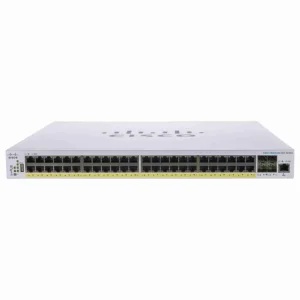
- Standard 1U rack height — efficient utilisation of valuable rack space in network cabinets and telecommunications closets, accommodating the full 24-port density in a single rack unit
- 19-inch rack mounting hardware included — deploy immediately in any standard equipment rack without sourcing additional mounting accessories
- Steel chassis construction — commercial-grade structural rigidity rated for 24/7/365 continuous operation under normal business environmental conditions
- Front-panel status LED array — per-port link activity, speed, and PoE status indicators providing at-a-glance operational visibility from the front of the rack without accessing the management interface
- IEC C14 power inlet — standard rack power connectivity compatible with rack-mount PDU power distribution units in professional equipment cabinets
- Structured cable management — port layout and chassis geometry designed for clean, organised structured cabling in rack environments
- Standard rack unit depth — compatible with shallow-depth network cabinets common in office telecommunications room installations
The rackmount form factor signals something beyond mere physical convenience — it represents the professional infrastructure discipline that distinguishes businesses that treat their network as a strategic asset from those that treat it as an afterthought. The C1300-24P-4G belongs in a rack because it was engineered to perform at the level that rack deployment implies.
Who Is the Cisco Catalyst C1300-24P-4G Built For?
The Switch That Fits the Ambitions of the Most Demanding SMB Deployments
Mid-Size Professional Services Firms Legal practices, architectural studios, engineering consultancies, and financial advisory firms with 15-25 staff members connect every workstation, VoIP handset, wireless access point, and shared device from a single switch — with MACsec encryption protecting client-confidential communications at the wire level and VLAN segmentation enforcing rigorous separation between client data systems and guest network access.
Healthcare and Allied Health Practices Multi-practitioner medical centres, specialist clinics, and allied health facilities connect clinical workstations, electronic health record terminals, medical imaging network interfaces, telehealth conferencing systems, nurse call infrastructure, and patient entertainment networks — with 802.1X ensuring only authorised clinical devices access patient data systems and VLAN isolation maintaining regulatory-compliant separation between clinical, administrative, and patient-facing network segments.
Financial Services and Professional Advisory Accounting firms, mortgage brokers, insurance agencies, and wealth management practices handling sensitive personal financial data deploy C1300-24P-4G infrastructure with MACsec link encryption and comprehensive ACL-enforced access controls — delivering a network security posture that satisfies both client trust requirements and relevant regulatory frameworks.
Technology Companies and Software Development Studios Fast-growing technology businesses and software development teams benefit from jumbo frame support optimising NAS and build server access performance, four SFP uplinks supporting dedicated server connectivity, QoS protecting real-time communication quality during heavy CI/CD pipeline traffic, and VLAN isolation separating development, testing, and production network environments.
Education — Secondary, Further, and Higher Education Secondary schools, sixth form colleges, and higher education institutions wire computer labs, administrative offices, staff rooms, and learning support areas — with time-based ACL policies enforcing examination period access controls, 802.1X authentication for managed device network access, VLAN separation between student and staff network environments, and PoE powering interactive display technology and wireless infrastructure throughout the estate.
Retail — Flagship Stores and Regional Operations Flagship retail locations and regional stores power and manage POS terminals, customer Wi-Fi access points, inventory management workstations, IP surveillance cameras, digital signage systems, and staff communications — with absolute VLAN isolation between customer-facing, payment processing, and back-office network segments supporting PCI-DSS compliance requirements for cardholder data protection.
Hospitality — Full-Service Hotels and Restaurants Full-service hotels, resort properties, and restaurant groups connect front desk property management systems, restaurant POS and payment terminals, back-of-house operations workstations, guest services VoIP, IP surveillance, staff communications, and multiple zones of guest-facing wireless infrastructure — with comprehensive VLAN architecture ensuring guest connectivity is completely isolated from payment and management systems.
Manufacturing and Industrial Operations Manufacturing facilities and industrial operations connect production floor management terminals, warehouse management system workstations, quality control stations, VoIP handsets, industrial IoT gateways, and IP surveillance infrastructure on a fully managed, VLAN-segmented network — with the operational visibility to monitor performance and troubleshoot connectivity issues remotely without disrupting production operations.
Government and Public Sector Local government offices, public sector agencies, and government-adjacent organisations meet stringent security, audit, and compliance requirements with MACsec encryption, 802.1X identity-based access control, ACL-enforced resource protection policies, SNMPv3 monitoring, comprehensive syslog audit trails, and encrypted management sessions that satisfy the most demanding public sector information security standards and frameworks.
Frequently Asked Questions About the Cisco Catalyst C1300-24P-4G
Q: How does the C1300-24P-4G compare to the CBS350-24P-4G it supersedes? The Catalyst C1300-24P-4G is the next-generation successor to the CBS350-24P-4G, carrying the enterprise-credentialed Cisco Catalyst brand and delivering three defining advances: MACsec IEEE 802.1AE hardware encryption not present in the CBS350 generation, an enhanced software platform with greater feature depth across security, multicast, and QoS implementations, and positioning on Cisco’s actively developed long-term Catalyst platform. For organisations prioritising security compliance, long-term platform investment value, and the most comprehensive SMB managed switch feature set available, the Catalyst 1300 is the unambiguous choice.
Q: What is the total PoE power budget and how is it managed across 24 ports? The C1300-24P-4G provides a 195W total PoE budget shared intelligently across all 24 downlink ports, each supporting up to 30W per IEEE 802.3at. The management interface provides per-port power allocation limit configuration, real-time consumption monitoring, and priority-based power management — ensuring critical devices maintain power during peak demand conditions while providing complete visibility into power budget utilisation across the entire switch.
Q: Can I use all four SFP uplinks simultaneously? Yes. All four dedicated SFP uplink ports operate independently and simultaneously — enabling complex uplink architectures combining LACP-bonded aggregates for high-bandwidth redundant core connectivity with independent uplinks to secondary infrastructure, dedicated server segments, or directly-connected security appliances concurrently.
Q: What SFP transceivers are compatible with the C1300-24P-4G uplink ports? The uplink ports accept standard 1G SFP transceivers including Cisco MGBSX1 (850nm multi-mode fiber, up to 550m), MGBLX1 (1310nm single-mode fiber, up to 10km), MGBT1 (copper RJ45, up to 100m), and other compatible 1G SFP modules. Cisco-branded transceivers are recommended for guaranteed compatibility, full warranty coverage, and complete LLDP media information reporting.
Q: Does the C1300-24P-4G require any ongoing software subscription or licensing fees? No. The complete Layer 2+ management feature set — including all VLAN, QoS, security, monitoring, and Cisco Business Dashboard integration capabilities — is fully included in the hardware purchase price with no ongoing subscription, licensing tier, or feature unlock fees required. Firmware updates are provided by Cisco at no additional charge throughout the product’s supported lifetime.
Q: How does MACsec encryption affect switch performance? MACsec has zero measurable performance impact on the C1300-24P-4G. Because encryption and decryption is implemented entirely in dedicated hardware ASIC — not software running on a general-purpose processor — MACsec operates at full line rate on every port simultaneously, with no latency addition, no throughput reduction, and no CPU utilisation penalty whatsoever.
Q: Is the C1300-24P-4G compatible with existing CBS350 deployments? Yes. The Catalyst 1300 implements the same industry-standard Layer 2 protocols as the CBS350 — including 802.1Q, RSTP, LACP, LLDP, 802.1X, and SNMP — ensuring complete protocol-level interoperability in mixed Catalyst 1300 and CBS350 network deployments. Both series are also managed cohesively through Cisco Business Dashboard within the same network topology.
Q: What warranty does Cisco provide on the Catalyst C1300-24P-4G? Cisco provides a Limited Lifetime Hardware Warranty — covering manufacturing defects under normal operating conditions for the operational lifetime of the product — supported through Cisco’s global partner, distributor, and technical support network with access to Cisco TAC for warranty-related technical assistance.
Q: Does the switch support DHCP server functionality for connected clients? The Catalyst 1300 supports DHCP relay agent functionality — forwarding DHCP requests from connected clients to an upstream DHCP server. For switches requiring integrated DHCP server functionality at the access layer, this is typically provided by an upstream router or dedicated DHCP server rather than the access switch itself.
The Bottom Line — Why the Cisco Catalyst C1300-24P-4G Is the Managed PoE Switch That Defines the Modern Small Business Network
The Cisco Catalyst C1300-24P-4G answers the question that every ambitious, security-conscious, growth-oriented small and medium business eventually arrives at: “What is the switch that gives us everything — the port density to connect our entire operation, the PoE power to energise every device, the management intelligence to control every network behaviour, the security architecture to protect every connection, and the platform credibility to trust as the foundation of our infrastructure for the next decade?”
The answer carries the Cisco Catalyst name. And it ships with 24 PoE+ ports, four SFP uplinks, MACsec hardware encryption, and a Limited Lifetime Warranty.
Every connected device served at full Gigabit speed. Every PoE device powered without a single additional power adapter. Every network behaviour under granular management control. Every data transmission cryptographically secured at the link level. Every administrator session encrypted end-to-end. Every network event visible in real time. Every Cisco device across your organisation manageable from a single unified platform.
This is not a switch for businesses that settle. It is a switch for businesses that lead.
- ✅ 24 x PoE+ Gigabit ports — connect and power your complete device ecosystem simultaneously
- ✅ 195W intelligent PoE budget — APs, cameras, VoIP, IoT, and access control all running concurrently
- ✅ 56 Gbps non-blocking switching fabric — wire-speed performance at full 24-port density
- ✅ 4 x dedicated 1G SFP uplinks — fiber, copper, LACP aggregation, or independent — your architecture
- ✅ MACsec IEEE 802.1AE hardware encryption — Catalyst-grade cryptographic link protection at line rate
- ✅ Full Layer 2+ managed platform — VLANs, QoS, ACLs, 802.1X, STP, SNMP, and beyond
- ✅ Up to 4,096 VLANs — enterprise-scale logical segmentation on a single access layer switch
- ✅ 16,000 entry MAC address table — supports the most device-dense SMB deployment environments
- ✅ Cisco Business Dashboard — free unified multi-device management, monitoring, and provisioning
- ✅ 1U rackmountable chassis — professional rack installation ready with included mounting hardware
- ✅ IPv4 and IPv6 dual-stack — complete next-generation network addressing readiness
- ✅ Cisco Limited Lifetime Warranty — the ultimate assurance on your network infrastructure investment
Order the Cisco Catalyst C1300-24P-4G today — and build your business network on the platform that means exactly what it says: enterprise capability, Catalyst reliability, and the Cisco commitment to your network’s performance, security, and longevity for every year of your business’s future.

 No products in the cart.
Reviews
There are no reviews yet.