
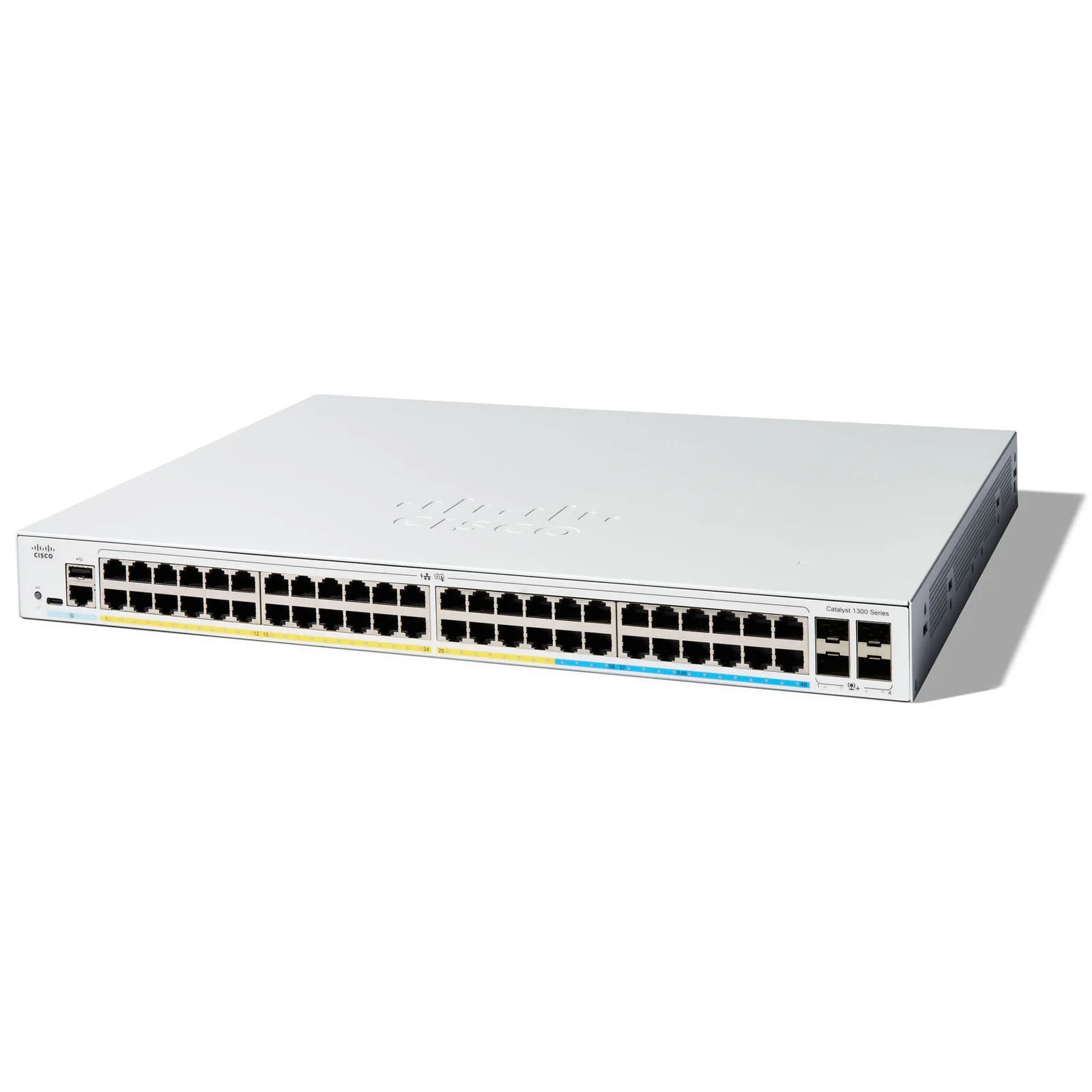
Cisco Catalyst C1300-48P-4G — 48-Port Gigabit PoE+ Managed Network Switch (370W) | The Full-Density Catalyst Platform Your Enterprise-Scale SMB Network Demands
The Switch That Powers an Entire Organisation — Every Port, Every Device, Every Application, Every Day
There is a category of network infrastructure decision that does not merely solve a connectivity problem — it defines the operational capability of an entire organisation for years to come. When your business reaches the scale where dozens of devices demand simultaneous Gigabit connectivity and Power over Ethernet, where network security must be demonstrably rigorous, where management complexity must remain genuinely accessible, and where the investment must be justified by performance that endures beyond the next technology refresh cycle — that decision demands the most capable, intelligent, and comprehensively featured switch in its class.
The Cisco Catalyst C1300-48P-4G is that switch.
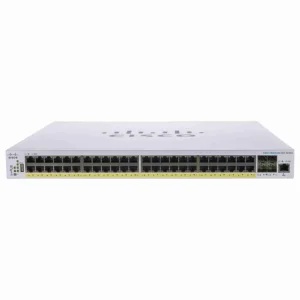
Forty-eight ports of full Gigabit PoE+ connectivity. A 370-watt power budget capable of energising an entire floor of powered devices simultaneously. Four dedicated 1G SFP uplinks providing flexible, high-speed gateway connections to your core network infrastructure. The complete Cisco Catalyst 1300 enterprise-derived management platform — including MACsec hardware encryption, comprehensive Layer 2+ intelligence, advanced security architecture, and the full depth of Cisco’s three-decade networking heritage — all delivered in a 1U rackmountable chassis that belongs at the heart of the most demanding small and medium business network environments in operation today.
Where the 24-port variants of the Catalyst 1300 serve individual departments, floors, or functional areas with precision, the C1300-48P-4G serves entire organisations — connecting and powering every workstation, every VoIP phone, every wireless access point, every IP camera, every IoT device, and every shared resource across a complete business operation from a single, intelligently managed, enterprise-calibre platform.
This is not the switch your business grows into. This is the switch your business grows with — and the switch that grows with your business in return.
Cisco Catalyst C1300-48P-4G — Complete Technical Specifications
The specifications of the Catalyst 1300-48P-4G represent the full expression of what the Catalyst 1300 platform achieves at maximum port density:
- 48 x 10/100/1000 Mbps PoE+ RJ45 Downlink Ports — IEEE 802.3at compliant, up to 30W per port
- 4 x 1G SFP Dedicated Uplink Ports — fiber or copper uplink flexibility via standard SFP transceivers
- Total PoE Power Budget: 370W — industry-leading high-density simultaneous device power delivery
- Switching Capacity: 104 Gbps — true non-blocking wire-speed architecture across all 52 ports
- Forwarding Rate: 77.38 Mpps — line-rate packet processing under maximum concurrent traffic density
- MAC Address Table: 16,000 entries — supports large, complex, highly device-dense environments
- Jumbo Frame Support: 9,000 bytes — optimised for NAS, iSCSI storage, and multimedia-intensive workflows
- VLAN Support: Up to 4,096 VLANs — enterprise-scale logical network segmentation capability
- Layer 2+ Managed — full VLANs, QoS, ACLs, STP/RSTP/MSTP, SNMP, 802.1X, and beyond
- MACsec Hardware Encryption — IEEE 802.1AE line-rate cryptographic link security across all ports
- Web-Based GUI Management — intuitive browser interface requiring zero command-line expertise
- SSH v2 & HTTPS Encrypted Management — every administrative session secured end-to-end
- IPv4 & IPv6 Dual-Stack Support — complete next-generation network addressing readiness
- LLDP & LLDP-MED — automatic device discovery, topology mapping, and VoIP endpoint configuration
- IEEE 802.3ad LACP Link Aggregation — bonded uplinks for redundancy and bandwidth multiplication
- Cisco Business Dashboard Compatible — free centralised multi-device management and monitoring
- 1U Rackmountable Form Factor — standard 19-inch rack deployment ready with included hardware
- Cisco Limited Lifetime Hardware Warranty — the gold standard of network hardware investment protection
Why 48 Ports? The Strategic Case for Full-Density Access Layer Switching
One Switch. One Rack Unit. One Complete Organisation Connected.
Port density is not a vanity specification — it is a fundamental architectural decision that determines how many physical switches your network requires, how many uplinks consume core switching capacity, how many management interfaces your IT team must administer, and ultimately how much your network infrastructure costs to deploy, operate, and scale over its entire operational lifetime.
The 48-port configuration of the Cisco Catalyst C1300-48P-4G is the density that transforms switching from a per-department consideration into an organisation-wide solution — and the operational, financial, and architectural advantages of consolidating 48 connections onto a single managed platform are profound:
Radical Infrastructure Simplification Where three 16-port switches might serve the same device count, the C1300-48P-4G replaces them with a single platform — eliminating two inter-switch uplinks that consume core switching capacity, reducing the switch count that requires individual management and firmware maintenance, shrinking the physical rack space consumed by access layer infrastructure, and creating a single point of policy enforcement where three previously existed.
Unified Policy Enforcement Security policies, VLAN architectures, QoS configurations, and access control rules defined once on the C1300-48P-4G apply consistently across all 48 connected endpoints simultaneously. There are no inter-switch policy gaps, no VLAN misconfiguration risks between trunk ports, and no inconsistent QoS implementations between separate managed devices. Every connected device experiences identical, centrally governed network behaviour — because they all connect to the same intelligent platform.
Superior Cost Efficiency at Scale A single Catalyst 1300-48P-4G typically represents significantly better cost-per-port economics than multiple smaller switches serving the same device count — particularly when the licensing, management overhead, rack space, power consumption, and inter-switch cabling costs of multiple smaller units are properly accounted for in the total cost of ownership calculation.
Investment Protection Through Scalability A business connecting 30 devices today and deploying a 48-port switch has 18 ports of immediate growth capacity — available without any additional infrastructure investment, without reconfiguration, and without network disruption when that growth materialises. In contrast, a business that deploys two 16-port switches to serve today’s 30 devices faces the cost and complexity of a third switch, an additional uplink, and extended management scope when device count crosses 32.
The C1300-48P-4G is not over-provisioned infrastructure. It is intelligently forward-provisioned infrastructure — the hallmark of network strategy that prioritises long-term operational efficiency over short-term capital minimisation.
48 Ports of Non-Blocking Gigabit Performance — Wire-Speed Connectivity for Every Connected Endpoint
Full Gigabit. All 48 Ports. Simultaneously. Without Exception.
The Cisco Catalyst C1300-48P-4G’s 104 Gbps non-blocking switching fabric delivers the mathematical guarantee that defines genuine enterprise-grade switching performance: every one of the 48 downlink ports plus all four SFP uplink ports can simultaneously transmit and receive at their full rated speed — at the same instant, under maximum concurrent load — without a single port waiting, queuing, or degrading due to internal switching fabric congestion.
At 77.38 million packets per second forwarding rate, the C1300-48P-4G processes network traffic at near-maximum theoretical line rate across its complete 52-port topology — ensuring that even the most demanding concurrent traffic scenarios involving high-frequency VoIP signalling, multicast video distribution, cloud application sessions, and bulk storage transfers are forwarded without processing delay, without packet loss, and without the latency spikes that congested switching fabrics impose on real-time sensitive applications.
What 104 Gbps Non-Blocking Means for Your Organisation in Practice
Consider the simultaneous demands placed on a fully-utilised 48-port switch in a real business environment during peak operational hours. Marketing is uploading campaign video assets to the NAS. Engineering is pulling design files from shared storage. Finance is running cloud ERP batch processes. Sales is conducting simultaneous video conference calls. The reception desk is managing VoIP calls on the queuing system. IT is pushing firmware updates to managed devices. Wireless access points on multiple ports are backhauling guest and staff Wi-Fi traffic.
In a switching fabric with inadequate capacity, these concurrent demands create internal congestion that manifests as the inexplicable network slowdowns that users report but that monitoring tools struggle to pinpoint — because the problem is not in any individual link but in the aggregate capacity of the switch’s internal forwarding engine.
The C1300-48P-4G’s non-blocking architecture eliminates this problem at the foundation level. Every port gets its full Gigabit. Every application gets its required bandwidth. Every user gets the network performance their productivity depends on — not sequentially, not at reduced speed under load, but simultaneously and continuously at full line rate.
370W PoE+ Power Budget — The Largest Power Budget in the Catalyst 1300 Access Series
Forty-Eight Ports of PoE Power. 370 Watts of Intelligent Delivery. Zero Compromise.
The 370-watt total PoE+ power budget of the Cisco Catalyst C1300-48P-4G is the specification that most dramatically transforms the economics and operational simplicity of deploying powered network devices at full 48-port density. It is the largest PoE power budget in the Catalyst 1300 access switch series — and its deployment impact is genuinely transformative for organisations building comprehensive PoE-dependent device ecosystems.
With IEEE 802.3at PoE+ delivering up to 30 watts per port across all 48 downlink ports simultaneously, the C1300-48P-4G becomes the single infrastructure component through which an entire organisation’s powered device ecosystem receives both data connectivity and electrical power — through a single Ethernet cable per device, without power adapters, without dedicated electrical circuits at device mounting locations, and without the installation complexity and cost that separate power infrastructure demands.
Understanding the 370W Budget — Capacity for Real-World High-Density Deployments
The 370W budget is engineered to serve the realistic power consumption profile of high-density mixed-device environments without artificial constraints on deployment architecture. Consider a representative full-deployment scenario across 48 ports:
- Ten Wi-Fi 6 access points at 16W each: 160W
- Sixteen VoIP IP desk phones at 6W each: 96W
- Twelve IP security cameras at 8W each: 96W
- Six door access controllers at 7W each: 42W
- Four digital signage players at 8W each: 32W
This comprehensive mixed deployment consumes a combined 426W — demonstrating that intelligent per-port priority management and realistic power consumption profiling are essential in high-density deployments. The Catalyst 1300’s sophisticated PoE management tools — including per-port power allocation limits, priority-based power governance, and real-time consumption monitoring — ensure critical devices always maintain power within the available budget. For organisations with lower average per-device consumption — as is typical in VoIP-heavy deployments where phones draw 5-7W — the 370W budget comfortably accommodates full simultaneous operation across a majority of the 48 ports.
The Complete PoE-Powered Device Ecosystem
Enterprise Wireless Infrastructure Power Wi-Fi 6 and Wi-Fi 6E access points from Cisco Business, Cisco Meraki, Ubiquiti UniFi, Aruba Instant, Ruckus, and any IEEE 802.3at compliant vendor across multiple wireless coverage zones — delivering simultaneous Gigabit data backhaul and clean PoE+ power from a single Ethernet cable per AP, with centralised power management and remote reboot capability from the switch management console.
Organisation-Wide VoIP Telephony Power an entire office floor’s VoIP telephony deployment simultaneously — SIP desk phones from Cisco IP Phone, Yealink, Poly, Grandstream, Fanvil, Snom, and Auerswald drawing 3-8W each, enabling comprehensive multi-department telephony infrastructure from a single switch while preserving substantial power headroom for concurrent wireless and surveillance devices.
Complete IP Surveillance Coverage Connect and power HD, 4K fixed, and PTZ IP cameras throughout your entire premises — entry points, car parks, server rooms, warehouses, retail floors, and common areas — without running dedicated power circuits to any camera mounting location, while enabling centralised surveillance power management and remote device reboot from the PoE interface.
Physical Access Control Infrastructure Power electronic door locks, card reader controllers, biometric fingerprint and facial recognition terminals, visitor management kiosks, intercom stations, and turnstile control units directly from PoE ports — simplifying building security installation across every access point in your premises and enabling centralised power management of your complete physical security estate.
Smart Building Automation and IoT Connect and power the expanding ecosystem of intelligent building management endpoints — occupancy and motion sensors, environmental quality monitors, smart HVAC controllers, digital clock systems, industrial IoT gateways, and building management system interface units — creating a unified, centrally managed powered device infrastructure across your entire facility.
Digital Signage and Interactive Kiosk Systems Drive compact media players, signage controller appliances, interactive kiosk computing units, and digital wayfinding displays from PoE ports throughout retail floors, corporate lobbies, hospitality venues, and educational facilities — enabling display deployment at any mounting location without dedicated power circuit installation requirements.
Catalyst 1300 PoE Intelligence at 48-Port Scale: The C1300-48P-4G’s management interface delivers real-time per-port PoE consumption monitoring across all 48 ports simultaneously, configurable per-port power allocation maximums, and intelligent priority-based power governance — ensuring that mission-critical devices including primary wireless access points, VoIP phones, and access control systems always maintain power during peak consumption conditions. Comprehensive power budget utilisation dashboards and historical consumption trend data transform PoE management from reactive troubleshooting into proactive capacity engineering.
4 x Dedicated 1G SFP Uplinks — Four High-Speed Pathways to Your Network Core
Flexible Uplink Architecture for Every Infrastructure Type
The four dedicated 1G SFP uplink ports of the C1300-48P-4G provide the connectivity pathways that carry aggregated traffic from 48 access layer connections to core switching, distribution infrastructure, WAN gateways, and server resources — with the transceiver flexibility to connect through fiber or copper to virtually any existing network infrastructure:
Multi-Mode Fiber Uplinks — In-Building 10G Readiness Install Cisco MGBSX1 or compatible OM3/OM4 multi-mode fiber SFP transceivers for clean Gigabit uplinks across building floors, between adjacent structures, or to fiber-backbone distribution switching at distances up to 550 metres — with complete immunity to electrical interference, ground potential differences, and surge damage that copper uplinks are vulnerable to in shared building electrical environments.
Single-Mode Fiber Uplinks — Campus and Long-Distance Connectivity For connectivity requirements spanning multiple buildings, campus environments, or connections over existing owned or leased fiber infrastructure — single-mode SFP transceivers including Cisco MGBLX1 support Gigabit uplinks at distances of 10 kilometres or beyond, enabling the C1300-48P-4G to serve as an access switch connected to a remote core network over long-haul fiber.
Copper SFP Uplinks — Structured Cabling Integration Install Cisco MGBT1 or compatible RJ45 SFP modules for copper uplink connections to distribution switches, router Ethernet interfaces, firewall uplink ports, or structured cabling patch panels within standard 100-metre copper distance — providing complete compatibility with copper-based network backbones in existing structured cabling environments.
LACP Link Aggregation — Doubled Bandwidth With Built-In Redundancy Combine any two SFP uplink ports using IEEE 802.3ad Link Aggregation Control Protocol to create a bonded logical uplink delivering 2 Gbps of aggregate upstream bandwidth with automatic seamless failover if either physical link experiences a fault — simultaneously increasing upstream throughput capacity and eliminating the uplink as a single point of failure in your access layer topology.
Dedicated Server and Storage Uplinks Utilise individual SFP ports as dedicated Gigabit uplink connections to network-attached storage arrays, application servers, or hypervisor hosts — delivering dedicated 1G bandwidth to high-demand infrastructure without consuming downlink ports or competing for shared uplink bandwidth with end-user device traffic.
Resilient Dual-Core Uplink Architecture Connect two SFP ports to a primary core distribution switch and two to a secondary distribution switch — with spanning tree managing primary/secondary path selection and providing automatic failover in the event of core switch failure — implementing dual-homed access layer resilience that eliminates the core switch as a single point of failure for your entire 48-port access layer.
MACsec Hardware Encryption — Enterprise Cryptographic Security Across 48 Ports at Line Rate
The Security Capability That Defines the Catalyst 1300 Generation — at Full 48-Port Density
The inclusion of IEEE 802.1AE MACsec hardware-accelerated encryption across all 48 ports and 4 SFP uplinks of the Cisco Catalyst C1300-48P-4G represents a security capability that fundamentally elevates the protection level achievable in small and medium business network infrastructure — bringing hardware-implemented cryptographic link security to a 48-port access layer platform for the first time at this price point.
MACsec at 48-Port Scale — Why This Changes Everything
In a 48-port deployment, the attack surface exposed by unencrypted Ethernet links is 48 times larger than in an 8-port deployment — and correspondingly more attractive as a target for sophisticated adversaries. Every Ethernet run from the switch to a connected endpoint traverses physical infrastructure — cable trays, ceiling voids, raised floors, wall conduits, and patch panels — that may be accessible to contractors, cleaning staff, visitors, or malicious actors in multi-tenant building environments.
Without MACsec, every one of those 48 cable runs transmits your organisation’s data in cleartext — readable to anyone who installs a passive network tap at any accessible point along any cable run. Business-critical communications, authentication credentials, financial transactions, client data, and strategic information all travel unencrypted across physical infrastructure that is rarely as physically secure as the server room from which it originates.
MACsec closes this attack surface across all 48 ports simultaneously — encrypting every Ethernet frame between the switch and every connected endpoint using AES-128 or AES-256 hardware-accelerated cryptography, operating at full Gigabit line rate on every port concurrently, with zero throughput reduction, zero latency addition, and zero CPU utilisation impact.
The Performance Guarantee That Makes 48-Port MACsec Practical
Because MACsec encryption and decryption is implemented entirely within the C1300-48P-4G’s dedicated hardware ASIC — operating independently of and in parallel with the forwarding engine — it scales to full 48-port simultaneous operation without any performance compromise. Whether one port or all 48 ports are running MACsec sessions simultaneously, the switch maintains its full 104 Gbps non-blocking switching capacity and 77.38 Mpps forwarding rate without degradation.
This is the hardware encryption guarantee that software-based alternatives cannot credibly make — and it is the reason that MACsec hardware implementation in switching silicon represents a qualitatively different security capability from software-layer encryption solutions.
Compliance Implications at 48-Port Deployment Scale
For organisations whose 48-port deployment serves environments subject to regulatory compliance frameworks — UK GDPR requiring appropriate technical security measures for personal data processing, PCI-DSS mandating encryption of cardholder data in transit across all network segments, HIPAA requiring protection of electronic protected health information over every network connection, ISO 27001 demanding demonstrable cryptographic controls for sensitive data transmission — MACsec across 48 ports provides the comprehensive, auditable, hardware-implemented cryptographic evidence that satisfies technical security control requirements across your entire access layer, not merely selected high-security ports.
Full Layer 2+ Managed Intelligence — Complete Network Orchestration at 48-Port Scale
Enterprise Management Depth. SMB Management Simplicity. 48-Port Deployment Scale.
The complete Cisco Catalyst 1300 Layer 2+ management platform delivers every managed feature with equal depth and accessibility at 48-port density as it does across smaller Catalyst 1300 models — because the management platform scales with the hardware, not against it. Every feature below is included fully in the hardware purchase price with no additional licensing, subscription, or software unlock costs:
VLAN Architecture — Logical Network Design Across 48 Physical Ports
With 4,096 VLAN support and a visual, guided web interface for VLAN creation and port assignment, the C1300-48P-4G transforms 48 physical access ports into a richly segmented logical network architecture serving multiple departments, user groups, and device types from a single physical platform:
- Departmental Data VLANs — dedicated segments for Finance, HR, Engineering, Sales, and Operations with inter-VLAN routing policies controlling cross-departmental data access at the network level
- Voice VLAN with Auto-Detection — automatic VoIP device identification and assignment to a priority VLAN across all 48 ports, ensuring consistent telephony quality organisation-wide without port-by-port manual configuration
- Multi-Zone Guest Wi-Fi VLANs — separate guest VLAN instances for different building areas — reception, conference rooms, staff cafeteria — each isolated from corporate resources and from each other
- IoT and Building Automation VLAN — contain smart building devices across all 48 potential IoT-connected ports in a restricted segment with controlled routing policies
- Multi-Zone Surveillance VLAN — dedicated bandwidth allocation for IP camera streams from cameras connected across multiple switch ports flowing to NVR storage infrastructure
- Server and Infrastructure VLAN — isolate shared resource access traffic from general user data flows across the 48-port fabric
- Management VLAN — completely segregate switch administration traffic from user data across all ports simultaneously
- 802.1Q Trunk Ports — carry complete VLAN sets across SFP uplink connections to distribution switching, routers, and wireless controllers
- Private VLAN (PVLAN) — port isolation within VLANs for security in shared-access deployment scenarios
- Voice VLAN Auto-Detection — automatic per-port recognition and VLAN assignment of VoIP endpoints without manual configuration across large deployments
Quality of Service — Guaranteed Application Performance Across 48 Simultaneous Connections
QoS becomes more critical — not less — as port density increases. With 48 devices potentially generating simultaneous traffic, the risk of latency-sensitive applications experiencing performance degradation from competing bandwidth demands is highest in dense access layer environments. The Catalyst 1300’s comprehensive QoS architecture addresses this directly:
- 8 Hardware Priority Queues Per Port — maximum traffic classification granularity applied consistently across all 48 access ports and 4 SFP uplinks simultaneously
- 802.1p Class of Service (CoS) — hardware-level traffic priority tagging and honouring across the complete 48-port switching fabric
- DSCP Differentiated Services — Layer 3 QoS marking support for integration with upstream routers, SD-WAN appliances, and cloud UCaaS platform traffic marking policies
- Strict Priority Queuing — absolute bandwidth and latency guarantee for real-time VoIP traffic across all 48 potentially VoIP-connected ports simultaneously
- Weighted Round Robin (WRR) — equitable bandwidth distribution preventing individual application classes from starving others in the 48-port traffic mix
- Auto-VoIP — automatic VoIP signalling and media detection and priority assignment across all 48 ports, simplifying telephony QoS configuration in large deployment environments
- Per-Port Ingress Rate Limiting — prevent individual devices from monopolising uplink bandwidth at the expense of other users across the 48-port population
- Egress Traffic Shaping — smooth traffic bursts from the 48-port aggregated output to protect WAN link quality and upstream device buffer performance
- QoS Trust Domains — configure which devices and ports are trusted to set their own priority markings versus receiving switch-assigned classification
Spanning Tree — Loop Prevention and Resilience at 48-Port Scale
- IEEE 802.1D STP — foundational loop protection for multi-switch topologies where 48-port access switches interconnect with distribution and core infrastructure
- IEEE 802.1w Rapid STP (RSTP) — sub-second topology reconvergence following uplink or inter-switch link failures — critical at 48-port density where convergence delay affects large user populations simultaneously
- IEEE 802.1s Multiple STP (MSTP) — per-VLAN spanning tree optimisation for complex multi-VLAN deployments across 48-port access infrastructure
- BPDU Guard on All Access Ports — automatic port shutdown on detection of unauthorised switch connections at any of the 48 access ports
- Root Guard — prevent rogue switches from assuming root bridge roles in topologies anchored by the C1300-48P-4G
- Loop Guard — supplementary indirect link failure protection across all port types
Link Aggregation — Bandwidth Multiplication Across SFP Uplinks
- IEEE 802.3ad LACP — dynamic bonding of SFP uplink ports for bandwidth multiplication and automatic failover resilience
- Up to 4 Gbps LACP Aggregate — bond all four 1G SFP uplinks into a single logical 4 Gbps connection with four-path failover redundancy
- Static LAG — manual aggregation for upstream devices without LACP support
- Flexible Load Balancing — configurable distribution algorithms for optimal traffic distribution across aggregated uplink members
Advanced Multicast Management at 48-Port Scale
- IGMP Snooping v1/v2/v3 — hardware-accelerated intelligent multicast forwarding exclusively to interested receiver ports across all 48 access connections — particularly valuable in 48-port deployments where unconstrained multicast flooding would consume substantial access port bandwidth
- MLD Snooping — IPv6 multicast management across all 48 ports in dual-stack environments
- Multicast VLAN Registration (MVR) — efficient multicast stream delivery across VLAN boundaries for IPTV and IP video distribution applications spanning the 48-port access topology
- Static Multicast Groups — manual multicast forwarding configuration for devices without IGMP support
Enterprise Security Architecture — Protecting 48 Simultaneous Connection Points
Defence in Depth Scaled to Full 48-Port Access Layer Density
The security challenge in a 48-port deployment is categorically more demanding than in an 8-port environment — because 48 ports represent 48 simultaneous potential entry points for unauthorised devices, 48 cable runs that could be physically tapped, and 48 connection opportunities that must each be individually governed by consistent security policy. The Cisco Catalyst C1300-48P-4G’s comprehensive security architecture addresses this challenge with hardware-enforced controls that scale uniformly across every port:
Identity-Based Access Control Across 48 Ports
- IEEE 802.1X Port-Based Authentication — authenticate every device at every one of the 48 ports before granting network access, using RADIUS-integrated centralised identity policy with dynamic VLAN assignment based on authenticated user or device identity
- Multi-Domain Authentication (MDA) — simultaneously authenticate VoIP phones and workstations on shared access ports across the 48-port population — automatically assigning each device type to its correct VLAN without manual per-port configuration for co-located phone and PC deployments
- MAC Authentication Bypass (MAB) — authenticate IoT devices, IP cameras, access controllers, and other non-802.1X capable devices across any of the 48 ports using hardware MAC address validation against a RADIUS-managed device database
- Guest VLAN Across All Ports — automatically redirect failed authentication devices organisation-wide to a restricted internet-only VLAN
Layer 2 Attack Prevention at Scale
- Dynamic ARP Inspection (DAI) — validate every ARP packet across all 48 ports against DHCP snooping bindings, preventing ARP spoofing attacks regardless of which port a malicious device connects to
- IP Source Guard (IPSG) — hardware-validate IP-to-MAC bindings at line rate across every access port, blocking IP spoofing attempts at the switch port before forged traffic reaches uplinks
- DHCP Snooping — trust designation and validation across all 48 access ports and SFP uplinks, preventing rogue DHCP servers from disrupting IP address assignment organisation-wide
- Port Security — configurable MAC learning limits, device-to-port binding, and violation response policies applied consistently across all 48 access ports
Comprehensive Access Control Lists
- IP ACLs — permit and deny traffic at Layer 3 and Layer 4 across the complete 48-port and 4-uplink port population at full hardware line rate
- MAC ACLs — hardware address-based access control for non-IP traffic across all access ports
- Time-Based ACLs — automated time-of-day access policy changes applied simultaneously across all relevant ports in the 48-port deployment
- VLAN ACLs (VACLs) — intra-VLAN security policy enforcement across all ports assigned to each VLAN
- IPv6 ACLs — comprehensive access control extending to IPv6 traffic in dual-stack deployments
Traffic Storm Control at High Port Density
- Broadcast Storm Control — hardware-rate-limiting of broadcast floods that at 48-port density could generate catastrophically large traffic volumes if unconstrained
- Multicast and Unknown Unicast Flood Control — preventing traffic storms that at 48-port scale would impact the entire organisation’s network performance simultaneously
- Hardware DoS Prevention — silicon-level protection against attack patterns targeting high-density access layer infrastructure
Encrypted and Role-Governed Management
- SSH v2 and HTTPS/TLS — end-to-end encrypted management access for every administrative session
- SNMPv3 — authenticated and privacy-encrypted SNMP monitoring
- Role-Based Access Control — granular permission profiles aligned with IT team roles and responsibilities
- Management ACLs — restrict management interface access to authorised administrative IP addresses
- Management VLAN Isolation — complete segregation of switch administration traffic from all user data across the 48-port fabric
Network Monitoring and Visibility — Total Operational Insight Across 48 Ports
Seeing Everything in a 48-Port Deployment — Because Scale Demands Superior Visibility
Network visibility becomes exponentially more important as port density increases — because the operational impact of a problem affecting a 48-port switch is proportionally larger than one affecting an 8-port device. The Catalyst 1300-48P-4G provides monitoring depth that matches the scale of its deployment impact:
Comprehensive Standards-Based Monitoring
- SNMP v1/v2c/v3 — full 48-port monitoring integration with PRTG, SolarWinds NPM, Zabbix, Nagios XI, LibreNMS, ManageEngine OpManager, and all standards-based network monitoring platforms, with per-port interface statistics, PoE consumption data, and error counters exposed via MIB
- RMON Groups 1, 2, 3, 9 — per-port traffic statistics, configurable history buffers, event triggers, and threshold alarms across all 48 access ports and 4 SFP uplinks
- sFlow — hardware-level traffic sampling for high-performance network analytics providing application-level visibility across the complete 48-port access population
Traffic Analysis and Diagnostics
- Port Mirroring (SPAN) — mirror traffic from individual ports, port ranges, or complete VLANs to a designated analysis port — enabling Wireshark packet capture, IDS/IPS sensor feeds, and network forensics across any subset of the 48-port population
- Cable Diagnostics (TDR) — remotely diagnose copper cable faults and measure lengths across all 48 access port cable runs from the management GUI, eliminating the need for physical cable testers or on-site visits to trace cable issues in dense deployments
Real-Time 48-Port Operational Data
- Per-Port Traffic Statistics — simultaneous granular real-time and historical data for all 48 access ports and 4 SFP uplinks — packets, bytes, errors, discards, CRC errors, and bandwidth utilisation graphs for every individual port
- 48-Port PoE Monitoring Dashboard — real-time per-port PoE consumption display across all 48 downlink ports simultaneously — showing current wattage per device, total budget utilisation, allocation limits, and power consumption history trends for comprehensive power estate management
- Interface Error Analytics — per-port physical layer error trending across the 48-port population identifying cable quality degradation and NIC issues proactively before connectivity failures occur
- Syslog at 48-Port Event Volume — real-time event streaming to external syslog servers providing complete audit trails for authentication events, link state changes, PoE events, and security anomalies across 48 simultaneous connection points
- LLDP and LLDP-MED — automatic topology discovery identifying the manufacturer, model, software version, and capabilities of devices connected across all 48 access ports — building a comprehensive connected device inventory for security audit and asset management purposes
Cisco Business Dashboard — Unified Management of 48-Port Scale Infrastructure
The Management Platform That Makes 48-Port Catalyst Infrastructure Operationally Accessible
The Cisco Catalyst C1300-48P-4G integrates fully with Cisco Business Dashboard — delivering centralised management capabilities that transform 48-port scale infrastructure from a complex management burden into a cohesively managed, centrally visible, proactively monitored network asset:
48-Port Topology Visualisation The Dashboard’s live network topology map presents the complete 48-port switch with real-time per-port link status, speed indicators, PoE consumption data, and connected device identification — providing at-a-glance operational visibility of the complete 48-port population without accessing the switch management interface directly.
Unified Multi-Switch and Multi-Site Management For organisations deploying multiple C1300-48P-4G switches — across multiple floors, buildings, or locations — the Dashboard provides a unified management view of every switch in the estate simultaneously, with site-based grouping, cross-site topology mapping, and estate-wide health status dashboards that scale from a single 48-port switch to dozens of managed Cisco devices across multiple locations.
48-Port Configuration Template Deployment Create standardised switch configurations — encapsulating VLAN architecture, QoS policies, security settings, PoE parameters, and management configuration appropriate for 48-port deployment environments — and deploy them simultaneously to multiple C1300-48P-4G units across your organisation, ensuring consistent network policy across every 48-port access switch in your infrastructure.
Proactive 48-Port Health Monitoring Configure alert policies for PoE budget threshold exceedances, individual port link failures, device unreachability, security authentication anomalies, and firmware version deviations — receiving immediate notifications that enable proactive response to issues affecting the 48-port population before they escalate to user-impacting outages across an entire floor or department.
Estate-Wide Firmware Management View firmware versions across every C1300-48P-4G and other managed Cisco device simultaneously, identify devices running outdated software, and execute coordinated bulk firmware updates across the complete switch estate — replacing time-consuming manual per-device update processes with a single, centrally orchestrated operation.
Zero-Touch Remote 48-Port Switch Provisioning Pre-configure C1300-48P-4G switches as Dashboard templates — including VLAN architecture, PoE settings, security policies, and uplink configurations — for zero-touch deployment at remote locations. Newly installed switches automatically retrieve and apply their complete configuration upon first network connection, enabling complex 48-port deployments without requiring on-site IT expertise or remote desktop sessions.
1U Rackmount Design — Professional Infrastructure for the Modern Network Closet
48 Ports. One Rack Unit. Complete Professional Infrastructure.
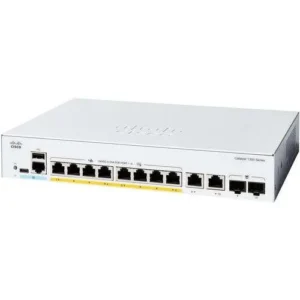
The 1U rackmountable chassis of the Cisco Catalyst C1300-48P-4G is the physical embodiment of exceptional port density engineering — delivering 48 full-speed PoE+ Gigabit access ports plus four SFP uplinks in a single standard rack unit that maximises the value of every centimetre of rack space in your telecommunications room:
- Standard 1U rack height — 48 ports of full-density access switching in the minimum possible rack footprint, preserving rack space for additional infrastructure layers in multi-tier deployments
- 19-inch rack mounting hardware included — deploy immediately in any standard equipment rack without sourcing additional mounting components or adapters
- Commercial-grade steel chassis — structural rigidity and thermal durability rated for 24/7/365 continuous operation under standard business environmental conditions
- Front-panel 48-port LED array — per-port link activity, speed, and PoE status indicators providing complete visual operational status across all 48 ports from the front of the rack without management interface access
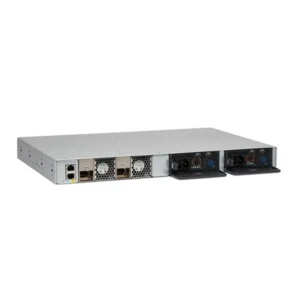
- IEC C14 power inlet — standard rack power connectivity compatible with rack-mount PDU power distribution units in professional equipment cabinets
- Optimised port layout — 48-port density arranged for clean, organised structured cabling with clear lane separation between port groups for professional cable management in dense deployments
- Forced-air ventilation design — efficient internal airflow management for thermal stability under maximum 48-port PoE load conditions in standard rack environments
For organisations managing network infrastructure at professional scale, the C1300-48P-4G’s 1U 48-port chassis signals something beyond physical convenience — it signals the infrastructure discipline that defines organisations that treat their network as a strategic asset, managed and maintained to the standards that business-critical infrastructure demands.
Ideal Deployment Scenarios — Where the C1300-48P-4G Delivers Its Full Organisational Impact
The Full-Density Catalyst Switch for Every Environment That Demands Complete Coverage
Medium-Sized Business Headquarters — Entire Floor Connectivity A 50-person professional services firm, technology company, or regional headquarters connects an entire open-plan floor from a single C1300-48P-4G — every workstation docking station, every VoIP desk phone, every wireless access point zone, every shared printer, and every networked peripheral simultaneously — with VLAN segmentation enforcing departmental data separation, MACsec protecting confidential client communications at every port, and QoS guaranteeing VoIP quality throughout the floor under any concurrent data traffic condition.
Corporate Campus — Multi-Department Wing Coverage Large SMB and mid-market organisations deploying multiple Catalyst 1300-48P-4G switches across different floors or building wings — managed cohesively through Cisco Business Dashboard with consistent policy templates, coordinated firmware management, and unified topology visualisation — create a standardised, intelligently managed access layer infrastructure that presents as a single managed network environment regardless of physical distribution.
Healthcare Facilities — Clinical Department Coverage Multi-practitioner hospitals, specialist clinics, and allied health facilities connect complete clinical departments — clinical workstations, EHR terminals, medical imaging workstations, telehealth conferencing systems, nurse call infrastructure, patient entertainment systems, and clinical IoT devices — from a single switch, with 802.1X ensuring only authorised clinical devices access patient data networks, MACsec protecting every patient data transmission at the link level, and VLAN isolation maintaining regulatory-compliant separation between clinical, administrative, and patient-facing network segments.
Education — School-Wide or Faculty-Wide Deployment Secondary schools, colleges, and universities deploying C1300-48P-4G switches in computer laboratories, teaching blocks, and administrative wings connect student devices, staff workstations, interactive display equipment, and wireless infrastructure simultaneously — with time-based ACL policies automating examination period access controls, 802.1X enforcing managed device authentication, and per-port PoE delivery powering interactive technology without dedicated power circuits at every installation point.
Retail — Large Format and Department Store Operations Large format retail stores, department stores, and shopping centre anchor tenants connect POS terminals, customer-facing Wi-Fi access points, inventory management systems, digital signage throughout the floor, IP surveillance covering every area, and staff communication devices — from one or multiple C1300-48P-4G switches — with strict VLAN isolation between payment processing, customer-facing, and back-office segments supporting PCI-DSS compliance, and PoE eliminating power infrastructure complexity at display and camera mounting locations throughout the retail environment.
Hospitality — Full-Service Hotels and Resort Properties Full-service hotels and resort properties connect front desk property management systems, restaurant POS terminals, conference facility AV systems, guest-facing wireless infrastructure across multiple zones, IP surveillance throughout public and back-of-house areas, staff communication devices, and building management system endpoints — with comprehensive VLAN architecture ensuring complete isolation between payment systems, guest networks, and management infrastructure, and PoE powering IP telephony, access control, and signage throughout the property.
Manufacturing and Industrial Facilities Production facilities and industrial operations connect management workstations, warehouse management terminals, quality control stations, production scheduling displays, VoIP communications, industrial IoT gateways, and comprehensive IP surveillance coverage — with managed VLAN segmentation separating operational technology from IT networks, and PoE eliminating separate power infrastructure for camera and communication devices distributed throughout the facility.
Government and Public Sector Offices Government agencies, local authority offices, and public sector bodies meeting demanding security, audit, and compliance requirements deploy C1300-48P-4G infrastructure with MACsec encryption across all 48 ports, 802.1X identity-based access control organisation-wide, comprehensive ACL-enforced resource protection, SNMPv3 monitoring for SIEM integration, and complete syslog audit trails satisfying the most demanding public sector information security frameworks and government security standards.
Managed Service Providers — Client Site Deployment Standard MSPs and IT infrastructure specialists standardising on Cisco Catalyst 1300-48P-4G hardware across enterprise client environments benefit from Cisco Business Dashboard multi-client management support, Catalyst brand credibility supporting client confidence, comprehensive 48-port monitoring integration with NMS platforms, and consistent configuration template deployment ensuring policy uniformity across every client site in the managed portfolio.
Frequently Asked Questions About the Cisco Catalyst C1300-48P-4G
Q: How does the C1300-48P-4G compare to the CBS350-48P-4G it supersedes in the Cisco portfolio? The Catalyst C1300-48P-4G is the definitive next-generation successor to the CBS350-48P-4G — delivering the same 48-port PoE+ density and 4x1G SFP uplink architecture on a fundamentally advanced platform. The critical advances are: MACsec IEEE 802.1AE hardware encryption not available in the CBS350 generation, delivering cryptographic link security across all 48 ports at line rate; an enhanced software platform with greater depth in security implementation, multicast management, and QoS capabilities; and positioning on Cisco’s actively developed Catalyst platform receiving long-term software investment. For organisations requiring the highest security standards, compliance-ready cryptographic controls, and the most future-proof access layer switching investment in the SMB market, the Catalyst 1300 is unambiguously the superior choice.
Q: How is the 370W PoE budget managed across 48 ports, and what happens if demand exceeds the budget? The 370W budget is managed intelligently through the switch’s PoE management interface, which provides per-port power allocation maximums, real-time consumption monitoring, and priority-based power governance. When total simultaneous device power demand approaches the 370W ceiling, the switch uses per-port priority settings to determine which ports maintain power — higher-priority ports (typically access points and VoIP phones) maintain power while lower-priority ports (such as IoT sensors or non-critical devices) gracefully reduce or suspend power delivery. Comprehensive power monitoring data allows network administrators to identify high-consumption devices and optimise budget allocation proactively.
Q: Can the four SFP uplinks all be used simultaneously in different configurations? Yes. All four SFP uplink ports operate simultaneously and independently, enabling flexible mixed uplink architectures — for example, a 2-port LACP aggregate for primary core switch connectivity paired with two independent uplinks to secondary distribution equipment and a dedicated NAS storage connection simultaneously. All four ports can alternatively be bonded into a single 4 Gbps LACP aggregate for maximum upstream bandwidth with four-path redundancy.
Q: Does MACsec encryption work across all 48 ports simultaneously? Yes. MACsec IEEE 802.1AE hardware encryption operates across all 48 access ports and 4 SFP uplinks simultaneously — because encryption and decryption is implemented in dedicated hardware ASIC that scales to full port density without any performance compromise. The switch maintains its full 104 Gbps non-blocking switching capacity and 77.38 Mpps forwarding rate with MACsec active on all 52 ports simultaneously — zero throughput reduction, zero latency addition, zero CPU impact.
Q: Is the C1300-48P-4G compatible with non-Cisco PoE devices and third-party network equipment? Absolutely. All 48 downlink ports implement IEEE 802.3at (PoE+) — the universal industry standard — ensuring complete compatibility with PoE-powered devices from any manufacturer. Standard Layer 2 protocols including 802.1Q, LACP, RSTP, LLDP, 802.1X, and SNMP ensure full interoperability with network equipment from any vendor in mixed-infrastructure environments.
Q: How does the C1300-48P-4G compare to the Cisco CBS350-48P-4G on switching capacity and forwarding rate? Both switches share identical 104 Gbps switching capacity and 77.38 Mpps forwarding rate at 48-port plus 4x1G SFP topology — confirming that the C1300-48P-4G delivers the same proven high-performance access layer switching engine as the CBS350-48P-4G, with the addition of MACsec hardware encryption, enhanced software platform depth, and Catalyst brand platform positioning as its defining generational advances.
Q: What ongoing software or licensing costs apply to the C1300-48P-4G? None. The complete Layer 2+ management feature set — including all VLAN, QoS, security, multicast, monitoring, and Cisco Business Dashboard integration capabilities — is fully included in the hardware purchase price with no ongoing subscription, licensing tier, or feature unlock fees. Cisco provides firmware updates at no additional charge throughout the product’s supported operational lifetime.
Q: What warranty does Cisco provide on the Catalyst C1300-48P-4G? Cisco provides a Limited Lifetime Hardware Warranty — covering manufacturing defects under normal operating conditions for the operational lifetime of the product — supported through Cisco’s global partner, distributor, and Technical Assistance Centre network with access to Cisco TAC for warranty-related technical assistance.
Q: Can multiple C1300-48P-4G switches be managed together through Cisco Business Dashboard? Yes. Any number of Catalyst 1300-48P-4G switches — across single or multiple physical locations — can be managed simultaneously through a single Cisco Business Dashboard instance, with unified topology visualisation, coordinated firmware management, configuration template deployment, and cross-switch health monitoring covering every managed switch and every port in the estate from a single operational interface.
The Bottom Line — Why the Cisco Catalyst C1300-48P-4G Is the Definitive Full-Density Managed PoE Switch for Organisations That Take Their Network Seriously
Every specification of the Cisco Catalyst C1300-48P-4G tells the same story — the story of a switch engineered without compromise for organisations that have outgrown half-measures and demand the full capability of enterprise-grade network infrastructure at the scale and investment level that ambitious SMB and mid-market organisations can confidently justify.
Forty-eight ports of non-blocking Gigabit performance that connect your entire organisation simultaneously without a single bottleneck. Three hundred and seventy watts of intelligent PoE+ power that energises every connected device without a single power adapter. Four SFP uplinks with the transceiver flexibility to connect to any network infrastructure — copper or fiber, short or long range, individual or LACP-aggregated. MACsec hardware encryption protecting every one of those 48 connections at full line rate with zero performance penalty. The complete Catalyst 1300 management platform making Layer 2+ intelligence, comprehensive security, and advanced monitoring accessible through an interface that requires no CLI expertise. And Cisco Business Dashboard providing unified management visibility and control across every Cisco device in your estate from a single, free, browser-based platform.
This is the switch that makes 48-port density feel manageable, 370W PoE feel organised, enterprise security feel accessible, and Cisco Catalyst performance feel attainable — because it was engineered to be all four, simultaneously, without compromise, backed by a Limited Lifetime Hardware Warranty from the organisation that has defined enterprise networking standards for thirty years.
- ✅ 48 x PoE+ Gigabit ports — connect and power your entire organisation from a single 1U switch
- ✅ 370W total PoE budget — the largest in the Catalyst 1300 access series for high-density deployments
- ✅ 104 Gbps non-blocking switching fabric — wire-speed performance across all 52 ports simultaneously
- ✅ 77.38 Mpps forwarding rate — near line-rate processing at maximum 48-port traffic density
- ✅ 4 x dedicated 1G SFP uplinks — fiber, copper, or LACP-aggregated to 4 Gbps with redundancy
- ✅ MACsec IEEE 802.1AE across all 48 ports — hardware encryption at line rate with zero performance cost
- ✅ Full Layer 2+ Catalyst management platform — VLANs, QoS, ACLs, 802.1X, MSTP, SNMP and beyond
- ✅ Up to 4,096 VLANs — enterprise-scale logical segmentation across the complete 48-port fabric
- ✅ 16,000 entry MAC address table — handles the most complex 48-port device-dense environments
- ✅ Cisco Business Dashboard — free unified multi-switch, multi-site management and monitoring
- ✅ 1U rackmount chassis — 48 ports in a single rack unit with included mounting hardware
- ✅ IPv4 and IPv6 dual-stack — complete next-generation network addressing readiness
- ✅ Cisco Limited Lifetime Warranty — the ultimate assurance on your most important infrastructure investment
Order the Cisco Catalyst C1300-48P-4G today — and deploy the full-density managed PoE switch that your organisation’s scale demands, your security requirements necessitate, your IT team will actually enjoy managing, and your business will rely on with complete confidence for every year of growth and ambition that lies ahead.

 No products in the cart.
Reviews
There are no reviews yet.