
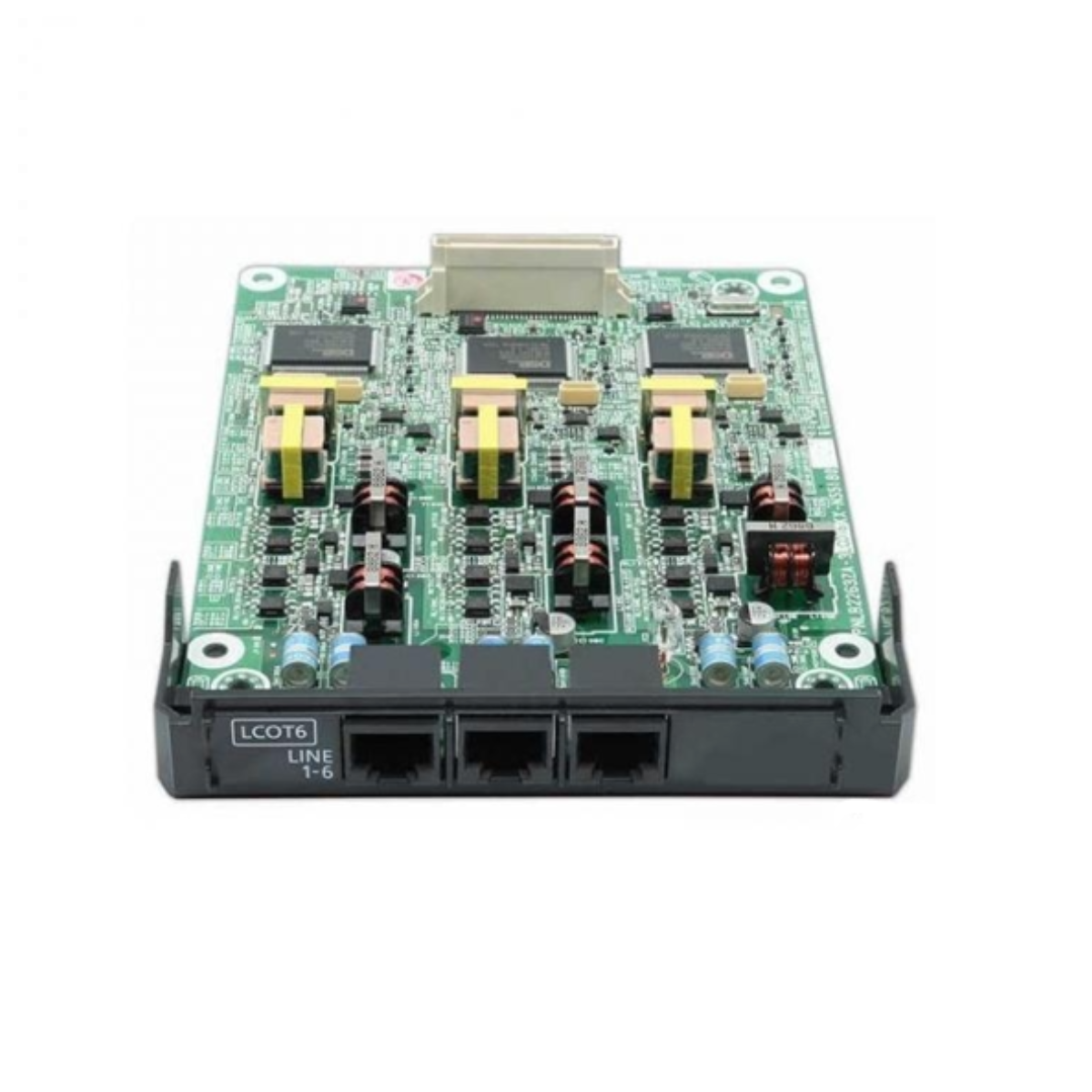
Panasonic KX-NS5170 — 4-Port Digital Hybrid Extension Card (DHLC4)
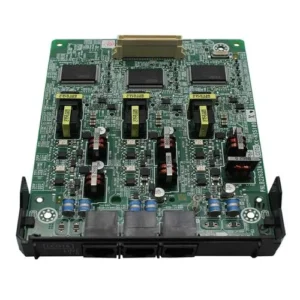
The Panasonic KX-NS5170 is a 4-port Digital Hybrid Extension Card, designated DHLC4, for the Panasonic KX-NS700 Smart Hybrid PBX system. It installs into an extension slot on the KX-NS700 base unit and adds four hybrid extension ports — each port independently accepting either a Panasonic Digital Proprietary Telephone (DPT), an Analogue Proprietary Telephone (APT), or a standard Single Line Telephone (SLT). All four ports include Caller ID via FSK. The card connects via two RJ45 sockets and also supports connection to PT-interface DECT base stations for wireless extension deployment.
The DHLC4 designation reflects the card’s core architecture: Digital Hybrid Line Card, 4 ports. Within the KX-NS700 extension card range, the KX-NS5170 is the only card that simultaneously supports digital proprietary handsets, analogue proprietary handsets, and standard analogue single-line devices across its ports — providing the widest per-port device compatibility of any extension card available for the platform.
Hybrid Port Architecture — DPT, APT, and SLT on the Same Card
Each of the four ports on the KX-NS5170 is independently configurable to accept one of the following device types:
DPT — Digital Proprietary Telephones — Panasonic digital desk phones from the KX-DT series (KX-DT300, KX-DT500, KX-DT600) and legacy KX-T7600 and KX-T7400 series connect to DHLC4 ports using a standard RJ45-to-RJ45 cable. Digital proprietary phones access the full KX-NS700 feature set — including LCD display of Caller ID and system status, programmable feature keys, Busy Lamp Field (BLF), DSS console support, voicemail key integration, and system-based call recording.
APT — Analogue Proprietary Telephones — Panasonic analogue proprietary phones, including the KX-T7700 series and KX-T7730/7731/7735/7736 range connect to DHLC4 ports. APTs access a substantial subset of the KX-NS700 feature set — call transfer, hold, system speed dial, and intercom — through their proprietary signalling interface, without requiring the system to be upgraded to full digital handsets. This makes the KX-NS5170 the transition card for organisations moving from older Panasonic analogue hybrid systems to the KX-NS700 while retaining existing APT handsets.
SLT — Single Line Telephones — Standard analogue single-line telephones, fax machines, modems, cordless analogue handsets (including the KX-TG3611BX also in this catalogue), and other RJ11-interfaced devices connect to DHLC4 ports. SLTs receive basic telephony — dial tone, incoming calls, hold recall, and intercom access — without requiring proprietary Panasonic handsets.
The ability to mix all three device types across a single four-port card is the KX-NS5170’s defining characteristic within the KX-NS700 extension card family. A single DHLC4 card can simultaneously serve a manager’s DPT, a conference room APT, a reception fax machine (SLT), and a wireless DECT base station (PT-interface CS) — without requiring separate digital-only and SLT cards to cover the same four positions.
Caller ID — FSK on All Ports
All four ports on the KX-NS5170 include Caller ID via FSK (Frequency Shift Keying). Incoming caller numbers received from the external trunk — whether via the LCOT6 analogue card (KX-NS5180X, also in this catalogue), SIP trunks processed via the DSP card (KX-NS5110X), or other trunk types — are passed through to the connected handset’s display on all DHLC4 ports.
FSK is the standard Caller ID delivery method used on the KX-NS700 platform and is compatible with all DPTs, APTs, and SLTs that support Caller ID display. The per-port Caller ID capability of the KX-NS5170 is consistent with the MCSLC8 and MCSLC16 SLT-only cards on the platform; digital-only cards (DLC8, DLC16) deliver Caller ID via digital signalling to DPT handsets directly.
PT-Interface CS — DECT Wireless Extension Support
Each RJ45 socket on the KX-NS5170 supports connection to a Panasonic PT-interface Cell Station (CS) — a DECT wireless base station. Connecting a CS to a DHLC4 port registers one or more wireless DECT handsets as extensions on the KX-NS700 system through the cell station, providing cordless coverage in areas of the building not served by wired extension cabling.
This IP DECT capability via the DHLC4 card is distinct from the IP DECT antenna connection on the KX-NS5110X DSP card. The DHLC4’s PT-interface CS connection uses the digital proprietary line interface — the same interface used by Panasonic DPT desk phones — to connect DECT base stations as digital extensions, without requiring IP infrastructure or VoIP DSP resource for the DECT connection itself.
Digital Voicemail Integration
The KX-NS5170 supports digital voicemail integration on its DPT-connected ports. Extensions using Panasonic digital proprietary phones can access the KX-NS700’s built-in voicemail system — recording and retrieving voicemail, accessing unified messaging features, and transferring calls directly to voicemail — via the voicemail key or feature key programming on the DPT handset. APT and SLT ports access voicemail via standard extension dial-up.
DSS Console Support
DHLC4 ports support the connection of Panasonic DSS (Direct Station Selection) consoles — add-on key panels that expand the number of programmable BLF/DSS keys available to an operator position. DSS consoles connect to the same port as the associated DPT handset via a passthrough connection, providing reception operators and attendants with a full Busy Lamp Field display of all extensions in the system without a second port being consumed.
Software Version Requirement
The KX-NS5170 requires LPR (Local Programming) software version 2.0 or later on the KX-NS700 base unit. This requirement also applies to the DLC8 (KX-NS5171) and DLC16 (KX-NS5172) digital extension cards. Systems running LPR software versions earlier than 2.0 must be updated before the DHLC4 card is installed and activated. Dealers and integrators should verify the system’s LPR version before specifying the KX-NS5170 for a KX-NS700 installation.
KX-NS700 Extension Card Landscape
The KX-NS5170 occupies a specific position within the KX-NS700 extension card range. Understanding how it compares with the other available extension cards is essential for correct specification:
| Card | Designation | Ports | Device Support |
|---|---|---|---|
| KX-NS5170 | DHLC4 | 4 | DPTs + APTs + SLTs + PT-interface CS |
| KX-NS5171 | DLC8 | 8 | DPTs + PT-interface CS only |
| KX-NS5172 | DLC16 | 16 | DPTs + PT-interface CS only |
| KX-NS5173 | MCSLC8 | 8 | SLTs only |
| KX-NS5174 | MCSLC16 | 16 | SLTs only |
The KX-NS5170 is the only card that supports all three handset types — DPT, APT, and SLT — within a single card. However, it provides only 4 ports per card, compared to 8 or 16 ports on the digital-only or SLT-only variants. Selecting the correct card requires matching the port count requirement to the device mix to be connected.
The DHLC4 is the appropriate choice when:
- A deployment includes a mix of DPT, APT, and SLT devices that cannot be cleanly separated onto device-type-specific cards
- An organisation is migrating from a legacy Panasonic APT system and needs to temporarily co-host APT and new DPT handsets on the same card
- A position requires DECT wireless coverage via PT-interface CS alongside wired DPT or SLT extensions
- The total per-card extension count is four or fewer, making the lower port count of the DHLC4 appropriate to the deployment scale
Compatible Systems
The KX-NS5170 is compatible with:
- Panasonic KX-NS700 — Primary compatible system (LPR software version 2.0 or later required)
- Panasonic KX-NS720 — KX-NS700 expansion cabinet
It is not compatible with the KX-NS500/NS520, KX-TDA, KX-TDE, or legacy KX-TA/KX-TES series platforms, which use different extension card formats.
Ideal Users
- KX-NS700 Dealers Deploying Mixed DPT/APT/SLT Environments — The DHLC4 is the only KX-NS700 extension card that supports all three Panasonic handset types on a single card. Installations with a mixed device requirement — a combination of digital proprietary phones at primary positions, retained analogue proprietary phones at secondary positions, and SLT devices for fax or shared-use extensions — use the KX-NS5170 to serve these positions from a single card without requiring separate DPT and SLT cards for a small number of ports.
- Organisations Migrating from Legacy Panasonic APT Systems to KX-NS700 — Businesses upgrading from a KX-TA824 or KX-TES824 with Panasonic APT handsets to the KX-NS700 can retain their existing APT phones on DHLC4 ports during the transition, deferring the cost of full digital handset replacement until the organisation is ready. The DHLC4 allows new DPT handsets to be deployed at priority positions while APTs remain in service at others on the same card.
- Small KX-NS700 Deployments with Four or Fewer Extensions Requiring Digital Features — For a KX-NS700 installation serving a small team where all extensions require full digital handset features — DPT display, BLF, voicemail key integration, programmable keys — but the total extension count is four or fewer, the DHLC4 provides the digital hybrid port capability without over-specifying to an 8- or 16-port digital card.
- Installations Requiring DECT Wireless Alongside Wired Extensions — The DHLC4’s PT-interface CS support allows DECT base stations to be connected to the same card as wired desk phone extensions, consolidating wired and wireless extension connectivity through a single card slot rather than requiring a separate card or IP infrastructure for DECT deployment.
- Reception and Attendant Positions with DSS Console — Operator positions using a Panasonic DPT with a DSS console require a digital proprietary port — the DHLC4 provides this at a position where other devices on the same card may be APTs or SLTs, without requiring a separate digital-only card to serve the operator port.
Card Specifications
| Attribute | Detail |
|---|---|
| Model | KX-NS5170 |
| Card Designation | DHLC4 (Digital Hybrid Line Card, 4 ports) |
| Compatible System | Panasonic KX-NS700 / KX-NS720 |
| LPR Software Requirement | Version 2.0 or later |
| Extension Ports | 4 hybrid ports |
| Connector | 2 × RJ45 sockets (2 ports per socket) |
Supported Device Types (Per Port)
| Device Type | Supported |
|---|---|
| DPT — Digital Proprietary Telephones (KX-DT / KX-T7600 / KX-T7400 series) | Yes |
| APT — Analogue Proprietary Telephones (KX-T7700 / KX-T7730 series) | Yes |
| SLT — Standard Analogue Single-Line Telephones | Yes |
| DSS Consoles | Yes — via DPT port passthrough |
| PT-Interface Cell Stations (DECT wireless) | Yes — 1 per RJ45 socket |
Features
| Feature | Detail |
|---|---|
| Caller ID | FSK — all 4 ports |
| Digital Voicemail Integration | Yes — DPT ports; SLT/APT via standard dial-up |
| DECT Wireless Support | Yes — PT-interface CS via RJ45 sockets |
| DSS Console Support | Yes |
KX-NS700 Extension Card Comparison
| Card | Ports | DPT | APT | SLT | DECT CS |
|---|---|---|---|---|---|
| KX-NS5170 (DHLC4) | 4 | ✓ | ✓ | ✓ | ✓ |
| KX-NS5171 (DLC8) | 8 | ✓ | — | — | ✓ |
| KX-NS5172 (DLC16) | 16 | ✓ | — | — | ✓ |
| KX-NS5173 (MCSLC8) | 8 | — | — | ✓ | — |
| KX-NS5174 (MCSLC16) | 16 | — | — | ✓ | — |
 No products in the cart.
Reviews
There are no reviews yet.