
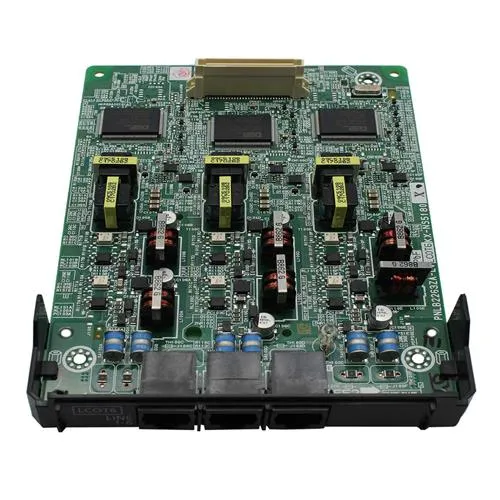
Panasonic KX-NS5180X — 6-Port Analogue Trunk Card (LCOT6)
The Panasonic KX-NS5180X is a 6-port analogue CO line trunk card for the Panasonic KX-NS700 and KX-NS720 Smart Hybrid PBX systems. It is classified as an LCOT6 card — Loop Current Operated Trunk, 6 ports — providing six standard analogue PSTN line connections to the host PBX. Each card adds six external analogue lines to the system’s trunk capacity, allowing the KX-NS700 to handle additional simultaneous external calls and expanding the total analogue CO line count available for inbound and outbound call routing.
The KX-NS5180X is the analogue trunk expansion component for organisations that continue to rely on PSTN analogue lines alongside or instead of SIP/IP trunking — whether as the primary external connectivity method, as a continuity measure during SIP migration, or for specific use cases such as fax lines, alarm lines, and EFTPOS terminal connections that remain on analogue infrastructure.
LCOT6 Trunk Ports
Each KX-NS5180X card provides six analogue loop-start CO trunk ports. These ports connect to standard PSTN analogue telephone lines supplied by the telephone service provider — the same analogue loop-start lines used for standard business landlines. The six ports on a single card represent six simultaneous external calls that can be in progress concurrently across inbound and outbound traffic.
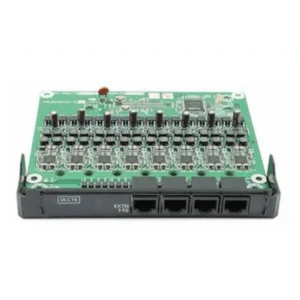
The card connects to the PSTN via three RJ45 sockets, each carrying two analogue line pairs — accommodating the six trunk connections through a compact connector arrangement suited to standard structured cabling infrastructure.
System Capacity Planning
On the KX-NS700 and KX-NS720, a maximum of two KX-NS5180X cards can be installed per system, providing up to 12 additional analogue CO lines per unit. The KX-NS700’s maximum analogue trunk capacity across all cards and the base unit’s onboard trunk ports is 48 lines — achievable through a combination of KX-NS5180X cards and the system’s other trunk card options.
The practical capacity planning for analogue trunk cards should be based on peak concurrent external call volume — the number of simultaneous inbound and outbound calls the organisation handles at its busiest periods — rather than total line count alone. Over-provisioning analogue lines adds recurring line rental cost; under-provisioning results in callers receiving busy signals during peak periods.
Caller ID — FSK and DTMF
The KX-NS5180X supports Caller ID on all six analogue trunk ports, compatible with both FSK (Frequency Shift Keying) and DTMF (Dual-Tone Multi-Frequency) Caller ID delivery formats. This dual-standard support ensures incoming caller number display functions correctly regardless of which Caller ID standard the telephone service provider uses on the connected lines — FSK being the most common delivery standard for Type 1 (between-ring) Caller ID on PSTN lines in East Africa and internationally.
Caller ID data received on the trunk ports is displayed on connected Panasonic proprietary telephones and single-line telephones with Caller ID capability, logged in the system’s call records, and available for incoming call routing rules configured in the system programming.
Reverse Polarity Detection
The KX-NS5180X includes built-in reverse polarity detection on all trunk ports. Telephone service providers use reverse polarity signalling on analogue lines to indicate call answer and call disconnect events to connected equipment. The card’s ability to detect polarity reversal enables the PBX to:
- Accurately detect when an outgoing call is answered by the remote party — starting call duration timing from the point of answer rather than the point of dialling
- Detect call disconnect from the network side, releasing the trunk promptly when the remote party hangs up rather than waiting for a timeout
- Support call accounting features that rely on accurate call duration data for billing and analysis purposes
Reverse polarity signalling is used by service providers in the majority of analogue line deployments in Kenya and East Africa. The built-in detection capability eliminates the need for external detection hardware or line monitoring equipment.
Damaged Line Detection
The card includes built-in diagnostic capability for detecting faults on connected analogue lines. Damaged line detection identifies line conditions — such as loss of loop current, excessive noise, or signalling anomalies — that indicate a fault on the PSTN connection between the PBX and the service provider. This allows the system to flag individual faulty trunk ports for attention rather than allowing calls to be routed to non-functional lines, which would result in failed calls reported as system faults by users rather than being correctly identified as line faults.
Power Failure Transfer (PFT) — 2 Emergency Ports
The KX-NS5180X includes two Power Failure Transfer (PFT) ports. In the event of a complete mains power failure — where the PBX system loses power and cannot operate — the PFT circuit automatically bridges two of the card’s analogue CO lines directly to two designated analogue telephone extensions, bypassing the PBX entirely.
This bypass connection allows basic incoming and outgoing calls to continue on those two lines using standard analogue handsets connected to the PFT extension ports, without the PBX being operational. The PFT function operates passively without requiring power — the CO line voltage alone sustains the bridged connection during the outage.
PFT is a critical resilience feature for essential call positions — reception desks, security points, and emergency contact extensions — that must maintain external telephone access regardless of building power status. The two PFT ports on the KX-NS5180X are in addition to any PFT capability built into the KX-NS700 base unit.
Role in the KX-NS700 Mixed-Trunk Architecture
The KX-NS700 is a Smart Hybrid PBX — designed to support simultaneous analogue PSTN trunks, SIP/IP trunks, and ISDN connections within the same system. The KX-NS5180X provides the analogue trunk layer within this hybrid architecture.
Organisations typically install the KX-NS5180X in the following deployment scenarios on the KX-NS700:
Retained PSTN lines alongside SIP trunking — During migration from PSTN to SIP, organisations often retain analogue lines for specific purposes (fax, alarm lines, EFTPOS) while moving voice calls to SIP. The KX-NS5180X provides the PSTN connection layer for retained analogue lines while the KX-NS5110X DSP card (also in the catalogue) handles the SIP/VoIP processing.
PSTN-primary with SIP as backup — Some organisations maintain analogue PSTN as the primary trunk and use SIP trunks as overflow or backup. The KX-NS5180X provides the primary analogue trunk capacity in this configuration.
Dedicated fax and alarm line connections — Fax machines, fire alarm diallers, lift emergency phones, and EFTPOS terminals typically require dedicated analogue lines that must not be shared with voice traffic. The KX-NS5180X’s individual port-level connection to analogue lines makes it appropriate for these dedicated-line applications.
Compatible Systems
The KX-NS5180X is compatible with the following Panasonic PBX platforms:
- Panasonic KX-NS700 — Primary compatible system (maximum 2 cards per unit)
- Panasonic KX-NS720 — KX-NS700 expansion unit (maximum 2 cards per unit)
- Panasonic KX-NS500 — Compatible
- Panasonic KX-NS520 — Compatible (NS500 expansion unit)
It is not compatible with KX-TDA, KX-TDE, or legacy KX-TA/KX-TES series systems, which use different trunk card formats.
Ideal Users
- IT and Telecoms Managers Retaining Analogue Lines on KX-NS700 Deployments — Organisations deploying the KX-NS700 that maintain PSTN analogue lines — either as the primary external connectivity or for specific use cases alongside SIP — require the KX-NS5180X to connect those lines to the system. The card provides the PSTN interface layer without requiring any external gateway or adapter hardware.
- Businesses with Dedicated Analogue Device Lines — Fax machines, fire alarm panels, lift emergency phones, security system diallers, and EFTPOS payment terminals typically require dedicated analogue lines. The KX-NS5180X’s individual port connections allow these devices to be assigned dedicated analogue lines through the PBX without consuming SIP trunk capacity or requiring separate analogue telephone adaptors.
- Organisations in SIP Migration with PSTN Continuity Requirements — The two PFT emergency ports on the KX-NS5180X provide analogue call continuity during power failures — critical for businesses that cannot accept complete loss of external telephone access during power outages. For organisations moving to SIP trunking, retaining an LCOT6 card with PFT provides an analogue fallback that SIP-only deployments cannot replicate without UPS or generator support for the IP infrastructure.
- Panasonic KX-NS700 Dealers and System Integrators — The KX-NS5180X is a standard trunk expansion card for KX-NS700 system builds that include analogue PSTN lines. Integrators specifying KX-NS700 systems should include the appropriate number of LCOT6 cards based on the client’s analogue line count — one card per 6 analogue trunks, up to a maximum of two cards per NS700 or NS720 unit.
- Businesses Requiring Accurate Call Accounting — The built-in reverse polarity detection enables accurate call duration measurement from answer to disconnect — a requirement for call accounting systems that bill by call duration, monitor staff telephony usage, or analyse call centre performance metrics. Without polarity detection, call duration data is based on dialling-to-disconnect rather than answer-to-disconnect, systematically overstating call duration in accounting reports.
Card Specifications
| Attribute | Detail |
|---|---|
| Model | KX-NS5180X |
| Card Type | 6-Port Analogue CO Trunk Card (LCOT6) |
| Trunk Ports | 6 × Analogue loop-start CO line |
| Connector | 3 × RJ45 sockets (2 lines per connector) |
| Maximum Cards per KX-NS700/NS720 | 2 |
| Maximum Analogue Lines (system total) | 48 |
Features
| Feature | Detail |
|---|---|
| Caller ID | FSK and DTMF — all 6 ports |
| Reverse Polarity Detection | Yes — built-in, all ports |
| Damaged Line Detection | Yes — built-in, all ports |
| Power Failure Transfer (PFT) | 2 emergency ports — operate without power |
| Trunk Type | Analogue PSTN (loop-start) |
| Digital/IP Trunks | Not supported — analogue only |
Compatible Systems
| System | Compatibility |
|---|---|
| Panasonic KX-NS700 | Compatible (max 2 cards) |
| Panasonic KX-NS720 | Compatible (max 2 cards) |
| Panasonic KX-NS500 | Compatible |
| Panasonic KX-NS520 | Compatible |
| KX-TDA / KX-TDE series | Not compatible |
| KX-TA / KX-TES series | Not compatible |

 No products in the cart.
Reviews
There are no reviews yet.