
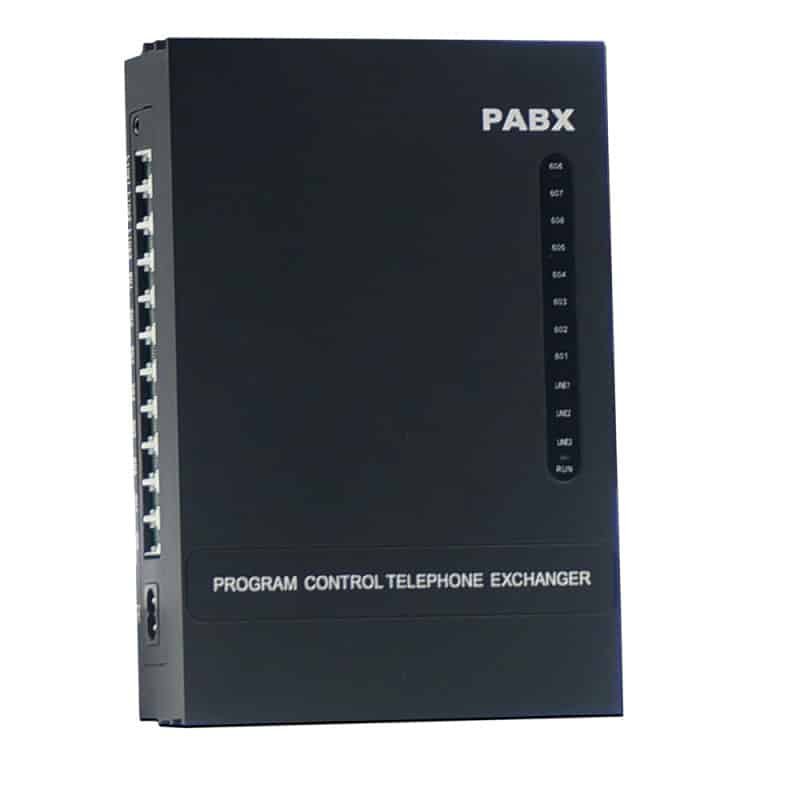
Panatron PXT 308 PABX — 3 CO Lines / 8 Extensions
The Panatron PXT 308 is a compact analogue Private Automatic Branch Exchange (PABX) system designed for small and medium-sized businesses requiring a reliable, feature-complete telephony infrastructure without the cost or complexity of a large enterprise PBX. In its standard configuration, the PXT 308 supports 3 external CO lines and 8 internal extensions, and is expandable to 4 CO lines and 16 extensions through the addition of optional expansion cards. Programming is performed using standard analogue handsets — no proprietary keyphone or PC is required for basic setup, reducing installation complexity and cost.
The PXT 308 is positioned at the entry level of the Panatron PABX range, sitting below the PXT 632 (6 CO lines, 32 extensions) and serving offices where the 3-line, 8-extension base capacity — or the expanded 4-line, 16-extension maximum — covers the full telephony requirement.
Capacity and Expansion
The PXT 308 ships in a 3 CO line / 8 extension base configuration. The underlying platform supports expansion to the following maximum:
| Configuration | CO Lines | Extensions |
|---|---|---|
| Base system | 3 | 8 |
| Maximum (with expansion cards) | 4 | 16 |
CO lines connect to standard PSTN analogue telephone lines from the service provider. Extension ports accept standard single-line analogue telephones — no proprietary handsets are required, allowing businesses to use existing handsets or any standard corded or cordless analogue phone. The 7-path simultaneous call capacity means up to 7 concurrent conversations can take place across CO and extension connections at any time.
Auto-Attendant and OGM
The PXT 308 includes a built-in Auto-Attendant with DISA (Direct Inward System Access) functionality. The auto-attendant answers incoming calls and presents a three-paragraph IVR greeting, directing callers to enter an extension number directly — bypassing the operator when the system is in auto-attendant mode. This reduces the call handling load on reception staff during peak periods and enables 24-hour automated call routing outside business hours.
The Outgoing Message (OGM) system provides recorded greeting messages for the auto-attendant. OGM duration is either 60 seconds or 90 seconds depending on configuration, with the option to download messages from a PC directly to the PBX memory (capacity up to 4MB). This PC-based OGM loading allows businesses to record professional-quality greetings on a computer and upload them to the system without requiring on-site recording through a handset.
The auto-attendant supports fast extension dialling while the OGM is playing — callers do not need to wait for the full message before entering their extension number. The system operates in either Auto mode (auto-attendant answers all calls) or Operator mode (calls ring to the operator extension first, with auto-attendant as fallback).
Caller ID
The PXT 308 supports Caller ID on external CO lines — displaying incoming caller numbers received from the telephone service provider on compatible handsets. Additionally, the system provides:
Transfer Caller ID — When a call is transferred from one extension to another, the original caller’s number is passed through to the receiving extension’s display, rather than showing only the transferring extension number. This allows the recipient to identify the external caller before answering a transferred call.
Intercom Caller ID — Internal calls between extensions display the calling extension’s number on the receiving handset, enabling extension-to-extension identification without answering.
These Caller ID features operate subject to connected handsets supporting Caller ID display and the external service provider delivering Caller ID data on the CO lines.
Call Routing and Management
The PXT 308 provides a comprehensive set of call routing and management features appropriate for small business telephony:
Intelligent Routing (LCR) — Least Cost Routing allows the system to be programmed to automatically select the most cost-effective CO line for outgoing calls based on dialled prefix rules — relevant in environments where multiple line types (standard PSTN, VoIP gateway) are connected.
Call Transfer — Internal and external call transfers between extensions.
Outgoing Call Transfer — Transfers outgoing calls to another extension or CO line.
Call Forwarding — Per-extension call forwarding to another extension or external number.
Call Pickup — Any extension can pick up a ringing call on another extension within the same pickup group.
Three-Way Conference — Three-party conference calls involving any combination of extensions and CO lines.
Call Duration Control — System-level or per-extension limits on call duration, relevant for controlling telephony costs on outgoing calls.
Call Restriction — Per-extension restrictions on outgoing call types (international, national, mobile) to manage telephone cost exposure.
Do Not Disturb (DND) — Per-extension setting to suppress incoming ring without disconnecting the call.
External Line Group — CO lines can be assigned to groups for routing control — specific extensions or departments can be restricted to specific CO lines.
Specific CO Line Dialling — Extensions can be programmed to dial out on a specific CO line rather than the next available line.
CO Line Booking / Reservation — A specific CO line can be reserved for a specific extension or call type.
CO Monitor — Monitoring of CO line status from authorised extensions.
Ring Assignment — Configurable ring patterns and assignments per extension and CO line.
Ringing Assignment — Customise which extensions ring for incoming calls on each CO line.
Extension Features
Extension Group — Extensions can be organised into groups for simultaneous ring, sequential ring, and call distribution.
Extension Dynamic Lock — Extensions can be dynamically locked to prevent outgoing calls without a PIN, useful for shared handsets or unattended positions.
Flexible Extension Number Assignment — Extension numbers can be assigned and reassigned freely within the system’s numbering plan without fixed slot-to-number mapping.
Flexible Coding — Extension numbers can be changed to match the organisation’s preferred numbering scheme.
Intercom — Direct internal calling between extensions.
Flash Time Choice — Selectable flash hook timing to match the PBX’s operation with the flash timing requirements of connected analogue handsets.
Automatic Extension Reporting — System-level reporting of extension activity.
Internal Music on Hold
The PXT 308 includes internal music-on-hold, played to callers placed on hold by any extension. This built-in music source eliminates the need for an external music input device at the entry level, while an external music source can be connected if a custom message or music track is preferred.
Power and Resilience
The PXT 308 is powered by a standard AC mains adapter. Two optional power resilience features are available:
Switched Power Supply (optional) — An alternative regulated switched-mode power supply for environments requiring more stable power input or where the standard transformer supply is insufficient.
Backup Battery Interface (optional) — An interface for connecting an external backup battery, maintaining system operation during mains power failures. When power fails, the system continues to function on battery backup.
Power Failure Transfer — In the event of a complete power failure (without battery backup), the system automatically connects designated CO lines to designated extension ports, ensuring basic incoming call reception continues on the failover handsets without the PBX being operational.
Memory Protect While Power Off — System programming, extension configuration, and speed dial entries are retained in non-volatile memory when power is removed, eliminating the need to reprogram the system after power interruptions.
Programming
The PXT 308 is programmed using any standard analogue telephone connected to the system — no proprietary keyphone, PC interface, or specialist programming handset is required for standard configuration. Remote programming is also supported, allowing authorised technicians to configure and modify the system over a telephone line without visiting the site.
A PC interface is used only for OGM message download to the PBX memory — standard system programming does not require a computer.
A system password protects programming access, preventing unauthorised changes to the system configuration.
Ideal Users
- Small Offices and SMEs (Up to 16 Staff) — The PXT 308’s 3-line, 8-extension base configuration covers the typical telephony requirement of a small office — a reception position, several staff desks, and a fax or dedicated data line. Expansion to 4 lines and 16 extensions accommodates growth without system replacement. No proprietary handsets are required, allowing businesses to use existing standard analogue phones.
- Retail Shops and Small Commercial Premises — A single-site retail operation with a service counter, back-office, and external line for customer calls is well served by the PXT 308. The auto-attendant handles calls when staff are engaged, and call restriction prevents unauthorised long-distance or international calls from staff positions.
- Panatron Telecommunications Dealers and Installers — The PXT 308 is the entry-level system in the Panatron PABX range, typically sold alongside Panatron handsets such as the PXT206. Programmed by standard phone without specialist tools, it reduces installation time and support overhead compared to systems requiring proprietary programming equipment.
- Home Offices and Residential SOHO Environments — For home-based businesses requiring separate incoming lines for voice and fax, internal intercom between rooms, and auto-attendant for professional call handling when the owner is unavailable, the PXT 308 provides a structured telephony solution at home-office scale.
- Businesses Replacing Legacy Key Systems — Small businesses running older key telephone systems with 3–8 lines can migrate to the PXT 308 using their existing analogue handsets, retaining familiar desk phones while gaining modern PABX features — auto-attendant, extension groups, call restriction, LCR, and Caller ID — that legacy key systems do not provide.
System Capacity
| Attribute | Detail |
|---|---|
| Model | PXT 308 |
| System Type | Analogue PABX |
| CO Lines (base) | 3 |
| CO Lines (maximum) | 4 |
| Extensions (base) | 8 |
| Extensions (maximum) | 16 |
| Simultaneous Call Paths | 7 |
Key Feature Summary
| Feature | Detail |
|---|---|
| Auto-Attendant / DISA | Yes — 3-paragraph IVR, 20-second greeting |
| OGM Duration | 60s or 90s (optional), up to 4MB PC-downloadable |
| External Line Caller ID | Yes |
| Transfer Caller ID | Yes |
| Intercom Caller ID | Yes |
| Call Transfer | Yes |
| Call Forwarding | Yes |
| Call Pickup | Yes |
| Three-Way Conference | Yes |
| Call Restriction | Yes |
| Do Not Disturb | Yes |
| Intelligent Routing (LCR) | Yes |
| Extension Groups | Yes |
| Extension Dynamic Lock | Yes |
| Internal Music on Hold | Yes — built-in |
| Remote Programming | Yes |
| Power Failure Transfer | Yes |
| Memory Protect (Power Off) | Yes |
| System Password | Yes |
| Flash Time Selection | Yes |
Power and Physical Specifications
| Attribute | Detail |
|---|---|
| Power Supply | AC mains adapter (standard) |
| Switch Power Supply | Optional |
| Backup Battery Interface | Optional |
| Operating Temperature | 0°C to 40°C |
| Operating Humidity | 20% to 80% non-condensing |
| Mounting | Desktop or wall-mount |
| Handset Compatibility | Standard analogue single-line telephones |
| Programming | Standard analogue handset or remote (no proprietary keyphone required) |
Reviews
There are no reviews yet.