
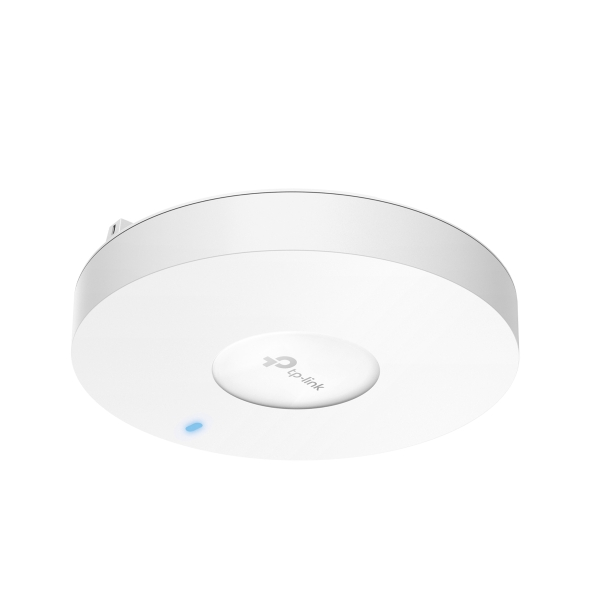
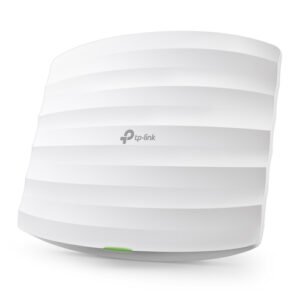
TP-Link BE9300 Ceiling Mount Tri-Band Wi-Fi 7 Access Point – Model No: TL-EAP773
The largest, most demanding enterprise networks — corporate headquarters, university campuses, hospital complexes — need a ceiling access point that doesn’t just handle today’s device density but genuinely leads the market on speed, spectrum, and backhaul capacity. The TP-Link EAP773 is exactly that: TP-Link’s flagship tri-band Wi-Fi 7 ceiling access point, opening up the clean, uncrowded 6 GHz band alongside a 10-Gigabit port that ensures the wired connection never becomes the bottleneck.
What Is the EAP773 and Why Does Tri-Band Wi-Fi 7 Matter?
The EAP773 delivers combined tri-band Wi-Fi 7 speeds of up to 9214 Mbps — 574 Mbps on 2.4 GHz, 2880 Mbps on 5 GHz, and 5760 Mbps on a genuinely clean 6 GHz band. That third band matters enormously in practice: 6 GHz carries far less legacy device traffic and interference than the crowded 2.4 GHz and 5 GHz bands, giving compatible Wi-Fi 7 (and Wi-Fi 6E) devices access to wider, cleaner channels with dramatically less contention.
320 MHz Channels: Doubling Available Bandwidth on 6 GHz
With the newly available 6 GHz band, the EAP773 supports channel widths up to 320 MHz — double the maximum channel width available on 5 GHz — enabling significantly more simultaneous high-speed transmissions than Wi-Fi 6 or 6E access points can achieve. That translates directly into faster real-world throughput for any compatible Wi-Fi 7 device connected to the 6 GHz band.
A 10-Gigabit Port That Actually Keeps Up
At tri-band Wi-Fi 7 speeds approaching 9.2 Gbps in aggregate, a standard Gigabit backhaul port becomes an obvious bottleneck. The EAP773’s dedicated 10-Gigabit Ethernet port ensures the wired connection back to your network core can genuinely support the access point’s full wireless capacity — critical infrastructure for organizations actually pushing the limits of what Wi-Fi 7 can deliver, rather than a marketing number that outstrips the hardware supporting it.
Multi-Link Operation and Multi-RUs for Genuine Low Latency
Multi-Link Operation lets compatible devices communicate across multiple bands and channels simultaneously, while Multi-RUs (Resource Units) make use of previously wasted channel spectrum — together delivering meaningfully lower latency and more reliable connections, directly benefiting real-time applications like video conferencing, VoIP, and cloud-based business applications that enterprise networks depend on daily.
4096-QAM for Higher Data Density
Wi-Fi 7’s 4096-QAM modulation (12 bits per signal, versus Wi-Fi 6’s 10-bit 1024-QAM) lets each wireless signal carry meaningfully more data — a genuine efficiency gain that helps the EAP773 meet the growing bandwidth demands of remote work, HD video conferencing, and cloud application traffic that modern enterprise networks handle constantly.
380+ Device Capacity Across Three Bands
Supporting 380+ concurrent connected clients across its three bands, with coverage rated up to 1,500 square feet, the EAP773 is built for genuinely large, device-dense enterprise environments — open-plan offices, university lecture halls, hospital wards — where lower-tier access points would show real congestion under full load.
Intelligent Power Management for Reliability
The EAP773’s intelligent power supply feature lets a PoE switch act as automatic backup power if the DC adapter is accidentally disconnected, and the access point continues operating under varying PoE power levels by adjusting its wireless functions — a genuine reliability safeguard for enterprise deployments where access point downtime has real business cost.
Full Enterprise Security and Guest Access
WPA3-Personal and WPA3-Enterprise encryption, RADIUS Accounting, MAC Authentication, up to 24 SSIDs (8 per band), and Rogue AP Detection provide comprehensive enterprise security. Captive Portal Authentication with SMS and voucher options, alongside a customizable marketing page, gives businesses genuine branded guest network capability.
Full Omada SDN Integration With AI Roaming
The EAP773 integrates with Omada Cloud-Based Controller, OC200/OC300 hardware controllers, or the Omada Software Controller, with Auto Channel Selection, Power Adjustment, Mesh support, and AI Roaming — centralized, intelligent network management appropriate for the scale of deployment this access point is built to serve.
Perfect For
- Corporate headquarters and university campuses needing genuine flagship Wi-Fi 7 performance
- Hospitals and large institutional networks with the highest device density requirements
- Organizations deploying Wi-Fi 7 client devices that can take advantage of the clean 6 GHz band
- Enterprises needing 10-Gigabit backhaul to match tri-band wireless capacity
- Large open-plan offices and lecture halls needing 380+ device capacity
- Businesses running latency-sensitive applications like video conferencing at scale
- Organizations building a multi-AP Omada SDN deployment requiring AI-driven roaming
- Hospitality businesses wanting branded, high-capacity guest Wi-Fi
- IT departments future-proofing infrastructure for the growing Wi-Fi 7 device ecosystem
- Any enterprise network where lower-tier access points have become a genuine capacity constraint
The Bottom Line
The largest, most demanding enterprise networks need a ceiling access point that leads on every axis — speed, spectrum, backhaul capacity, and device density — not just a faster label. The TP-Link EAP773 delivers genuine tri-band Wi-Fi 7 with a clean 6 GHz band, 320 MHz channels, a 10-Gigabit port, and 380+ device capacity, backed by intelligent power management and full Omada SDN integration — TP-Link’s flagship ceiling access point for organizations operating at genuine enterprise scale.
Reviews
There are no reviews yet.