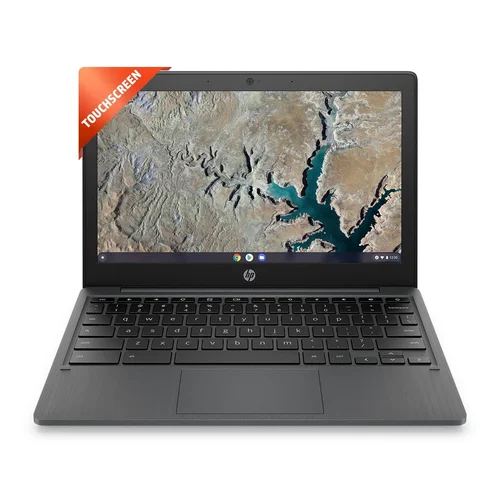
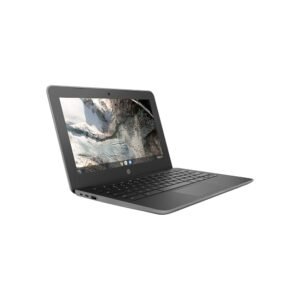
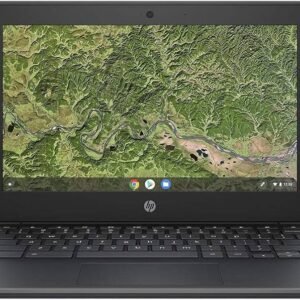
HP Chromebook 11 G5 EE — 11-Inch Education Chromebook with Touchscreen and Intel Celeron
The HP Chromebook 11 G5 EE is a compact, education-hardened Chromebook designed for managed institutional deployments. Built around an Intel Celeron processor and running ChromeOS, the 11 G5 EE operates as a cloud-dependent endpoint where web-based applications, Google Workspace tools, and centrally managed policies replace locally installed software. Its 11-inch touchscreen, 4GB of RAM, and 16GB of eMMC storage reflect a device architecture shaped by the ChromeOS platform’s requirements rather than those of a locally compute-dependent operating system.
As with the broader Chromebook 11 EE line, the “EE” designation — Education Edition — identifies specific physical reinforcements and fleet management capabilities intended for multi-user, high-turnover school environments.
Processor and ChromeOS Performance
The HP Chromebook 11 G5 EE is powered by an Intel Celeron N3350 or N3060 processor, depending on configuration. Both are dual-core chips from Intel’s Apollo Lake or Braswell platform, designed for low-power, entry-level computing. Within ChromeOS, the Celeron’s processing capacity is well-matched to the platform’s lightweight operating environment. ChromeOS demands substantially less from local hardware than Windows, allowing the Celeron to sustain smooth operation across Google Workspace applications, browser-based learning platforms, video conferencing, and web content rendering.
Intel HD Graphics 500 (N3350) or Intel HD Graphics 400 (N3060) are integrated into the processor. Consequently, the G5 EE handles standard classroom media tasks — video playback, Google Meet sessions, and web-rendered interactive content — without performance issues under typical single-user workloads. The Celeron platform is not designed for locally compute-intensive tasks, but within the intended ChromeOS application scope this constraint is rarely encountered in practice.
Memory
The Chromebook 11 G5 EE is equipped with 4GB of LPDDR4 RAM. Within ChromeOS, 4GB supports concurrent browser tab operation, Google Workspace application use, video streaming, and lightweight web-based tools simultaneously. ChromeOS applies aggressive memory management, reclaiming resources from inactive tabs and suspended processes more efficiently than Windows, making 4GB more operationally effective in this environment than the same capacity in a Windows deployment.
For education fleet deployments where students access a defined and consistent set of web-based platforms and learning tools, 4GB represents an appropriate and cost-controlled allocation. Furthermore, the absence of locally installed software overhead — antivirus, background update services, and resident application processes common in Windows environments — means available memory is directed toward active user tasks rather than system maintenance.
Storage
The 11 G5 EE includes 16GB of eMMC storage. This reflects ChromeOS’s cloud-first design: primary data storage is expected to reside in Google Drive or institutional cloud infrastructure, with local storage functioning as an OS host, offline content cache, and temporary file buffer.
16GB accommodates ChromeOS system files, locally cached Google Drive documents for offline access, and a limited number of Android application installations where Google Play is enabled. For institutions managing student data through Google Workspace for Education, the minimal local footprint keeps data centralised on managed infrastructure and simplifies device reset and redeployment between users or academic years.
As with the broader Chromebook category, eMMC storage delivers faster access speeds than mechanical hard disk drives, contributing to quick boot times and responsive application launching despite the modest capacity.
Touchscreen Display
The HP Chromebook 11 G5 EE features an 11.6-inch HD (1366 × 768) touchscreen display. Touch input supports stylus-style interaction, tap-based navigation within learning applications, and direct screen engagement with interactive educational content. The touch capability is particularly relevant for younger students transitioning from tablet-based learning environments to laptop form factors, as it preserves familiar interaction patterns alongside keyboard and trackpad use.
The anti-glare display coating manages reflections under classroom overhead lighting. At 11.6 inches and HD resolution, the display renders web content, documents, and video at sizes appropriate for student use across primary and secondary education contexts. The compact screen size additionally contributes to the device’s low weight and reduced footprint on shared classroom desks.
Education Edition Build and Durability
The EE designation on the Chromebook 11 G5 introduces physical reinforcements calibrated for student handling and shared deployment environments:
- Reinforced hinges — rated for repeated open-and-close cycles across multiple daily users and sessions
- Spill-resistant keyboard — tolerates incidental liquid exposure from drinks common in classroom settings
- Rubber bumper protection — absorbs impact along chassis edges during transport between classrooms and in backpacks
- Drop resistance — tested for drops consistent with student handling in education contexts
- MIL-STD-810G certification — validates resistance to shock, vibration, humidity, dust, and temperature variation
These reinforcements directly extend device lifespan across institutional procurement cycles, reducing per-unit replacement frequency and associated costs in large fleet deployments.
Connectivity and Ports
The HP Chromebook 11 G5 EE provides a practical port configuration for classroom and cart-based deployment:
- 2× USB-C — supports charging, data transfer, and display output; left and right-side placement enables flexible charging orientation in cart storage
- 2× USB-A (3.0) — connects USB peripherals, input devices, and storage accessories
- MicroSD card slot — provides local storage expansion for offline content and media
- 3.5mm audio combo jack — connects headphones and headsets for individual audio during lessons or assessments
- Nano security lock slot — physical restraint for cart storage and shared desk environments
Wireless connectivity includes Wi-Fi 5 (802.11ac) and Bluetooth 4.2. Dual-band Wi-Fi supports network segmentation across 2.4GHz and 5GHz bands, allowing administrators to manage bandwidth allocation across high-density classroom environments with 20–30 simultaneously connected devices.
ChromeOS and Fleet Management
ChromeOS shapes the operational profile of the 11 G5 EE more fundamentally than any individual hardware specification. For institutional IT teams, the platform’s management capabilities are the primary procurement consideration:
- Google Admin Console — centralised policy enforcement, application deployment, user management, and device monitoring across all enrolled devices without per-unit configuration
- Automatic background updates — ChromeOS updates silently without user intervention, removing patch management from IT team workloads
- Auto-enrolment — devices enrol automatically into institutional management on first boot when pre-provisioned, minimising per-device IT setup time
- Managed Guest Session — provides isolated, data-free sessions for shared device deployments, supporting classroom cart pooling with no residual data between users
- Zero-touch provisioning — enables large-scale deployment without manual IT touchpoints per device
- User profile roaming — students access their personalised environment from any managed Chromebook, supporting flexible device assignment
These capabilities reduce per-device IT management overhead substantially compared to Windows-based education deployments, particularly at fleet scales above 50 devices.
Battery and Charging
The HP Chromebook 11 G5 EE delivers up to approximately 10 hours of battery life under mixed-use conditions. This runtime covers a full school day of continuous classroom use without mid-day charging. Dual USB-C charging port placement on both sides of the device simplifies cable management in classroom charging carts where devices are stored in varied orientations.
The Intel Celeron processor’s low thermal output keeps the device cool during sustained use and contributes to stable battery performance across back-to-back user sessions. In shared deployment environments where devices cycle between students throughout the day, consistent thermal behaviour reduces performance variation between sessions.
Ideal Users
The HP Chromebook 11 G5 EE is well-suited for the following deployment profiles:
- Primary and secondary school student deployments — The EE durability reinforcements address the physical realities of student handling across age groups. The touchscreen supports interactive and stylus-based learning content. ChromeOS managed guest sessions enable shared device use across class groups without data persistence between sessions, supporting cart-based classroom deployment.
- 1:1 student device programmes — For institutions issuing individual devices, the 11 G5 EE provides full-day battery coverage, Google Workspace integration, and Google Admin Console management at a controlled per-unit cost. Automatic ChromeOS updates eliminate ongoing maintenance overhead for IT teams managing large individual device fleets.
- Classroom cart and shared device pools — Managed guest session support and auto-enrolment make the G5 EE well-suited for high-turnover shared use. Each session initialises cleanly without data from previous users, satisfying student privacy requirements without IT intervention between sessions.
- Google Workspace for Education institutions — Schools and colleges standardised on Google Workspace benefit directly from ChromeOS’s native Workspace integration. Browser-based learning platforms, assessment tools, collaborative document environments, and communication applications operate within the device’s performance profile without requiring local software installation.
- Budget-sensitive institutional procurement — The 11 G5 EE sits at the lower end of the managed education laptop cost range. Combined with ChromeOS’s reduced IT management overhead and the EE platform’s extended physical durability, total cost of ownership over a multi-year deployment cycle is lower than Windows-based alternatives at comparable acquisition price points.
Technical Specifications
Processor
| Attribute | Detail |
|---|---|
| Processor | Intel Celeron N3350 or N3060 (configuration-dependent) |
| Architecture | Dual-core |
| Graphics | Intel HD Graphics 500 (N3350) / Intel HD Graphics 400 (N3060) |
| TDP | 6W |
Memory
| Attribute | Detail |
|---|---|
| Installed RAM | 4GB |
| Memory Type | LPDDR4 |
| Configuration | Soldered (non-upgradeable) |
Storage
| Attribute | Detail |
|---|---|
| Storage Capacity | 16GB |
| Storage Type | eMMC |
| Expandable Storage | MicroSD card slot |
Display
| Attribute | Detail |
|---|---|
| Screen Size | 11.6 inches |
| Resolution | 1366 × 768 (HD) |
| Aspect Ratio | 16:9 |
| Touch | Yes — multi-touch capacitive touchscreen |
| Panel Coating | Anti-glare |
Ports and Connectivity
| Attribute | Detail |
|---|---|
| USB-C | 2× USB-C (charging + data, both sides) |
| USB-A | 2× USB-A 3.0 |
| MicroSD | Yes |
| Audio | 3.5mm combo jack |
| Wi-Fi | Wi-Fi 5 (802.11ac), dual-band |
| Bluetooth | 4.2 |
| Security Lock | Nano security lock slot |
Security
| Attribute | Detail |
|---|---|
| OS Security | ChromeOS Verified Boot |
| Fleet Management | Google Admin Console |
| Physical Lock | Nano security lock slot |
| Data Isolation | Managed Guest Session support |
Power and Battery
| Attribute | Detail |
|---|---|
| Estimated Battery Life | Up to ~10 hours (mixed use) |
| Charging Interface | USB-C (either side) |
Build and Compliance
| Attribute | Detail |
|---|---|
| Edition | Education Edition (EE) |
| Durability Standard | MIL-STD-810G |
| Hinge | Reinforced for multi-user daily use |
| Keyboard | Spill-resistant |
| Drop Protection | Yes |
| Operating System | ChromeOS |
| Form Factor | Clamshell laptop |
| Weight | Approximately 1.29 kg (2.84 lbs) |
| Auto-Update Expiry (AUE) | Check Google AUE policy for current date |

 No products in the cart.
Reviews
There are no reviews yet.