
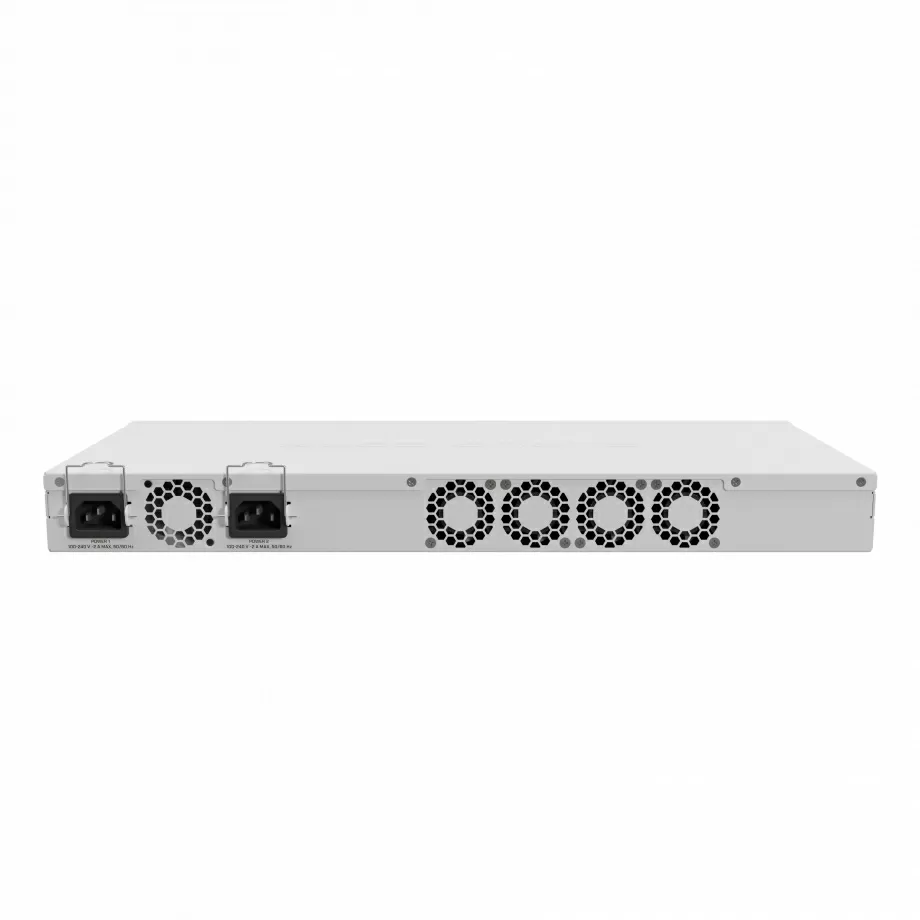
MikroTik CCR2116-12G-4S+ — Cloud Core Router 12x Gigabit Ethernet, 4x10G SFP+ | The 16-Core Routing Powerhouse That Redefines High-Throughput Network Performance
The Router That Thinks at 16-Core Speed — So Your Network Never Has to Wait
There is a fundamental difference between a router that handles your network’s demands and a router that obliterates them. Between infrastructure that keeps pace with traffic and infrastructure that runs so far ahead of it that throughput, latency, and packet loss become irrelevant concerns rather than daily firefighting exercises. Between a device that manages your routing table and one that processes it at speeds that make every connected user, every latency-sensitive application, and every high-bandwidth workload perform at its absolute theoretical maximum.
The MikroTik CCR2116-12G-4S+ is that second router — in every dimension that matters.
Built around the formidable Annapurna Labs Alpine v3 AL73400 16-core processor, equipped with a generous 16GB of DDR4 RAM, delivering routing throughput that competes directly with enterprise-grade equipment costing multiples of its price, and running MikroTik RouterOS v7 — the most feature-complete, endlessly configurable network operating system available to network professionals worldwide — the CCR2116-12G-4S+ is the routing platform that ISPs, data centres, managed service providers, enterprise network architects, and technically sophisticated organisations have been waiting for from MikroTik’s Cloud Core Router series.
Twelve Gigabit Ethernet ports for flexible WAN and LAN connectivity. Four dedicated 10-Gigabit SFP+ ports for high-speed uplinks, peering connections, and backbone integration. Hardware-accelerated encryption for IPsec VPN performance that software routing solutions cannot approach. And the complete MikroTik RouterOS feature ecosystem — BGP, OSPF, MPLS, VXLAN, CAPsMAN, traffic shaping, firewall, and hundreds of additional capabilities — running on a platform with the raw processing muscle to execute every feature simultaneously without compromise.
This is the router that network professionals choose when the routing table gets serious.
MikroTik CCR2116-12G-4S+ — Complete Technical Specifications
Every specification in the CCR2116-12G-4S+ reflects MikroTik’s commitment to delivering professional-grade routing hardware at a price point that transforms what ambitious organisations can afford to deploy:
- CPU: Annapurna Labs Alpine v3 AL73400 — 16-core ARM Cortex-A72 processor at 2.0 GHz
- RAM: 16GB DDR4 — substantial memory for large routing tables, complex firewall rulesets, and advanced traffic management
- Storage: 128MB NAND Flash — RouterOS system storage with configuration retention
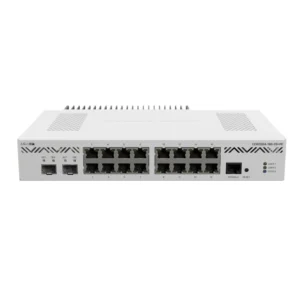
- 12 x 10/100/1000 Mbps Gigabit Ethernet Ports — full-speed RJ45 connectivity for WAN, LAN, and management interfaces
- 4 x 10G SFP+ Ports — dedicated 10-Gigabit fiber or DAC cable uplink and peering connectivity
- Total Switching Capacity: 120 Gbps — high-throughput non-blocking forwarding architecture
- Routing Performance: Up to 30+ Mpps — line-rate packet forwarding across the full port population
- Hardware Encryption Acceleration — dedicated IPsec hardware offload for line-rate VPN throughput
- Operating System: MikroTik RouterOS v7 — the complete professional network operating system
- RouterOS License: Level 6 — the highest tier, enabling unlimited routing, tunnelling, and user capacity
- Dual Redundant Power Supply Slots — hot-swap PSU support for maximum uptime assurance
- Included Power Supply: AC — single PSU included, second slot available for optional redundant PSU
- Operating Temperature: 0°C to +50°C — standard data centre and network closet ambient range
- 1U Rackmountable Form Factor — standard 19-inch rack deployment with included mounting hardware
- Dimensions: 443 x 144 x 44mm — standard 1U depth for conventional rack installation
- Power Consumption: Approximately 40W typical — energy-efficient 16-core routing platform
- RouterOS Features: BGP, OSPF, RIP, MPLS, VXLAN, IPsec, L2TP, SSTP, OpenVPN, WireGuard, CAPsMAN, Queues, Firewall — comprehensive professional routing feature set
The 16-Core Advantage — What Annapurna Labs Alpine v3 Delivers for Routing Performance
Processing Power That Changes the Conversation About What a Router Can Do
The central architecture of the CCR2116-12G-4S+ is the specification that defines its routing capability ceiling — and that ceiling is extraordinarily high. The Annapurna Labs Alpine v3 AL73400 processor delivers sixteen ARM Cortex-A72 cores running at 2.0 GHz — a processor architecture designed explicitly for network infrastructure applications, not adapted from a consumer computing platform.
Understanding why core count matters profoundly in routing hardware requires understanding how modern RouterOS processes network traffic. Unlike simple forwarding switches that operate purely in hardware silicon, a fully-featured router running complex firewall rules, dynamic routing protocols, VPN encryption, traffic shaping, connection tracking, and deep packet inspection requires substantial CPU resources for every packet that demands more than simple forwarding decisions. As routing complexity increases — more firewall rules, more VPN tunnels, more routing protocol peers, more queue trees — the demand on processing resources scales accordingly.
The 16-core architecture of the CCR2116-12G-4S+ addresses this reality directly:
RouterOS v7 is architected to distribute network processing workloads across multiple CPU cores simultaneously — with advanced features including Receive Side Scaling (RSS) and parallel packet processing enabling genuine multi-core utilisation across the full 16-core array. This means:
- 16 simultaneous packet processing streams capable of operating on different traffic flows concurrently without serialisation bottlenecks
- Routing protocol processing on dedicated cores — BGP table calculations, OSPF SPF runs, and MPLS label operations consuming cores that do not compete with fast-path packet forwarding
- VPN encryption on hardware-accelerated paths — IPsec offloaded to dedicated cryptographic engines rather than consuming general-purpose CPU cycles
- Firewall rule evaluation at high connection rates — the connection tracking table and stateful firewall engine running across cores that scale with traffic volume
- Traffic shaping and QoS processing — complex hierarchical queue trees executing without degrading forwarding throughput on other cores
The practical consequence: the CCR2116-12G-4S+ maintains routing performance that lesser hardware surrenders as complexity increases. Enable BGP with 1 million routes, add 50 IPsec tunnels, implement a complex firewall ruleset, and activate traffic shaping on all WAN interfaces — and the 16-core platform continues to route at throughputs that make those features feel invisible rather than expensive.
16GB DDR4 RAM — The Memory Foundation for Serious Routing
Why Memory Defines the Outer Boundary of What Your Router Can Achieve
In professional routing applications, RAM is not merely a comfort specification — it is a hard ceiling on routing capability. The 16GB DDR4 RAM of the CCR2116-12G-4S+ removes that ceiling from virtually every real-world deployment scenario this router will encounter:
Full Internet Routing Table Support The global BGP routing table currently contains over 900,000 IPv4 prefixes and a growing number of IPv6 routes. Maintaining a full internet routing table — necessary for ISPs, IX participants, and organisations with sophisticated traffic engineering requirements — demands substantial RAM for route storage, BGP attribute tracking, and RIB/FIB differentiation. The 16GB memory footprint of the CCR2116-12G-4S+ comfortably accommodates full internet routing tables from multiple BGP peers simultaneously — including multiple full tables with different path attributes for advanced traffic engineering without route summarisation compromises.
Large Firewall and Connection Tracking Tables RouterOS’s stateful firewall maintains an entry in the connection tracking table for every active network connection. In high-throughput environments serving many simultaneous users — particularly NAT-heavy deployments where many private addresses share public IPs — connection tracking tables can grow to millions of entries. 16GB RAM eliminates connection table overflow as a routing concern even in the most demanding high-user-count environments.
Complex Queue Tree and Traffic Shaping Structures Sophisticated traffic shaping implementations — hierarchical queue trees with per-subscriber queues, burst parameters, and priority configurations — consume memory proportional to their complexity and the number of simultaneous subscribers being shaped. For ISPs and managed service providers implementing per-customer bandwidth management, 16GB RAM provides the headroom for large-scale subscriber queue trees without memory pressure affecting routing stability.
RouterOS v7 Operating Environment RouterOS v7 introduces enhanced features including improved container support, advanced scripting capabilities, and expanded protocol implementations that benefit from generous memory availability. The 16GB allocation ensures RouterOS v7 operates with ample headroom for all features simultaneously without the memory pressure that triggers performance degradation or instability in memory-constrained routing platforms.
4 x 10G SFP+ Ports — High-Speed Connectivity for Backbone, Peering, and Uplink Applications
Ten Gigabits Per Port. Four Simultaneous High-Speed Paths. Complete Connectivity Flexibility.
The four dedicated 10-Gigabit SFP+ ports of the CCR2116-12G-4S+ are the connectivity tier that defines its capability as a high-performance routing platform — enabling 10G-speed connections to upstream providers, peering partners, core switching infrastructure, and high-bandwidth server resources that define the performance ceiling of your network:
Direct ISP and Carrier Uplinks Connect directly to carrier-grade 10G Ethernet handoffs from your upstream transit providers — eliminating the need for intermediate patch equipment and achieving the cleanest possible connection between your routing platform and your transit bandwidth. For organisations with 10G or multiple 10G transit circuits, the CCR2116-12G-4S+ terminates them directly on SFP+ ports while applying routing policy, traffic shaping, and firewall rules at line rate.
Internet Exchange (IX) Peering Connections Organisations participating in Internet Exchange Points — connecting to route servers and bilateral peers at IX fabric — benefit from the CCR2116-12G-4S+’s combination of 10G SFP+ connectivity, full BGP implementation with advanced path selection capabilities, and 16GB RAM accommodating large peer routing tables. The CCR2116 is engineered for IX peering deployments where routing sophistication and memory capacity are as important as raw throughput.
10G Fiber Uplinks for Campus and Enterprise Core Install MikroTik or compatible SFP+ SR/LR transceivers for 10-Gigabit connections to core distribution switches, campus backbone infrastructure, and data centre switching fabric — carrying routing and inter-VLAN traffic at 10G speeds between network tiers with complete RouterOS policy control over every traffic flow.
Direct Attach Copper (DAC) for Adjacent Equipment For high-speed connections within the same rack or between adjacent racks — to 10G core switches, server 10G NICs, or storage array controllers — 10G SFP+ DAC twinax cables provide cost-effective 10-Gigabit connectivity at distances up to 5-7 metres with minimal latency and zero optical transceiver cost.
LACP-Bonded 10G Uplinks Combine multiple SFP+ ports using IEEE 802.3ad Link Aggregation in RouterOS to create bonded logical uplinks — a 20 Gbps 2-port aggregate or 40 Gbps 4-port aggregate — with automatic load balancing and seamless failover if any individual 10G member link experiences a fault.
Dedicated High-Speed WAN and LAN Separation Utilise individual SFP+ ports as dedicated WAN-facing and LAN-facing interfaces — creating clean architectural separation between upstream provider connectivity and internal network distribution at 10G speed on each interface, with RouterOS firewall rules and routing policies enforced at the boundary.
12 x Gigabit Ethernet Ports — Versatile Connectivity for the Complete Network Topology
Twelve Ports of Full Gigabit Flexibility for Every Network Role
The 12 Gigabit Ethernet ports of the CCR2116-12G-4S+ provide the access layer and management connectivity that complements the 10G SFP+ uplinks — enabling flexible network topology implementations across a wide range of professional deployment scenarios:
Multi-WAN Load Balancing and Failover Terminate multiple Gigabit WAN connections from different upstream providers on dedicated GbE interfaces — implementing sophisticated multi-WAN load balancing with per-connection, per-address, or per-protocol traffic distribution policies, and automatic WAN failover with sub-second detection and recovery through RouterOS’s advanced routing and scripting capabilities.
Dedicated Management Interface Designate a dedicated Gigabit port for out-of-band router management — creating a separate management path that remains accessible even during WAN interface failures or routing table changes, with management traffic completely isolated from transit and customer data flows.
Segment and Zone Connectivity Connect separate network segments — office LAN, DMZ, server subnet, guest network, IoT zone, and management network — on individual Gigabit interfaces, with RouterOS firewall rules enforcing precise inter-zone traffic policies at line rate for each port combination.
LAN Switch Integration Connect aggregation switches, access layer switches, and distribution switching infrastructure via dedicated Gigabit interfaces — enabling clean router-on-a-stick or routed inter-VLAN architectures with RouterOS providing full Layer 3 routing, firewall, and traffic management between switching domains.
VLAN-Tagged Sub-Interface Architecture Each physical Gigabit interface supports multiple VLAN-tagged sub-interfaces — enabling a single physical port to carry dozens of logically separated traffic streams, dramatically increasing the effective interface count beyond the physical 12 ports for complex network segmentation requirements.
RouterOS v7 — The Most Powerful Network Operating System in the SMB and Mid-Market Segment
Not Just Software. A Complete Professional Networking Ecosystem.
If the CCR2116-12G-4S+’s hardware is the foundation, MikroTik RouterOS v7 is the intelligence that transforms raw silicon into a professional networking platform of extraordinary capability. RouterOS v7 is not a simplified router firmware — it is a comprehensive, professional-grade network operating system that rivals the feature sets of enterprise routing platforms costing tens of thousands of pounds more:
Routing Protocols — Complete Dynamic Routing for Any Topology
BGP (Border Gateway Protocol)
- Full BGP-4 implementation supporting IPv4 and IPv6 (MP-BGP) address families
- Route reflector and confederation support for complex iBGP topologies
- Advanced path selection with configurable route preference, MED, local preference, and community-based filtering
- Full internet routing table capable — 16GB RAM accommodates complete BGP tables from multiple peers
- BGP route filtering with prefix lists, AS path filters, and community-based policies
- RPKI (Resource Public Key Infrastructure) — route origin validation for BGP security against route hijacking
- Graceful Restart for BGP session continuity during planned maintenance
- BFD (Bidirectional Forwarding Detection) integration for sub-second BGP peer failure detection
OSPF (Open Shortest Path First)
- OSPFv2 for IPv4 and OSPFv3 for IPv6 with full multi-area support
- Stub, NSSA, and totally stubby area configuration for scalable OSPF hierarchies
- Route redistribution between OSPF, BGP, static, and connected routes
- Virtual links and area border router configurations for complex campus topologies
- BFD integration for rapid OSPF neighbour failure detection
RIP and RIPng
- RIPv1, RIPv2, and RIPng (IPv6) for simple and legacy routing environments
- Route filtering, summarisation, and redistribution support
Static Routing with Advanced Policy
- Multiple routing tables with policy-based routing selecting tables based on source address, destination, firewall marks, or routing marks
- Recursive static routes with tracking and automatic failover
- ECMP (Equal Cost Multi-Path) for load-balanced static routing across multiple next-hops
MPLS and Traffic Engineering
- Full MPLS label switching with LDP (Label Distribution Protocol) and RSVP-TE signalling
- VPLS (Virtual Private LAN Service) for Layer 2 VPN over MPLS infrastructure
- L3VPN with VRF (Virtual Routing and Forwarding) instances for isolated routing domains
- Traffic engineering with RSVP-TE for explicit path control across MPLS networks
VPN and Tunnelling — Comprehensive Secure Connectivity
IPsec with Hardware Acceleration The CCR2116-12G-4S+’s dedicated hardware IPsec acceleration transforms VPN performance from a CPU bottleneck into a line-rate capability — enabling IPsec tunnel throughput that software routing platforms cannot achieve:
- IKEv1 and IKEv2 key exchange with certificate and pre-shared key authentication
- AES-128 and AES-256 encryption with hardware offload eliminating CPU overhead
- Site-to-site IPsec VPN for secure inter-office connectivity at throughputs approaching 10G on SFP+ interfaces
- Remote access IPsec with IKEv2 and EAP authentication for mobile workforce connectivity
- IPsec over GRE for routed VPN topologies with dynamic routing protocol support
WireGuard — Modern High-Performance VPN RouterOS v7 includes native WireGuard VPN support — the modern, cryptographically superior VPN protocol delivering:
- Significantly higher throughput than legacy IPsec implementations on equivalent CPU resources
- Simpler configuration with peer-based key management
- Roaming support for mobile clients across changing IP addresses
- Site-to-site WireGuard for high-performance inter-site connectivity
OpenVPN
- Full OpenVPN server and client implementation supporting SSL/TLS encrypted tunnels
- TCP and UDP transport options for firewall traversal flexibility
- Certificate-based authentication for enterprise identity management integration
L2TP and SSTP
- L2TP/IPsec for Windows-native VPN client compatibility without additional client software
- SSTP for VPN connectivity over HTTPS port 443, traversing restrictive firewalls and proxy environments
GRE and EoIP Tunnels
- GRE tunnelling for routed point-to-point and point-to-multipoint tunnel topologies
- Ethernet over IP (EoIP) — MikroTik’s Layer 2 tunnelling protocol for bridging remote network segments transparently over IP infrastructure
VXLAN
- Native VXLAN implementation for Layer 2 network extension over Layer 3 infrastructure
- Data centre overlay networking and cloud connectivity applications
- Integration with BGP EVPN for scalable VXLAN control plane in multi-site architectures
Firewall — Stateful Packet Inspection at Line Rate
RouterOS’s stateful firewall engine provides comprehensive network protection with the processing power of 16 cores ensuring firewall rules never become a throughput bottleneck:
- Connection tracking with support for millions of simultaneous connections
- Layer 7 protocol detection — application-aware filtering without dedicated DPI hardware
- Address lists — dynamic and static IP grouping for efficient large-scale firewall rule management
- Firewall marks and routing marks — traffic classification for policy-based routing integration
- NAT (Network Address Translation) — masquerade, src-NAT, and dst-NAT with port forwarding
- Hairpin NAT for internal server access via public IP from internal clients
- Connection rate limiting — per-source connection rate control for DoS mitigation
- Raw firewall tables — pre-connection-tracking filtering for maximum performance on volumetric attack mitigation
- IPv6 firewall — comprehensive firewall policy enforcement for IPv6 traffic flows
- Fasttrack connection — hardware-accelerated forwarding for established connection flows bypassing full rule evaluation
Quality of Service and Traffic Management
RouterOS’s QoS and traffic shaping capabilities at 16-core processing power enable traffic management implementations of a complexity and scale that most routing platforms cannot execute without degrading forwarding throughput:
- Hierarchical Token Bucket (HTB) Queue Trees — multi-level hierarchical bandwidth allocation with parent/child relationships and burst parameters
- Per-Subscriber Queuing — individual bandwidth management for each connected user or customer — fundamental for ISP and managed service provider deployments
- Simple Queues — rapid per-address bandwidth allocation for straightforward deployments
- PCQ (Per Connection Queuing) — fair-share bandwidth distribution across multiple simultaneous connections per subscriber
- CAKE — the modern, sophisticated queue discipline implementing flow-level fairness, diffserv support, and active queue management for optimal bufferbloat control
- DSCP marking and honouring — Layer 3 QoS integration with upstream and downstream QoS-aware infrastructure
- Firewall mark-based queue assignment — precise traffic classification directing specific flows to appropriate queue policies
- Burst allowance configuration — time-based burst permissions above sustained rate limits for improved user experience
Advanced Network Features
VLAN and Bridging
- Hardware-accelerated bridge with VLAN filtering for switch-like performance on bridged interfaces
- Bridge VLAN filtering — managed switch functionality with hardware VLAN table acceleration
- MSTP (Multiple Spanning Tree) for loop prevention in bridged topologies
- Dot1q VLAN tagging across all interfaces including bonded and tunnel interfaces
DHCP and DNS
- Full DHCP server and relay with static address assignment, option delivery, and lease management
- DNS server with caching, static entries, and DoH (DNS over HTTPS) for encrypted client DNS resolution
- DHCP client on WAN interfaces with automatic IP configuration from upstream providers
IPv6
- Complete dual-stack IPv4 and IPv6 support across all routing, firewall, and VPN features
- DHCPv6 server, client, and prefix delegation for downstream IPv6 address distribution
- IPv6 neighbour discovery and router advertisement configuration
- Seamless IPv4/IPv6 routing table management with separate RIB instances
CAPsMAN — Centralised Wireless Management RouterOS v7 includes CAPsMAN v2 — MikroTik’s centralised Access Point Manager — enabling the CCR2116-12G-4S+ to serve as the wireless controller for MikroTik Controlled Access Points (CAP) deployed throughout your network, providing unified SSID management, roaming, and RF configuration from the router.
Scripting and Automation
- RouterOS scripting language — a comprehensive scripting environment for configuration automation, scheduled tasks, event-triggered actions, and dynamic policy management
- REST API — modern HTTP-based API enabling integration with network management platforms, orchestration systems, and custom automation workflows
- NETCONF — industry-standard network configuration protocol for enterprise automation integration
- SSH API — programmatic configuration access via SSH for legacy automation integration
- Scheduler for time-based script execution and maintenance window automation
Hardware IPsec Acceleration — VPN Performance That Software Cannot Match
The VPN Capability That Makes the CCR2116-12G-4S+ a Data Centre-Grade VPN Gateway
For organisations where IPsec VPN performance is a critical infrastructure requirement — multi-site enterprise connectivity, remote workforce VPN gateway, carrier-grade VPN service delivery, or secure peering between data centre locations — the CCR2116-12G-4S+’s dedicated hardware IPsec acceleration represents a qualitative performance advantage over software-only VPN implementations.
Why Hardware IPsec Acceleration Changes the VPN Performance Equation
IPsec encryption operations — AES encryption and decryption, SHA authentication, and Diffie-Hellman key exchange — are computationally intensive processes that consume significant CPU cycles when implemented purely in software. On a router simultaneously managing large BGP routing tables, complex firewall rules, and traffic shaping, software IPsec encryption competes directly with these functions for the same CPU resources — creating a scenario where enabling IPsec at high throughput degrades overall routing performance.
Hardware IPsec acceleration removes this competition entirely by offloading cryptographic operations to dedicated silicon operating independently of the general-purpose CPU cores. The 16-core ARM processor handles routing decisions, firewall processing, and protocol management while the hardware crypto engine simultaneously processes IPsec encryption and decryption — enabling high-throughput IPsec VPN performance without any impact on routing, firewall, or traffic management functions.
Practical IPsec VPN Deployment Scenarios
- Multi-site enterprise VPN hub — terminate dozens of branch office IPsec tunnels simultaneously at high aggregate throughput without CPU saturation
- Remote access VPN gateway — support large numbers of concurrent IKEv2 remote access VPN sessions for mobile workforce connectivity
- Encrypted transit between data centres — 10G SFP+ interface IPsec encryption for secure high-speed inter-DC connectivity
- Service provider encrypted connectivity offerings — deliver IPsec-encrypted connectivity services to enterprise customers at line-rate throughput
- Secure peering encryption — encrypt BGP peering traffic over untrusted transport networks using IPsec without impacting routing table processing performance
Dual Power Supply Support — Operational Continuity for Mission-Critical Deployments
Redundancy Where Network Downtime Is Unacceptable
The CCR2116-12G-4S+ includes dual power supply slots — a hardware design decision that speaks directly to the deployment contexts this router is engineered to serve. When routing infrastructure fails, the consequences extend across every device, every user, and every service that depends on it. In ISP networks, enterprise environments, data centres, and managed service deployments where network availability is a contractual and operational requirement, single power supply routers represent an unacceptable single point of failure.
Dual PSU Architecture — How It Protects Your Network
- Single AC PSU included — the CCR2116-12G-4S+ ships with one power supply unit installed and operational
- Second PSU slot available — a second power supply unit can be installed to provide full hot-swap redundant power delivery
- Hot-swap capability — a failed PSU can be replaced while the router remains fully operational, with zero network disruption or routing session interruption
- Independent power path operation — each PSU connects to an independent power distribution circuit, protecting against single circuit breaker trip or PDU failure eliminating router power
- Automatic load sharing and failover — both PSUs share the router’s power load during normal operation, with automatic full-load assumption by the surviving PSU in the event of a failure
For ISPs, colocation facilities, enterprise data centres, and managed service providers where router uptime is measured in nines — 99.9%, 99.99%, or beyond — dual PSU support is not an optional luxury. It is a fundamental requirement that the CCR2116-12G-4S+ meets from its hardware foundation.
RouterOS Level 6 License — Unlimited Capability, Unlimited Scale
The Highest License Tier. Every Feature. No Artificial Limitations.
The CCR2116-12G-4S+ ships with RouterOS License Level 6 — MikroTik’s highest licensing tier, providing unlimited access to every RouterOS capability without the feature restrictions or capacity limitations that lower license levels impose:
- Unlimited PPPoE connections — no cap on simultaneous PPPoE subscriber sessions for ISP and service provider deployments
- Unlimited PPTP, L2TP, SSTP, and OpenVPN tunnels — no restriction on concurrent VPN session count
- Unlimited hotspot users — full-scale captive portal and hotspot deployments without user count ceilings
- Unlimited EoIP tunnels — unrestricted Layer 2 tunnel deployments for large-scale bridged network architectures
- Unlimited VLANs and bridge instances — no artificial limitations on network segmentation complexity
- Full CAPsMAN capability — unlimited managed access point count for large-scale wireless deployments
- All RouterOS features enabled — BGP, OSPF, MPLS, VXLAN, traffic shaping, scripting, REST API — every feature at full capacity
The Level 6 license ensures that the CCR2116-12G-4S+’s software capability scales without restriction alongside its hardware performance — enabling deployments of any scale, complexity, and subscriber count without encountering licensing ceilings.
WinBox, WebFig, and CLI — Three Management Paths, One Powerful Platform
The Management Interface That Fits Every Administrator’s Preference
MikroTik RouterOS provides multiple management interfaces — each optimised for different administrative workflows and expertise levels — ensuring that the CCR2116-12G-4S+ is accessible to both experienced MikroTik administrators and engineers new to the RouterOS ecosystem:
WinBox — The Native GUI Application WinBox is MikroTik’s dedicated Windows-native management application — a powerful, responsive GUI that provides complete access to every RouterOS configuration element through an interface specifically designed for the RouterOS data model:
- Direct MAC address connectivity — access the router for initial configuration before IP addressing is established
- Drag-and-drop interface organisation — customise the management workspace for your workflow
- Real-time traffic graphs — per-interface bandwidth visualisation with configurable time windows
- Neighbours discovery — automatic discovery of adjacent MikroTik devices for rapid network topology management
- Multi-session management — manage multiple routers simultaneously from a single WinBox instance
- Available for Windows and via Wine on Linux — widely compatible management platform
WebFig — Browser-Based Management WebFig provides complete RouterOS management through any modern web browser — eliminating the need for application installation and enabling management from any platform including Linux, macOS, and mobile devices:
- Full configuration access equivalent to WinBox through a responsive web interface
- Real-time graphs and monitoring within the browser session
- Secure HTTPS access with certificate-based encryption
SSH CLI — Professional Command-Line Control For experienced network engineers, automation workflows, and configuration scripting, RouterOS’s SSH command-line interface provides:
- Complete configuration access through a consistent, scriptable command structure
- Batch configuration deployment — apply complex configurations efficiently through scripted CLI commands
- Integration with automation platforms — Ansible, Python netmiko, and other automation frameworks support RouterOS SSH CLI
- Configuration export and import — complete router configuration backup and restoration through CLI
REST API — Modern Programmatic Management RouterOS v7’s REST API enables modern network automation and orchestration integration:
- HTTP/HTTPS-based API for language-agnostic integration
- Full configuration read and write capability through standard REST operations
- Integration with network orchestration platforms, monitoring systems, and custom management applications
- JSON data format for straightforward parsing and manipulation
Dude Network Monitor Integration The CCR2116-12G-4S+ integrates with The Dude — MikroTik’s free network monitoring application — providing automatic network discovery, topology mapping, device status monitoring, and alert management for complete visibility of infrastructure built around the CCR2116.
Where the MikroTik CCR2116-12G-4S+ Defines Network Performance
The Routing Platform Purpose-Built for the Most Demanding Deployment Environments
Internet Service Providers — Small to Mid-Size ISP Core Routing Regional ISPs, WISPs (Wireless Internet Service Providers), and community broadband operators deploy the CCR2116-12G-4S+ as a BGP-capable core router — maintaining full internet routing tables from multiple upstream transit providers, implementing sophisticated traffic engineering and route preference policies, managing per-subscriber bandwidth shaping for thousands of concurrent customers, and terminating PPPoE subscriber sessions at Level 6 unlimited capacity. The 16-core processor and 16GB RAM enable full BGP functionality at subscriber scales that make the CCR2116 the most cost-effective professional ISP routing solution available.
Data Centre Edge Routing Colocation facilities, private data centres, and cloud service operators deploy the CCR2116-12G-4S+ as an edge routing platform — connecting to multiple transit providers and IX peering connections via 10G SFP+ interfaces, implementing BGP route policies for traffic engineering and cost optimisation, and providing high-throughput NAT and firewall services for tenant networks. Hardware IPsec acceleration enables encrypted connectivity between data centre locations at throughputs that justify the CCR2116 as a primary inter-DC routing solution.
Enterprise Multi-Site WAN Hub Large SMB and mid-market enterprise organisations with multiple locations deploy the CCR2116-12G-4S+ as a centralised WAN hub — terminating IPsec or WireGuard VPN tunnels from branch offices at hardware-accelerated throughput, implementing OSPF or BGP for dynamic multi-site routing, providing centralised internet security and traffic management, and delivering QoS policies that prioritise business-critical applications across the WAN infrastructure.
Managed Service Providers — Multi-Tenant Routing Infrastructure MSPs providing managed network services to multiple enterprise clients deploy CCR2116-12G-4S+ infrastructure with VRF (Virtual Routing and Forwarding) instances providing complete routing isolation between tenant networks on shared physical hardware — enabling efficient, scalable multi-tenant managed routing services with complete inter-customer traffic separation enforced at the routing table level.
Network Service Providers — VPN and Connectivity Services Service providers delivering managed VPN connectivity, MPLS-based VPN services, and encrypted connectivity offerings to enterprise customers benefit from the CCR2116-12G-4S+’s combination of hardware IPsec acceleration for high-throughput VPN delivery, full MPLS stack for L3VPN and VPLS service construction, and Level 6 licensing removing per-session capacity constraints on VPN service delivery.
Academic and Research Networks Universities, research institutions, and academic network operators requiring sophisticated routing capabilities — including BGP peering with NREN (National Research and Education Network) providers, MPLS traffic engineering for research traffic prioritisation, and high-throughput VPN connectivity between campus and remote research facilities — find the CCR2116-12G-4S+’s combination of routing protocol depth, 16GB memory for large routing tables, and 10G SFP+ connectivity ideal for academic network infrastructure.
Critical Infrastructure and Government Networks Government agencies, utilities, and critical infrastructure operators requiring routing platforms with comprehensive security capabilities — hardware-accelerated IPsec, advanced firewall architecture, BGP with RPKI route validation, and detailed audit logging — deploy CCR2116-12G-4S+ infrastructure in environments where network security and routing integrity are essential to organisational operations.
High-Performance Network Laboratories and Testing Environments Network researchers, advanced hobbyists, and professional network engineers building high-performance test environments — including full internet routing table simulation, complex VPN topology testing, traffic engineering research, and RouterOS feature validation at scale — leverage the CCR2116-12G-4S+’s processing power, memory capacity, and feature depth as a research and testing platform that matches production-grade capability.
Frequently Asked Questions About the MikroTik CCR2116-12G-4S+
Q: What is the difference between the CCR2116-12G-4S+ and the CCR2004 series? The CCR2116-12G-4S+ and CCR2004 series both use Annapurna Labs Alpine v3 processors but differ significantly in core count and memory. The CCR2116 features 16 CPU cores and 16GB RAM, while CCR2004 models offer fewer cores and less memory at lower price points. The CCR2116 is positioned for deployments requiring maximum multi-core processing performance — full BGP routing tables, large-scale VPN termination, complex traffic shaping at high subscriber counts, and maximum concurrent connection tracking — where the CCR2004 series’ core count creates throughput ceilings under high processing load.
Q: Can the CCR2116-12G-4S+ hold a full BGP internet routing table? Yes. With 16GB DDR4 RAM, the CCR2116-12G-4S+ comfortably accommodates full BGP internet routing tables — including complete IPv4 tables exceeding 900,000 prefixes and growing IPv6 tables from multiple peers simultaneously. Memory headroom remains available for RIB processing, BGP attribute storage, and multiple full table peers from different transit providers for traffic engineering implementations.
Q: What IPsec VPN throughput can the CCR2116-12G-4S+ achieve? The hardware-accelerated IPsec engine enables significantly higher VPN throughput than software-only implementations on equivalent hardware. Exact throughput depends on encryption algorithm selection, packet size distribution, and simultaneous feature load. MikroTik publishes performance benchmarks in their official documentation and community testing has demonstrated multi-gigabit IPsec throughput under AES-128 encryption — substantially higher than comparable-class software routing platforms without dedicated crypto hardware.
Q: Does the CCR2116-12G-4S+ support WireGuard? Yes. RouterOS v7 includes native WireGuard support — enabling high-performance WireGuard VPN tunnels for site-to-site and remote access connectivity. WireGuard in RouterOS v7 leverages the 16-core processor for parallel tunnel processing, delivering competitive throughput for encrypted connectivity workloads.
Q: What SFP+ transceivers are compatible with the four 10G uplink ports? The SFP+ ports accept standard 10-Gigabit SFP+ form factor transceivers — including MikroTik branded modules (S+85DLC03D for multi-mode fiber, S+1310DLC03D for single-mode fiber) and compatible third-party IEEE-compliant SFP+ transceivers. MikroTik’s SFP+ ports are generally compatible with standard 10G SFP+ modules from major vendors. Direct Attach Copper (DAC) cables are also supported for short-distance rack connections.
Q: Can the CCR2116-12G-4S+ function as a PPPoE concentrator for ISP subscriber management? Yes — this is one of the CCR2116’s primary ISP deployment use cases. RouterOS Level 6 licensing removes all PPPoE session count restrictions, while the 16-core processor and 16GB RAM provide the processing capacity and memory headroom for large-scale PPPoE subscriber management with per-subscriber traffic shaping, RADIUS integration for authentication and accounting, and dynamic bandwidth policy assignment.
Q: How is the CCR2116-12G-4S+ managed and what automation capabilities are available? The CCR2116-12G-4S+ is managed through WinBox (native GUI application), WebFig (browser-based interface), SSH CLI (command-line), and REST API (programmatic HTTP interface introduced in RouterOS v7). Automation integration is supported through the REST API, SSH-based scripting with tools like Ansible netmiko, NETCONF, and RouterOS’s built-in scripting language for on-device automation. Configuration backup and restoration is supported through CLI export commands and Dude integration for network-level monitoring.
Q: Is the second power supply slot populated in the standard CCR2116-12G-4S+ package? The standard CCR2116-12G-4S+ package includes one AC power supply unit installed. The second PSU slot is available for an optional additional power supply unit — available separately from MikroTik and its reseller network — for full hot-swap redundant power operation. Organisations requiring power redundancy from deployment day should order the appropriate additional PSU simultaneously with the router.
Q: How does RouterOS v7 differ from RouterOS v6 for CCR2116 deployments? RouterOS v7 delivers several significant advances relevant to CCR2116 deployments — including improved multi-core packet processing leveraging the 16-core architecture more effectively, native WireGuard VPN support, enhanced BGP implementation with RPKI support, REST API for modern automation integration, improved container support, and various feature enhancements across routing protocol implementations. The CCR2116-12G-4S+ ships with RouterOS v7 as its operating system, ensuring immediate access to the latest platform capabilities.
The Bottom Line — Why the MikroTik CCR2116-12G-4S+ Is the Professional Router That Changes What Your Network Can Achieve
The routing market is filled with products that promise performance and deliver limitations — limitations that reveal themselves when routing tables grow beyond a threshold, when VPN tunnel counts exceed a ceiling, when subscriber counts stress connection tracking memory, or when complex firewall rulesets finally find the boundary of what the CPU can sustain without degrading forwarding throughput.
The MikroTik CCR2116-12G-4S+ was not engineered to find those boundaries. It was engineered to place them so far beyond any realistic deployment requirement that they cease to be a consideration — replaced by a routing platform experience defined by consistent performance, feature depth without compromise, and hardware capability that matches the full ambition of RouterOS v7’s extraordinary software ecosystem.
Sixteen ARM Cortex-A72 cores that distribute packet processing, routing protocol management, VPN encryption, and traffic shaping across parallel processing streams without serialisation bottlenecks. Sixteen gigabytes of DDR4 RAM that accommodates full internet routing tables, large connection tracking databases, complex queue trees, and RouterOS v7’s complete operating environment simultaneously. Four 10-Gigabit SFP+ ports that connect your routing infrastructure to transit providers, peering partners, and core switching at the speed modern networks demand. Twelve Gigabit Ethernet ports providing complete multi-WAN, LAN, DMZ, and management interface flexibility. Hardware IPsec acceleration delivering VPN throughput that transforms encrypted connectivity from a performance compromise into a line-rate capability. And RouterOS Level 6 licensing that removes every artificial constraint from an already boundless software feature set.
This is the router that ISPs deploy for BGP. The router that enterprises deploy for IPsec. The router that MSPs deploy for multi-tenant VRF. The router that data centres deploy for edge routing. And the router that every serious network professional recognises as the most compelling combination of routing performance, feature depth, and investment value available in the professional networking market today.
- ✅ 16-core Annapurna Labs Alpine v3 processor — the most powerful CPU in the Catalyst 1300 access series
- ✅ 16GB DDR4 RAM — full internet routing table capacity with extensive operational headroom
- ✅ 12 x Gigabit Ethernet ports — flexible multi-WAN, LAN, DMZ, and management connectivity
- ✅ 4 x 10G SFP+ uplinks — 40 Gbps of high-speed peering, transit, and core switching connectivity
- ✅ Hardware IPsec acceleration — multi-gigabit VPN throughput without CPU performance impact
- ✅ RouterOS v7 with Level 6 license — every feature, unlimited capacity, zero artificial restrictions
- ✅ Full BGP implementation with RPKI — internet routing table support with route origin validation
- ✅ Complete MPLS stack — LDP, RSVP-TE, VPLS, and L3VPN for service provider applications
- ✅ Native WireGuard VPN — modern high-performance encrypted tunnelling in RouterOS v7
- ✅ Dual PSU slot support — hot-swap redundant power for mission-critical uptime requirements
- ✅ Unlimited PPPoE, VPN, and hotspot sessions — Level 6 licensing removing all capacity ceilings
- ✅ REST API and NETCONF — modern automation integration for professional network orchestration
- ✅ 1U rackmount form factor — professional data centre and network closet deployment ready
- ✅ WinBox, WebFig, and CLI management — complete management flexibility for every administrator
Order the MikroTik CCR2116-12G-4S+ today — and deploy the routing infrastructure that serious networks demand: 16-core processing power, full BGP capability, hardware-accelerated VPN performance, and the complete RouterOS v7 ecosystem at a price point that makes enterprise-grade routing accessible to organisations of every scale and ambition.
 No products in the cart.
Reviews
There are no reviews yet.