
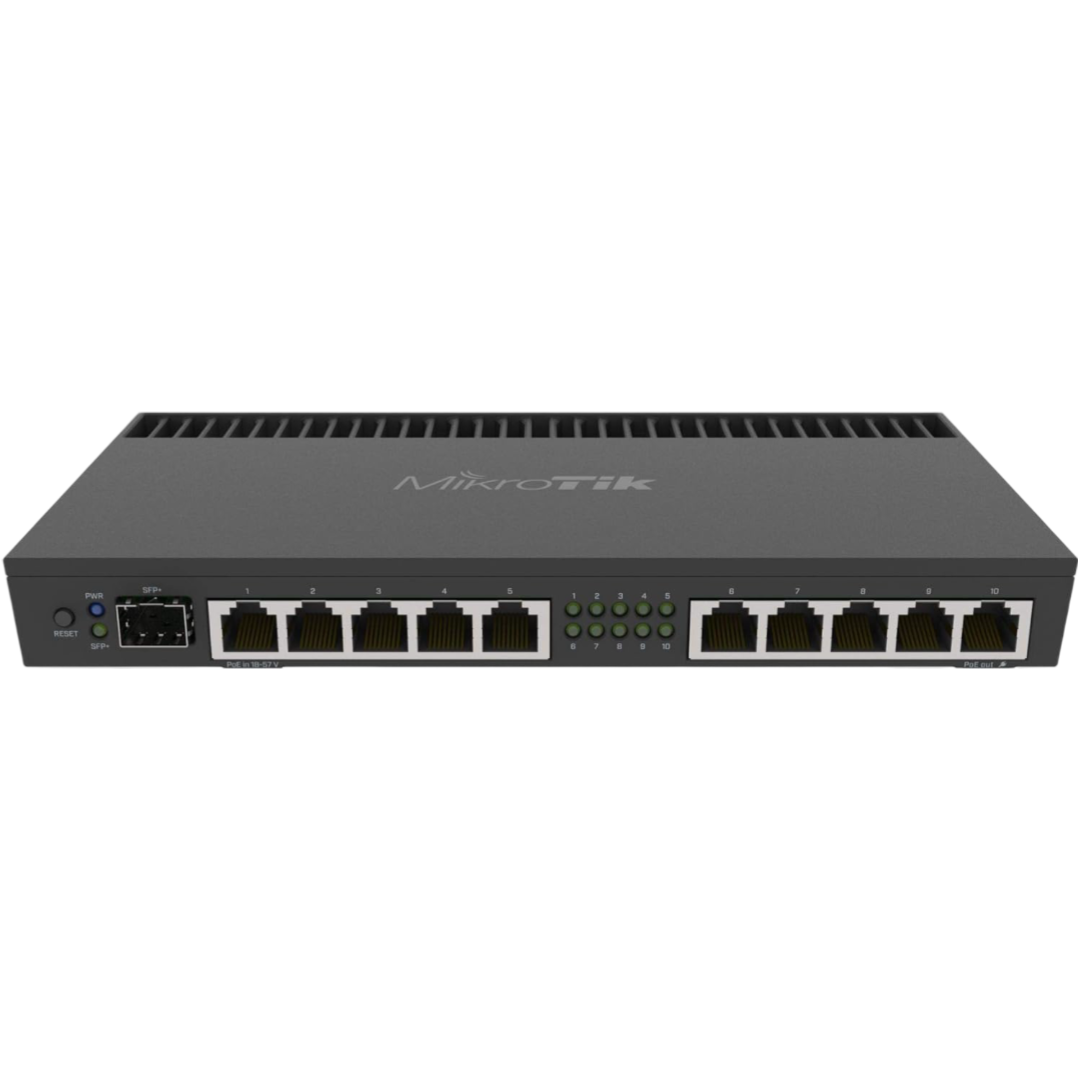
MikroTik RB3011UIAS-RM — The Dual-Core Rackmount Gigabit Router With 10 Ports, SFP Uplink, and Built-In LCD That Delivers Enterprise Routing at an Unbeatable Price
There is a class of network deployment that sits in the most demanding space in professional IT — too large and too critical for consumer-grade equipment, yet constrained by budgets that cannot absorb the eye-watering cost of traditional enterprise vendor solutions. Branch offices. Regional headquarters. Growing SMBs. School districts. Healthcare clinics. Municipal government networks. Managed service provider client sites. For all of these, and countless others, the MikroTik RB3011UIAS-RM was engineered with singular purpose and absolute precision.
Ten Gigabit Ethernet ports. One SFP fiber uplink. A dual-core 1.4GHz ARM processor. 1GB of RAM. A built-in LCD status panel. PoE output for powering connected devices. USB 3.0 for expanded connectivity. RouterOS Level 5 with the complete professional feature set. All of it housed in a clean, 1U rack-mount chassis that slides into your equipment rack and immediately begins delivering the kind of routing performance, network intelligence, and operational visibility that rack-mounted professional deployments demand.
The RB3011UIAS-RM is not trying to be the fastest router on the market. It is doing something far more valuable — it is being the most complete, most capable, and most intelligently designed professional router available at its price point, anywhere in the world. And it succeeds at that mission with remarkable authority.
What Is the MikroTik RB3011UIAS-RM and Who Is It Built For?
The RB3011UIAS-RM is MikroTik’s purpose-built rackmount professional routing solution — a 1U chassis device that combines ten-port Gigabit density, SFP fiber connectivity, dual-core ARM processing, and the full depth of RouterOS Level 5 into a single, elegantly engineered rack unit designed to serve as the network core for small-to-medium professional environments.
The model designation is precise and informative:
- RB3011 — RouterBOARD 3011 platform, MikroTik’s professional ten-port routing series
- U — USB 3.0 port for external storage, modem connectivity, and configuration management
- I — LCD information display with touch navigation built into the front panel
- A — SFP port for fiber or optical uplink connectivity
- S — Serial console port for out-of-band management access
- RM — Rack-Mount form factor with standard 19-inch rack compatibility
Every letter in that designation represents a deliberate feature addition that makes the RB3011UIAS-RM more capable, more manageable, and more professionally appropriate than stripped-down alternatives. This is a router specification built by engineers who understood exactly what network professionals actually need in a rackmount deployment — and then delivered every single item on that list.
Dual-Core ARM Cortex A15 — Processing Intelligence That Scales With Your Network
The Processor Architecture Behind Professional Routing Performance
The RB3011UIAS-RM is powered by the IPQ8064 dual-core ARM Cortex A15 processor running at 1.4GHz — a network-optimized processor that delivers the multi-threaded packet processing performance required for professional routing workloads without the thermal and power overhead of more complex multi-core architectures.
The ARM Cortex A15 at 1.4GHz is not an arbitrary specification — it is a carefully considered balance point that delivers:
- Dual-core parallel processing — distribute routing table lookups, firewall rule evaluation, NAT processing, VPN encryption, and QoS queue management across two independent processing cores simultaneously, preventing the CPU saturation that single-core routers experience under mixed workload conditions
- Out-of-order execution engine — the Cortex A15’s advanced microarchitecture executes instructions out of program order to maximize pipeline efficiency — delivering higher effective throughput per clock cycle than in-order processors running at equivalent frequencies
- Hardware network acceleration — dedicated silicon for packet classification, header processing, and checksum computation offloads these routine operations from the general-purpose CPU cores — preserving processing headroom for higher-level routing, firewall, and VPN functions
- ARM NEON SIMD acceleration — vectorized processing for pattern matching, deep packet inspection, and application-layer traffic classification at speeds that software-only approaches cannot match
- Crypto engine integration — hardware acceleration for AES encryption operations enables IPsec VPN tunnels at throughput levels that would saturate software-only encryption on comparable hardware
- Power-efficient architecture — the Cortex A15’s ARM lineage delivers its performance within a modest thermal envelope that the RB3011’s active cooling system manages reliably across the full rated temperature range
1GB DDR3 RAM — Professional Memory for Complex Network Deployments
The RB3011UIAS-RM is equipped with 1GB of DDR3 RAM — a memory allocation that reflects serious professional intent and distinguishes this router from underpowered alternatives that constrain their RAM to reduce cost at the expense of real-world capability:
- Substantial routing table capacity — accommodate large OSPF topologies, BGP route tables, static routing entries, and dynamic routing updates without memory pressure forcing premature route table truncation
- Deep connection tracking — maintain state for tens of thousands of simultaneous network connections across all attached clients — critical for accurate NAT, stateful firewall operation, and connection-aware traffic policies
- Complex firewall rule processing — deploy comprehensive firewall rule sets with dynamic address lists, Layer 7 pattern matching, and connection state tracking without memory constraints limiting policy depth or breadth
- Extensive QoS queue hierarchies — implement multi-level HTB queue trees with per-user, per-service, and per-application bandwidth policies simultaneously without RAM limitations reducing policy granularity
- VPN session management — maintain IPsec, WireGuard, OpenVPN, and L2TP tunnel state for dozens of simultaneous VPN connections across remote sites and traveling users
- Operational headroom for growth — 1GB RAM ensures the RB3011 remains capable as your network grows in complexity, connected device count, and traffic volume — without memory saturation becoming the bottleneck that forces premature hardware replacement
Ten Gigabit Ethernet Ports — Exceptional Connectivity Density for a Professional Router
The Ten-Port Architecture That Eliminates the Need for Additional Hardware
Ten independent 10/100/1000 Gigabit Ethernet ports make the RB3011UIAS-RM one of the highest port-density professional routers available at its price tier — providing enough physical connectivity to directly serve the complete infrastructure requirements of most small-to-medium professional network deployments from a single 1U chassis.
The Dual Switch Group Architecture
The RB3011UIAS-RM’s ten Gigabit ports are organized into two groups of five ports, each group served by a dedicated switch chip — an architectural decision with significant practical implications for network design flexibility:
- Group 1 (Ports 1–5) — managed by the first switch chip, optimized for internal LAN segment connectivity
- Group 2 (Ports 6–10) — managed by the second switch chip, ideal for WAN interfaces, DMZ segments, and secondary LAN zones
- Hardware-accelerated switching within each group — traffic flowing between ports within the same group is switched at the hardware level with full wire-speed performance and minimal CPU involvement
- Full routing between groups — traffic crossing from one port group to the other passes through the ARM processor for full RouterOS routing, firewall, NAT, and QoS processing
This dual switch group architecture delivers a fundamental operational advantage — the ability to configure multiple independent network segments with full hardware-level traffic isolation between them, while still maintaining centralized RouterOS policy control over all inter-segment traffic flows.
What Ten Gigabit Ports Enable in a Professional Deployment
With ten Gigabit ports at your disposal, a single RB3011UIAS-RM can simultaneously support:
- Multiple WAN connections from different ISPs for load balancing and automatic failover — connect two, three, or four independent internet circuits for maximum uptime and combined throughput
- Dedicated LAN segments for different organizational departments, security zones, or device categories — corporate workstations, guest Wi-Fi access points, VoIP systems, IoT devices, security cameras, and server infrastructure can each occupy physically separate ports with independent firewall and routing policies
- DMZ network interface — isolate publicly accessible servers (web, mail, FTP, VPN) in a dedicated demilitarized zone physically separated from internal LAN segments
- Out-of-band management network — dedicate a port to a physically separate management VLAN accessible even when primary production networks experience issues
- Uplink ports to access-layer switches — connect multiple managed switches serving different building floors, departments, or areas through independent ports for granular per-uplink traffic management
- Direct server connections — attach critical servers directly to the router for minimum-latency, maximum-throughput connectivity bypassing access-layer switching
PoE Output on Port 10 — Power Your Devices Directly From the Router
Port 10 of the RB3011UIAS-RM includes PoE output capability — delivering up to 500mA of passive PoE power to a connected device over the Ethernet cable. This built-in power delivery enables direct powering of:
- MikroTik wireless access points running on 24V passive PoE — deploy a remote AP from the router port without a separate PoE injector
- IP phones and VoIP endpoints — power desk phones directly from the router in small deployments without dedicated PoE switches
- Small network cameras — power IP cameras with passive PoE compatibility directly from router ports for simple surveillance deployments
- Remote network devices — power any device requiring passive PoE within the 500mA delivery capability without additional power infrastructure
The practical value of integrated PoE output is most evident in lean deployments where every piece of additional hardware eliminated reduces cost, rack space, and potential failure points.
The SFP Port — Fiber Connectivity for Extended Reach and Infrastructure Integration
Optical Uplink That Connects Your Router to the Broader World
The dedicated SFP port on the RB3011UIAS-RM provides Gigabit fiber connectivity — opening the router to a world of deployment scenarios that copper-only routers categorically cannot address:
- ISP fiber handoff connection — connect directly to ISP fiber optic service termination equipment via SFP transceiver, eliminating the media converter that copper-only routers require in fiber ISP environments
- Long-distance campus uplink — use single-mode SFP transceivers to connect the RB3011 to equipment in other buildings across a campus or between geographically separated sites via dark fiber — distances far beyond the 100-meter limit of copper Ethernet
- Core switch fiber uplink — connect the RB3011 to a 10G or Gigabit core switching infrastructure via fiber for electrically isolated, interference-free high-speed interconnection
- Point-to-point fiber backbone link — establish dedicated Gigabit fiber links between the RB3011 and remote switches, routers, or servers in environments where fiber infrastructure is already deployed
- CWDM wavelength multiplexing — using CWDM SFP modules, share existing single-mode fiber capacity across multiple logical Gigabit links — maximizing the value of installed fiber infrastructure
Compatible SFP transceivers include:
- MikroTik S-85DLC05D — multi-mode, 550m reach over OM2
- MikroTik S-31DLC20D — single-mode, 20km reach
- MikroTik S-3553LC20D — single-mode, 20km reach
- MikroTik S-C2SCD31D — CWDM single-mode transceiver
- Industry-standard third-party Gigabit SFP modules from leading vendors
Built-In LCD Panel — Real-Time Visibility Without a Management Station
The Front-Panel Intelligence That Sets the RB3011UIAS-RM Apart
One of the RB3011UIAS-RM’s most distinctive and practically valuable hardware features is its integrated LCD display panel on the front face of the chassis — a feature rarely found on professional routers at this price point and one that delivers genuine operational value in rack-deployed environments.
The LCD panel, navigated via capacitive touch keys on the front panel, provides real-time access to critical operational information directly at the router chassis — without requiring a laptop connection, remote management session, or Winbox client:
What the LCD Display Shows
- CPU utilization — real-time processing load across both cores, enabling instant identification of CPU saturation conditions without remote access
- RAM usage — current memory consumption versus total available, providing immediate visibility into memory pressure before it affects performance
- Interface traffic counters — per-port transmit and receive traffic rates for real-time bandwidth monitoring at the device
- IP address information — current IP addresses assigned to router interfaces for quick verification without management access
- RouterOS version — currently running firmware version for immediate identification during audits and troubleshooting
- System temperature — chassis temperature monitoring for thermal environment awareness in dense rack deployments
- Uptime — current system uptime since last boot for operational status verification
Why the LCD Panel Matters in Professional Rack Deployments
In rack environments — server rooms, telecommunications closets, equipment cabinets — connecting a laptop for routine status checks is inefficient and sometimes physically impractical. The RB3011’s front-panel LCD transforms these routine status checks into immediate, hands-free visual verification from a standing position in front of the rack.
For NOC technicians performing physical rack inspections, field engineers commissioning remote sites, and IT administrators conducting regular equipment audits, the LCD panel eliminates the time and tool overhead of connecting to each device individually for basic status verification — compounding into meaningful operational efficiency gains across fleets of deployed devices.
USB 3.0 Port — Expanded Connectivity and Storage Capability
The External Interface That Extends the RB3011’s Capability
The USB 3.0 port on the RB3011UIAS-RM provides high-speed external connectivity that extends the router’s operational capabilities beyond its built-in feature set:
- External storage for RouterOS logging — attach a USB flash drive for expanded system log storage, enabling longer log retention periods for compliance, security auditing, and troubleshooting analysis
- Configuration backup storage — store RouterOS configuration exports on external USB storage for rapid disaster recovery and configuration restoration without network access to backup servers
- The Dude database expansion — when running The Dude network monitoring server package, USB storage provides expanded database capacity for longer monitoring history and larger device inventories
- USB LTE/4G modem connectivity — attach a compatible USB cellular modem for out-of-band management access or WAN failover connectivity via cellular networks — ensuring the router remains manageable even when primary WAN connections fail
- USB tethering — connect a smartphone via USB for temporary internet access through cellular tethering during ISP outages or site commissioning before permanent WAN connectivity is established
- Firmware storage — maintain RouterOS upgrade packages on USB storage for offline firmware management in environments with restricted internet access
Serial Console Port — Professional Out-of-Band Management Access
The Management Interface That Works When Nothing Else Does
The dedicated RJ45 serial console port on the RB3011UIAS-RM provides the last-resort management access method that professional network engineers require when all network-based management paths are unavailable:
- RouterOS bootloader access — connect directly to the router’s bootloader for firmware recovery, Netinstall operations, and factory reset procedures that cannot be performed over network connections
- Out-of-band emergency access — when misconfigured firewall rules, routing issues, or IP address changes lock out network-based management, the serial console provides unconditional access regardless of network configuration state
- Scripted deployment and provisioning — automate initial router configuration through serial console scripting for zero-touch provisioning workflows in MSP and enterprise deployment pipelines
- Console server integration — connect the RB3011’s serial port to a console server for centralized, network-accessible out-of-band management across entire equipment racks — the professional standard for data center and remote site infrastructure management
- Troubleshooting without network access — diagnose boot issues, kernel messages, and hardware problems through direct console connection when network-based diagnostics are unavailable
Hardware Specifications — Complete Technical Reference
| Specification | Detail |
|---|---|
| CPU | IPQ8064 Dual-Core ARM Cortex A15, 1.4GHz |
| RAM | 1GB DDR3 |
| Storage | 1GB NAND Flash |
| Gigabit Ethernet Ports | 10 x 10/100/1000 RJ45 |
| SFP Port | 1 x 1Gbps SFP |
| USB Port | 1 x USB 3.0 |
| Serial Console | 1 x RJ45 Serial |
| LCD Display | Built-in front panel with touch navigation |
| PoE Output | Port 10, passive PoE up to 500mA |
| RouterOS License | Level 5 |
| Operating System | RouterOS v6/v7 |
| Form Factor | 1U Rack-mount |
| Power Supply | DC input (included adapter) |
| Cooling | Active (fan-cooled) |
| Operating Temp | -20°C to +60°C |
| Power Consumption | ~22W typical |
| Dimensions | 443 x 144 x 44mm |
| Weight | 1.85kg |
RouterOS Level 5 — The Complete Professional Feature Set, Included Forever
Everything You Need. Nothing Extra to Purchase.
The RB3011UIAS-RM ships with a RouterOS Level 5 license — a comprehensive, non-expiring professional license that unlocks the full depth of MikroTik’s industry-leading router operating system without annual fees, subscription renewals, or per-feature module purchases. What you pay for on day one is what you own permanently.
Routing Protocols and Network Architecture
- OSPF v2 and v3 — dynamic link-state routing for both IPv4 and IPv6 networks with multi-area support, route summarization, and rapid convergence on topology changes — ideal for multi-site enterprise and campus network deployments
- BGP — full Border Gateway Protocol support for multi-homed internet connectivity, upstream ISP peering, route filtering with prefix lists and community attributes, and inter-AS routing topology management
- RIP v1/v2 and RIPng — distance-vector routing support for simpler multi-router environments and legacy protocol compatibility requirements
- Static routing with recursive resolution — precise traffic steering for specific destination prefixes with administrative distance and routing scope control
- Policy-based routing — route traffic decisions based on source address, destination, protocol type, port number, or any combination of Layer 3 and Layer 4 traffic attributes — completely independent of the main routing table
- ECMP load balancing — distribute routed traffic across multiple equal-cost upstream paths simultaneously for combined throughput and automatic path failover
- IPv6 dual-stack — complete native IPv6 support across all routing, firewall, VPN, and management features for forward-compatible network architecture
Multi-WAN Failover and Load Balancing
For professional deployments requiring maximum internet connectivity resilience, RouterOS on the RB3011UIAS-RM delivers comprehensive multi-WAN management:
- Recursive routing failover — automatically detect WAN link failure through recursive route monitoring and reroute all traffic to surviving WAN connections within seconds — without manual intervention
- Netwatch-based failover scripting — trigger configuration changes based on ICMP reachability monitoring of upstream hosts — the most reliable WAN failover mechanism in RouterOS
- Per-connection load balancing — distribute outbound internet connections across multiple WAN links simultaneously for combined bandwidth utilization from multiple ISP circuits
- Per-destination load balancing — route specific destination prefixes through designated WAN connections for deterministic traffic engineering across multiple uplinks
- WAN interface monitoring and alerting — detect link degradation, packet loss, and latency increases on WAN connections before complete link failure affects users
VPN and Secure Connectivity — Every Protocol Your Network Needs
- WireGuard — native RouterOS v7 implementation of the modern high-performance VPN protocol — the recommended choice for new deployments requiring maximum throughput with minimal configuration complexity
- IPsec IKEv2 with AES-256-GCM — enterprise-grade encrypted site-to-site and remote access VPN with hardware-accelerated encryption for high-throughput tunnels to branch offices, remote sites, and cloud infrastructure
- OpenVPN — SSL/TLS-based VPN for universal client platform compatibility and firewall traversal in restrictive network environments
- L2TP/IPsec — native VPN client support across Windows, macOS, iOS, and Android without third-party client software installation requirements
- SSTP — Microsoft-compatible SSL VPN for environments enforcing strict traffic type policies that block non-HTTP protocols
- PPTP — legacy VPN protocol support for backward compatibility with older client infrastructure
- GRE and IPIP tunneling — lightweight encapsulation for network overlay topologies, inter-router connectivity, and MPLS transport
- L2 MPLS and EoIP — Ethernet-over-IP tunneling for Layer 2 bridging across routed networks — connecting remote sites as if they were on the same local LAN
Firewall and Security — Enterprise-Grade Protection at Every Layer
- Stateful connection tracking firewall — evaluate traffic against established, related, new, and invalid connection states for comprehensive protection against unsolicited inbound traffic and session manipulation attacks
- NAT with hairpin and double-NAT support — complete source NAT, destination NAT, masquerade, and advanced NAT traversal for complex network address translation scenarios
- Layer 7 protocol detection — identify and classify application traffic by matching application-layer protocol patterns — control specific applications by name rather than just by port number
- Address lists with dynamic population — automatically add IP addresses to firewall block lists based on traffic behavior, connection patterns, or scripted conditions — enabling automated threat response without manual intervention
- Mangle rules for packet marking — mark packets, connections, and routing decisions for downstream QoS processing, policy routing, and traffic analysis
- Connection rate limiting — protect network resources against SYN flood attacks, port scan attempts, and brute-force login attacks through connection rate constraints
- Port knocking sequences — implement security-through-obscurity access control for management services using sequence-based firewall triggers
Quality of Service — Every Application Receives the Experience It Deserves
- HTB hierarchical token bucket queuing — implement multi-level bandwidth policy trees that simultaneously guarantee minimum bandwidth for priority traffic and enforce maximum limits for bulk traffic — ensuring VoIP quality is never compromised by background file transfers
- HFSC fair service curve scheduling — advanced QoS algorithm providing both bandwidth and delay guarantees — the preferred choice for environments mixing real-time (voice, video) and elastic (file transfer, web browsing) traffic
- CAKE with FQ-CoDel — modern intelligent active queue management that proactively eliminates bufferbloat — the primary cause of high latency and poor interactive application performance on congested links
- DSCP traffic classification and marking — classify inbound traffic into QoS categories at ingress and propagate DSCP markings through the network for consistent QoS treatment at every hop
- Simple queues for rapid deployment — implement per-IP and per-subnet bandwidth limits in seconds using Simple Queue entries — ideal for quick deployment without full HTB queue tree complexity
Ideal Use Cases — Where the RB3011UIAS-RM Delivers Maximum Value
Small and Medium Business Network Core Router
The RB3011UIAS-RM is the ideal core router for SMB networks ranging from twenty to several hundred users across single or multi-site deployments. Its ten Gigabit ports provide direct connectivity to all primary network segments, its dual-core processor handles mixed routing and security workloads simultaneously, and its RouterOS Level 5 license delivers every feature a growing business network requires:
- Connect primary and backup ISP circuits for always-on internet connectivity with automatic failover
- Implement comprehensive VLAN segmentation for employee, management, guest, VoIP, and IoT network isolation
- Terminate site-to-site VPN connections to branch offices and remote workers securely
- Apply per-user and per-department bandwidth policies through HTB queue trees
- Enforce application-aware security policies through Layer 7 firewall rules and dynamic address lists
Branch Office and Remote Site Router
For organizations deploying standardized routing infrastructure across multiple branch locations, the RB3011UIAS-RM offers an outstanding combination of capability, manageability, and reliability:
- Rackmount form factor integrates cleanly into branch office server cabinets alongside switches and patch panels
- VPN connectivity to headquarters via WireGuard or IPsec for secure inter-site communication
- Local firewall, routing, and QoS enforcement independent of WAN link quality and latency
- Remote management via Winbox, SSH, REST API, and SNMP for centralized administration from headquarters
- Serial console port enables remote console server integration for out-of-band emergency access
- LCD panel provides field technicians with instant device status visibility during site visits
Managed Service Provider (MSP) Client Site Deployment
MSPs managing network infrastructure for enterprise clients find the RB3011UIAS-RM an outstanding standardized CPE platform:
- Deep RouterOS feature set satisfies the routing, security, and QoS requirements of demanding enterprise clients
- Remote management via Winbox, API, and SNMP integrates with MSP RMM and NMS platforms
- USB port supports cellular modem backup for guaranteed out-of-band management access
- Serial console port connects to remote access servers for emergency console access
- Scalable configuration via RouterOS scripting enables rapid deployment across multiple client sites from standardized templates
- RouterOS Level 5 license covers all required routing and VPN features without additional per-site licensing costs
School District and Educational Institution Networking
Educational networks present unique challenges — high user density, diverse traffic types, strict content policy requirements, and budget constraints that demand maximum value per dollar. The RB3011UIAS-RM addresses all of these:
- Ten Gigabit ports accommodate direct connection of multiple building switches, server infrastructure, and WAN interfaces
- Layer 7 firewall rules enable content filtering and application control for student network segments
- QoS policies prioritize educational application traffic over recreational browsing and video streaming during school hours
- VLAN segmentation isolates student, faculty, administrative, and guest network traffic with independent security policies
- Hotspot gateway with captive portal provides authenticated guest Wi-Fi access for visitors and temporary users
Internet Service Provider (ISP) Customer Edge Router
For ISPs deploying managed router services to small business customers, the RB3011UIAS-RM represents an outstanding balance of feature depth and cost efficiency:
- BGP support accommodates enterprise customers requiring their own AS and IP prefix management
- RADIUS integration enables dynamic per-customer bandwidth policy assignment and centralized authentication
- Multi-WAN capability supports customers with redundant ISP connections from multiple carriers
- Remote management integration with ISP NOC systems via SNMP, API, and SSH
- PoE output on Port 10 powers customer CPE devices without additional power injection equipment
Network Operations Center (NOC) and Server Room Infrastructure
In NOC and data center environments where rack density and operational visibility are paramount:
- 1U rack-mount form factor maximizes rack space efficiency in dense equipment environments
- Front-panel LCD provides instant status visibility during physical rack inspections without workstation connection
- Serial console port integrates with console servers for centralized out-of-band access management
- Dual-WAN failover ensures NOC management network connectivity survives individual ISP outages
- Comprehensive SNMP support integrates with Zabbix, PRTG, LibreNMS, and commercial NMS platforms
RB3011UIAS-RM vs. The Competition — The Value Case Made Clear
| Feature | MikroTik RB3011UIAS-RM | Competing SMB Router |
|---|---|---|
| Gigabit Ethernet Ports | 10 x GbE RJ45 | Typically 4–5 ports |
| SFP Fiber Port | ✅ Yes — included | ❌ Rarely at this price |
| Front-Panel LCD Display | ✅ Yes — unique feature | ❌ No |
| PoE Output | ✅ Port 10, 500mA | ❌ No |
| USB 3.0 Port | ✅ Yes | ❌ Rarely |
| Serial Console Port | ✅ Yes — professional standard | ❌ Rarely |
| BGP / OSPF Routing | ✅ Full RouterOS support | ❌ No |
| WireGuard VPN | ✅ Native RouterOS v7 | ❌ Limited or none |
| Layer 7 Application Control | ✅ Yes | ❌ Limited |
| RouterOS Level 5 | ✅ Full — included permanently | ❌ Subscription required |
| Dual-Core ARM Processor | ✅ Yes | ❌ Often single-core |
| 1GB RAM | ✅ Yes | ❌ Typically 256–512MB |
| Annual Licensing Fees | ❌ None — ever | ✅ Often mandatory |
| Rack-Mount Form Factor | ✅ Standard 1U | ❌ Desktop only |
| Total Cost of Ownership | ✅ Exceptional | ❌ Higher over time |
Frequently Asked Questions
How many VPN tunnels can the RB3011UIAS-RM support simultaneously?
RouterOS Level 5 supports up to 200 PPPoE tunnels and a large number of IPsec, WireGuard, OpenVPN, and L2TP tunnels simultaneously. Practical VPN tunnel capacity depends on per-tunnel traffic load and encryption overhead — the dual-core processor with hardware crypto acceleration handles dozens of simultaneous encrypted tunnels efficiently for typical branch office and remote access scenarios.
Can the RB3011UIAS-RM handle a full BGP internet routing table?
With 1GB of DDR3 RAM, the RB3011UIAS-RM has sufficient memory for BGP peering with upstream providers and maintaining substantial routing tables — suitable for multi-homed enterprise BGP deployments. For deployments requiring full internet BGP routing tables exceeding 900,000+ prefixes, MikroTik’s CCR series Cloud Core Routers with 2–4GB RAM are the more appropriate platform.
What is the maximum throughput of the RB3011UIAS-RM?
MikroTik rates the RB3011UIAS-RM at ~2Gbps total throughput for large packet routing with minimal firewall processing — sufficient for most SMB and branch office deployments. Real-world throughput with stateful firewall, NAT, and QoS active is lower and depends heavily on traffic patterns, rule complexity, and concurrent connection count.
Does the PoE output on Port 10 support 802.3af/at PoE standards?
Port 10 provides passive PoE output — not 802.3af/at active PoE negotiation. This means it delivers power at a fixed voltage without the negotiation handshake required by 802.3af/at PoE devices. It is compatible with MikroTik access points and other devices designed for passive PoE input. Connecting active PoE-only devices to passive PoE sources can damage equipment — always verify PoE compatibility before connecting.
Can I run The Dude network monitoring server on the RB3011UIAS-RM?
Yes. The Dude package can be installed on the RB3011UIAS-RM via the RouterOS package manager. With 1GB of RAM and USB 3.0 storage expansion for the monitoring database, the RB3011 provides sufficient resources to run The Dude alongside normal routing operations — monitoring hundreds of network devices from the same chassis without dedicated monitoring server hardware.
How is the RB3011UIAS-RM powered — does it include a power supply?
The RB3011UIAS-RM is powered via a DC barrel jack input and ships with an appropriate power adapter in the box. It does not include redundant PSU options in the standard configuration — for deployments requiring power supply redundancy, consider pairing with an external UPS or selecting MikroTik’s CCR series routers which include dual PSU configurations.
Is the RB3011UIAS-RM compatible with RouterOS v7?
Yes. The RB3011UIAS-RM supports RouterOS v7 — MikroTik’s latest, most feature-rich operating system release — including native WireGuard support, improved container functionality, and enhanced hardware offloading capabilities introduced in the v7 release series.
Ten Ports of Professional Routing Intelligence — In One Elegant Rack Unit
Every rack tells a story. And the story of a rack that contains the MikroTik RB3011UIAS-RM is a story of engineering confidence, professional intent, and infrastructure that was built to perform without apology.
The ten Gigabit ports that connect every critical network segment. The SFP port that reaches across buildings and campuses via fiber. The LCD panel that gives field engineers instant device visibility without plugging in a single cable. The PoE output that powers connected devices without additional injectors. The USB 3.0 that expands capability with cellular backup and extended storage. The serial console that ensures management access survives every network failure scenario. The dual-core ARM processor and 1GB RAM that handle complex routing, firewall, VPN, and QoS workloads simultaneously without strain. And RouterOS Level 5 that delivers more professional networking capability than any comparably priced device from any competing vendor — permanently, without subscription, without limitation.
The RB3011UIAS-RM is the router that professional network environments deserve — the device that handles today’s traffic, today’s security requirements, today’s multi-site VPN needs, and today’s QoS complexity — while remaining fully capable of handling whatever tomorrow’s growth demands.
Ten ports. One SFP. LCD intelligence. PoE output. USB 3.0. Serial console. RouterOS Level 5. All of it, in 1U, for a price that makes the competition genuinely difficult to justify.
Order the MikroTik RB3011UIAS-RM today — and rack-mount the professional routing infrastructure your network has always deserved.
 No products in the cart.
Reviews
There are no reviews yet.