
MikroTik CCR1016-12S-1S+ — The 16-Core Cloud Core Router That Delivers Carrier-Grade Performance at Enterprise Pricing
There exists a threshold in networking where standard routers surrender — where traffic volumes overwhelm processing pipelines, where routing table complexity defeats single-core architectures, where ISP-grade demands expose the limits of enterprise-class hardware. The MikroTik CCR1016-12S-1S+ was engineered specifically for what lies beyond that threshold.
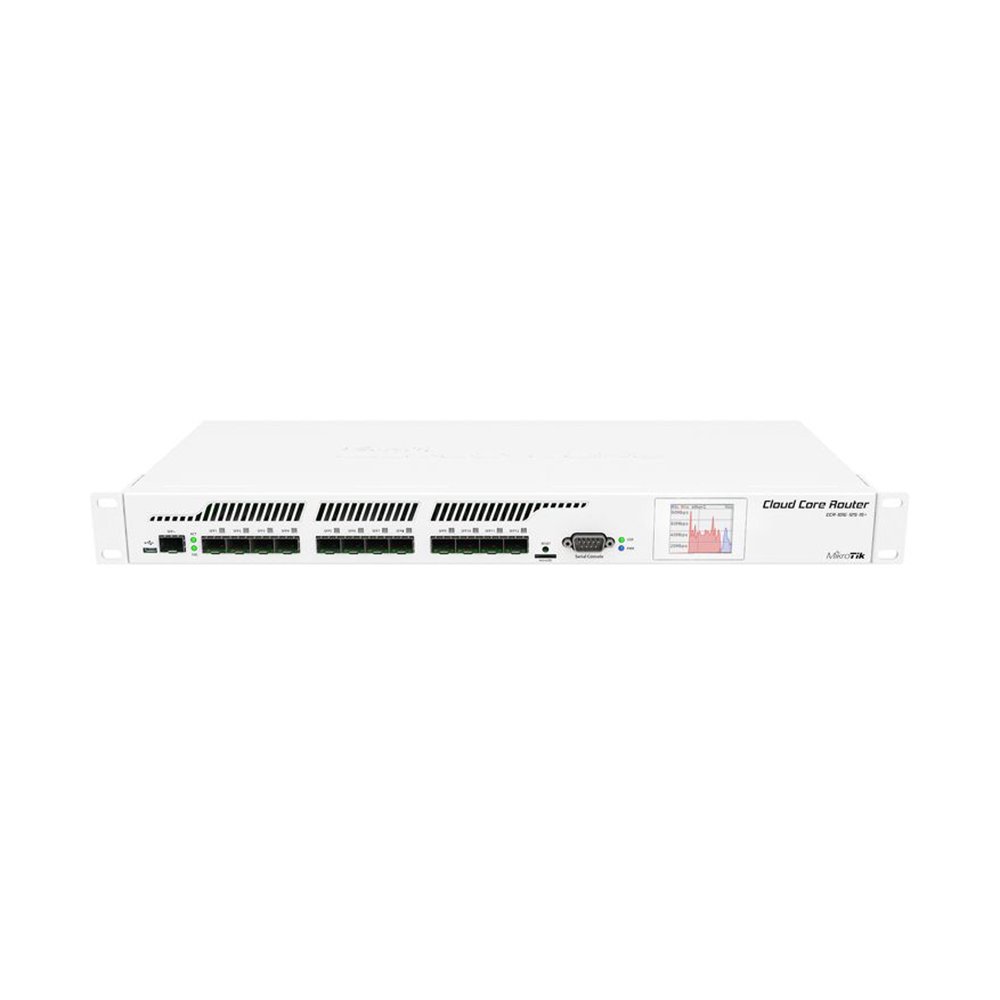
Sixteen cores. Twelve SFP Gigabit ports. One SFP+ 10 Gigabit uplink. A switching fabric capable of handling the most demanding routing workloads on the planet — all wrapped in a 1U rack-mount chassis running RouterOS Level 6 with zero licensing fees and zero performance compromises.
This is not a router for a small office. This is the router that powers Internet Service Providers, carrier networks, large enterprise backbones, and hyperscale content delivery infrastructures around the world. If your network carries serious traffic, the CCR1016-12S-1S+ is the engine it deserves.
What Is the MikroTik CCR1016-12S-1S+?
The CCR1016-12S-1S+ is part of MikroTik’s legendary Cloud Core Router (CCR) series — a purpose-built family of high-performance routers powered by Tilera TILE-Gx multi-core processors specifically architected for network packet processing at wire speed.
Where traditional routers rely on a single or dual-core processor to handle all routing operations sequentially, the CCR architecture distributes packet processing across all 16 cores simultaneously — delivering a level of parallelized throughput that transforms how your network handles peak load, complex firewall rulesets, VPN encryption, and multi-gigabit routing simultaneously.
The result is a router that doesn’t just handle your current traffic demands — it absorbs them effortlessly and leaves headroom for growth that most organizations won’t reach for years.
16-Core Tilera TILE-Gx Processor — The Architecture That Changes Everything
Why Multi-Core Packet Processing Is the Only Answer to Modern Traffic Demands
The networking world has fundamentally changed. Traffic volumes that would have been considered extraordinary a decade ago are now routine. A single ISP uplink carries the simultaneous demands of thousands of subscribers streaming 4K video, conducting video conferences, transferring large files, and running cloud-hosted applications — all at once, all expecting wire-speed performance.
The Tilera TILE-Gx processor inside the CCR1016-12S-1S+ was designed from silicon upward to address exactly this challenge:
- 16 independent processing cores work in true parallel — no core ever waits on another to complete a task before handling the next packet
- Each core runs at 1.2GHz with dedicated cache and memory bandwidth — eliminating the shared-resource bottlenecks that throttle traditional router architectures
- Hardware-level packet distribution — incoming traffic is automatically load-balanced across all 16 cores at the hardware layer, ensuring perfectly even processing load distribution
- Native network instruction set — the TILE-Gx architecture includes dedicated silicon instructions for packet forwarding, header parsing, checksum calculation, and flow classification — operations that consume disproportionate CPU cycles on general-purpose processors
- Massive concurrent flow handling — process millions of simultaneous network flows without table overflow or performance degradation
- Consistent latency under load — because processing never concentrates on a single bottlenecked core, latency remains stable and predictable even at maximum throughput
2GB DDR3 RAM — The Memory Backbone for Full Internet Routing Tables
The CCR1016-12S-1S+ ships with 2GB of DDR3 RAM — a critical specification for organizations running BGP with full internet routing tables. A complete IPv4 BGP routing table currently exceeds 900,000 prefixes. A full IPv6 table adds further requirements. The CCR1016’s 2GB RAM handles full dual-stack BGP tables with comfortable headroom for routing processes, connection tracking, firewall state tables, and system operations — simultaneously.
For ISPs, IXP participants, and enterprise networks with direct carrier peering, this memory capacity is not optional — it is foundational.
Port Configuration — Fiber-First Design for Modern High-Density Networks
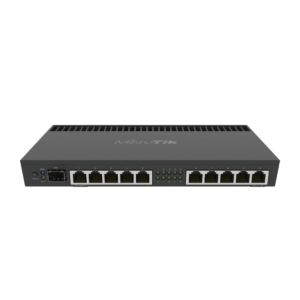
12 x SFP Gigabit Ports + 1 x SFP+ 10 Gigabit Port
The CCR1016-12S-1S+ makes a deliberate architectural choice that sets it apart from copper-port routers — every data port is optical. Twelve standard SFP Gigabit ports and one SFP+ 10 Gigabit port form a connectivity matrix purpose-built for the way modern carrier and enterprise networks are actually built.
Why Optical SFP Ports Over Copper RJ45?
- Distance without signal degradation — fiber connections maintain full Gigabit performance across hundreds of meters to tens of kilometers, making the CCR1016 ideal for distributed campus networks, multi-building enterprises, and carrier interconnects
- Electrical isolation — fiber carries no electrical current between endpoints, eliminating ground loops, lightning strike propagation, and electromagnetic interference that plague copper installations
- Physical security — fiber connections cannot be tapped without physically breaking the cable, making optical connectivity inherently more secure for sensitive network segments
- Higher density in structured cabling — SFP fiber cabling is thinner, lighter, and more manageable than copper Cat6/Cat6A at scale — critical for dense rack environments
- Compatibility with existing fiber infrastructure — organizations that have invested in structured fiber cabling can connect the CCR1016 directly to existing runs without any media conversion
SFP Port Flexibility — Your Choice of Transceivers
The 12 SFP ports support the full range of standard SFP transceivers:
- 1000Base-SX (multi-mode, 550m) — for intra-building and campus connections
- 1000Base-LX/LH (single-mode, 10km) — for inter-building and metropolitan connections
- 1000Base-ZX (single-mode, 80km) — for long-haul regional network connections
- 1000Base-T SFP (copper SFP) — for environments where RJ45 connectivity is required on specific ports
- CWDM/DWDM SFP — for wavelength-division multiplexing deployments sharing fiber capacity across multiple logical links
- MikroTik S-31DLC20D, S-3553LC20D, and compatible third-party modules — broad ecosystem compatibility across multiple vendors
The SFP+ 10G Uplink — Your High-Speed Aggregation Port
The single SFP+ 10 Gigabit port serves as the CCR1016’s high-speed aggregation and uplink interface — ideal for:
- Upstream carrier connection at 10G for ISP deployments
- Core switch interconnect via 10G DAC cable or fiber transceiver
- Data center fabric uplink connecting the CCR1016 to a 10G switching core
- High-throughput server or storage direct connection for bandwidth-intensive applications
- Inter-router 10G backbone link in multi-router network topologies
RouterOS Level 6 — Unlimited Power, Zero Additional Cost
The Complete Feature Set of the World’s Most Capable Router OS
The CCR1016-12S-1S+ ships with a RouterOS Level 6 license — MikroTik’s unrestricted, highest-tier operating system license — included as standard. Every feature. Every protocol. Every capability. No upsells, no annual renewals, no per-feature module purchases.
Routing Protocols — Built for the Internet’s Complexity
- BGP (Border Gateway Protocol) — full eBGP and iBGP support with route filtering, communities, local preference, MED attributes, and route reflector capability for complex internet routing deployments
- OSPF v2 and v3 — link-state routing for IPv4 and IPv6 enterprise and ISP interior networks with area segmentation and route summarization
- IS-IS — intermediate system routing protocol support for service provider networks preferring IS-IS over OSPF
- RIP and RIPng — legacy routing protocol support for environments requiring backward compatibility
- Static routing with recursive resolution — precise control over specific traffic flows and policy-based routing decisions
- ECMP (Equal Cost Multi-Path) — distribute routed traffic intelligently across multiple equal-cost paths for both load balancing and redundancy
- BFD (Bidirectional Forwarding Detection) — sub-second failure detection for routing protocol adjacencies, enabling rapid convergence in high-availability deployments
VPN and Tunneling — Secure Connectivity at Scale
- IPsec IKEv1/IKEv2 — hardware-assisted encrypted site-to-site and remote access VPN with AES-256, SHA-256, and modern cipher support
- WireGuard — modern, high-performance VPN protocol with minimal overhead and maximum throughput
- OpenVPN — SSL/TLS-based VPN for maximum firewall traversal compatibility
- L2TP/IPsec — industry-standard remote access VPN for Windows, macOS, iOS, and Android clients without additional software
- SSTP — Microsoft-compatible SSL VPN protocol for environments with strict firewall policies
- GRE and IPIP tunnels — lightweight tunneling for network interconnection and overlay topologies
- MPLS and LDP — full Multi-Protocol Label Switching support for service provider traffic engineering
Quality of Service — Delivering the Right Experience to Every User
- HTB (Hierarchical Token Bucket) — precise bandwidth allocation and guaranteed minimums for traffic classes, users, and services
- HFSC (Hierarchical Fair Service Curve) — advanced QoS with both bandwidth and latency guarantees for voice, video, and data traffic differentiation
- CAKE — modern, intelligent queue management that actively combats bufferbloat for consistent low-latency performance
- DSCP marking and remarking — classify and mark traffic at ingress for consistent QoS treatment across the entire network path
- Priority queuing and traffic shaping — ensure VoIP calls, video conferencing, and real-time applications always receive priority over bulk data transfers
Security and Access Control — Enterprise-Grade Protection
- Stateful firewall with connection tracking — filter traffic based on connection state, eliminating the vulnerabilities of stateless ACL-only approaches
- Layer 7 application detection — identify and control specific application traffic patterns, not just port numbers
- Address lists and dynamic blocking — automatically add offending IPs to block lists based on traffic behavior patterns
- Port knocking and stealth services — hide management interfaces from automated scanning and brute-force attacks
- RADIUS authentication integration — centralize authentication for PPPoE subscribers, VPN users, and administrative access through existing RADIUS infrastructure
- Certificate management — import and manage SSL certificates for HTTPS management, VPN authentication, and hotspot captive portals
Hardware Specifications — Built for the Rack, Built for the Long Haul
| Specification | Detail |
|---|---|
| CPU | Tilera TILE-Gx16 16-Core, 1.2GHz per core |
| RAM | 2GB DDR3 |
| Storage | 1GB NAND Flash |
| SFP Ports | 12 x 1Gbps SFP |
| SFP+ Ports | 1 x 10Gbps SFP+ |
| Management Port | 1 x 10/100 Ethernet RJ45 |
| Serial Console | RJ45 Serial Port |
| USB | 1 x USB 2.0 |
| RouterOS License | Level 6 |
| Operating System | RouterOS v6 / v7 |
| Form Factor | 1U Rack-mount |
| Power Supply | Dual redundant hot-swap PSUs |
| Cooling | Active (dual fans) |
| Operating Temp | 0°C to +45°C |
| Power Consumption | ~65W typical |
| Dimensions | 443 x 208 x 44mm |
| Weight | 3.4kg |
Dual Redundant Hot-Swap Power Supplies — Because Your Network Never Sleeps
Engineering Reliability Into Every Component
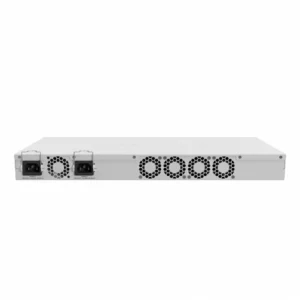
The CCR1016-12S-1S+ includes dual redundant hot-swappable power supply units — a hardware-level commitment to the uptime standards that carrier and enterprise networks demand.
In active operation, both PSUs share the load. Should either PSU fail — without warning, without scheduled maintenance — the surviving unit assumes the full load instantaneously, with no routing interruption, no packet loss, and no manual intervention required. When replacement is needed, the failed unit is swapped out while the router continues routing — hot, live, and uninterrupted.
For organizations bound by SLAs, uptime guarantees, and regulatory compliance requirements, dual hot-swap PSU redundancy is the difference between a manageable maintenance window and an unacceptable service outage. The CCR1016 makes it standard.
Ideal Use Cases — Networks That Demand the CCR1016-12S-1S+
Internet Service Providers — The ISP Router Built for Growth
The CCR1016-12S-1S+ is a natural choice for ISPs managing from hundreds to tens of thousands of subscribers. Its combination of 16-core parallel processing, 2GB RAM for full BGP tables, PPPoE server capabilities, and advanced QoS makes it the ideal subscriber aggregation and border routing platform:
- Terminate thousands of simultaneous PPPoE subscriber sessions without performance degradation
- Peer directly with upstream carriers via BGP and maintain full internet routing tables
- Apply per-subscriber bandwidth policies and QoS through Queues and RADIUS integration
- Monitor and shape subscriber traffic in real time with MikroTik’s traffic analysis tools
- Scale from a single CCR1016 to a multi-router cluster as your subscriber base grows
Carrier and Transit Network Core Routing
For carriers providing IP transit, peering, and interconnection services, the CCR1016-12S-1S+ delivers:
- Full BGP table handling with ample RAM headroom for both IPv4 and IPv6 prefixes
- Multi-path routing and traffic engineering across multiple upstream and peer connections
- MPLS label switching for traffic isolation and service segmentation
- High-throughput routing at sustained multi-gigabit rates across the 16-core fabric
Enterprise WAN Aggregation and Core Routing
Large enterprises with multi-site WAN connectivity, complex VLAN architectures, and demanding traffic volumes use the CCR1016 to:
- Aggregate multiple WAN connections from different carriers with intelligent load balancing and failover
- Route inter-VLAN traffic at wire speed across complex campus and data center environments
- Terminate and manage site-to-site VPN connections to branch offices, partners, and cloud providers
- Enforce granular security policies across all network segments simultaneously
Internet Exchange Point (IXP) Connectivity
Organizations participating in Internet Exchange Points for direct peering with content providers, CDNs, and other networks require full BGP table processing and high-throughput routing that the CCR1016-12S-1S+ delivers natively.
Managed Service Provider (MSP) Infrastructure
MSPs delivering managed network services to enterprise clients rely on the CCR1016’s routing depth and protocol support to deliver carrier-grade service quality from centralized or distributed routing infrastructure.
Data Center Border and Edge Routing
Position the CCR1016-12S-1S+ at the data center network border — handling upstream carrier BGP sessions, traffic engineering, DDoS mitigation policy enforcement, and high-throughput routing for data center services facing the public internet.
CCR1016-12S-1S+ vs. The Competition — An Honest Comparison
Carrier-Grade Capability at a Fraction of the Traditional Cost
| Feature | MikroTik CCR1016-12S-1S+ | Traditional Carrier Router |
|---|---|---|
| CPU Cores | 16 x 1.2GHz TILE-Gx | Typically 4–8 Cores |
| RAM | 2GB DDR3 | 2–8GB (at higher cost) |
| Full BGP Table Support | ✅ Yes | ✅ Yes |
| 12 x SFP Gigabit Ports | ✅ Yes | ❌ Typically Fewer |
| 10G SFP+ Uplink | ✅ Yes | ✅ Yes |
| RouterOS Level 6 (All Features) | ✅ Included | ❌ Tiered Licensing |
| BGP/OSPF/MPLS/IS-IS | ✅ Included | ❌ Often Extra License |
| Dual Hot-Swap PSU | ✅ Standard | ✅ Often Extra Cost |
| Annual Software Subscription | ❌ None Required | ✅ Mandatory |
| Total Cost of Ownership | ✅ Exceptional | ❌ Very High |
| Vendor Lock-In | ❌ Open Ecosystem | ✅ Proprietary |
Frequently Asked Questions
Can the CCR1016-12S-1S+ handle a full BGP internet routing table?
Yes. With 2GB of DDR3 RAM and a Level 6 RouterOS license, the CCR1016-12S-1S+ comfortably handles a full IPv4 BGP routing table exceeding 900,000 prefixes, plus IPv6 prefixes, with memory headroom remaining for routing processes, connection tracking, and firewall state tables.
How many PPPoE sessions can the CCR1016 handle simultaneously?
RouterOS Level 6 supports unlimited PPPoE sessions from a licensing perspective. Practical capacity depends on per-session traffic load and QoS complexity, but the 16-core architecture allows the CCR1016 to manage thousands of concurrent PPPoE subscriber sessions under realistic ISP traffic profiles.
Are the SFP ports compatible with third-party transceivers?
Yes. The CCR1016-12S-1S+ is compatible with a broad range of industry-standard SFP and SFP+ transceivers from MikroTik and third-party vendors. MikroTik’s own transceiver lineup covers multi-mode, single-mode, long-haul, CWDM, and copper SFP options for complete flexibility.
Can I use copper connectivity on the SFP ports?
Yes. Standard 1000Base-T copper SFP transceivers (RJ45 SFP modules) can be inserted into any of the 12 SFP ports to provide copper Gigabit connectivity on specific ports where fiber is not available or appropriate.
Does the CCR1016 support IPv6 natively?
Absolutely. RouterOS on the CCR1016 provides complete dual-stack IPv4 and IPv6 support across all routing protocols, firewall features, QoS, VPN, and management interfaces — making it fully ready for modern dual-stack and IPv6-only network deployments.
What is the maximum throughput of the CCR1016-12S-1S+?
MikroTik rates the CCR1016-12S-1S+ at multi-gigabit routing throughput depending on packet size and feature complexity. With 64-byte packets (the most demanding scenario), the 16-core architecture sustains significantly higher packet-per-second performance than single or dual-core alternatives. For large packet sizes typical of real-world traffic, the CCR1016 sustains wire-speed routing across all ports simultaneously.
Can the CCR1016 be used as a pure Layer 2 switch?
While the CCR1016-12S-1S+ is primarily a routing platform, RouterOS supports bridge mode and VLAN-aware bridging — enabling Layer 2 switching operations on any combination of ports when required. However, for pure switching workloads at 10G+ scale, MikroTik’s CRS series switches are the more appropriate choice.
The 16-Core Difference — Routing at the Speed Your Network Demands
There is a moment in every growing network’s life when the router becomes the bottleneck. When traffic graphs reveal CPU saturation on a router that was perfectly capable two years ago. When subscriber complaints about peak-hour slowdowns point directly at packet processing limits. When the routing table grows beyond what available RAM can accommodate. When the business requires five-nines uptime and the hardware provides four.
That moment is the moment you need the MikroTik CCR1016-12S-1S+.
Sixteen cores that never tire. Twelve fiber ports that connect everything. One 10G uplink that carries it all upstream. A dual redundant power system that refuses to fail. And RouterOS Level 6 that gives you every tool ever built for routing, security, QoS, and VPN — included, unlocked, and ready on day one.
Your ISP subscribers deserve wire-speed performance. Your enterprise clients deserve carrier-grade reliability. Your operations team deserves a router they can trust absolutely and configure completely.
The MikroTik CCR1016-12S-1S+ delivers all of it — at a price that makes the competition irrelevant.
Order yours today and deploy the routing infrastructure your network has always deserved.
Reviews
There are no reviews yet.