
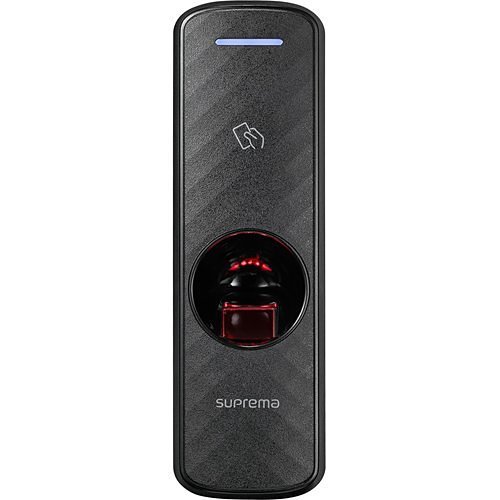
Suprema BSL2-OM BioStation L2 — Compact Fingerprint & MIFARE RFID Access Terminal
The Suprema BSL2-OM BioStation L2 is a compact fingerprint and RFID access control terminal designed for both physical access control and time and attendance applications. It combines Suprema’s optical fingerprint sensor with 13.56 MHz smart card reading capability — supporting MIFARE, MIFARE Plus, DESFire EV1/EV2/EV3, FeliCa, and NFC — in a wall-mounted unit suited to door entry points, turnstiles, and time attendance stations across enterprise, education, healthcare, and government environments.
The BSL2-OM variant is specifically the 13.56 MHz MIFARE-capable model, distinguishing it from the BSL2-OE which supports 125 kHz EM cards. This distinction is critical during system specification — the card frequency must match the organisation’s existing credential infrastructure or the planned card standard for new deployments.
Biometric Engine and Fingerprint Sensor
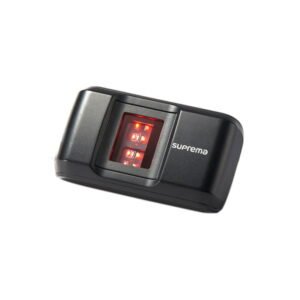
The BioStation L2 is built on Suprema’s optical fingerprint sensor (OP6) and next-generation fingerprint matching algorithm. The sensor reads and processes fingerprint images at a matching speed sufficient to support enterprise-scale user databases without perceptible authentication delay. Additionally, the 1.2 GHz quad-core processor contributes to rapid image processing and template matching across large enrolled fingerprint sets.
A key security feature of the BSL2-OM is Live Finger Detection (LFD) 2.0. This technology uses a dual light source imaging approach — combining infrared and visible white light — to distinguish live fingers from artificial replicas made from silicone, gelatin, latex, and other spoofing materials. The LFD engine analyses liveness characteristics and unnaturalness features in the captured fingerprint image. Consequently, the BSL2-OM resists spoofing attacks that would defeat single-light-source optical sensors, making it appropriate for deployments where biometric integrity is a security requirement rather than a convenience feature.
Up to 10 fingerprints per user can be enrolled, accommodating users with damaged or difficult-to-read fingers and providing fallback credentials within the biometric layer.
RFID Card Credentials — BSL2-OM
The BSL2-OM supports 13.56 MHz smart card reading across the following card types:
- MIFARE Classic — The most widely deployed contactless smart card standard in access control
- MIFARE Plus — Enhanced security migration path from MIFARE Classic with AES-128 encryption
- DESFire EV1 / EV2 / EV3 — High-security contactless smart cards with hardware-based cryptographic processing; DESFire EV2 and EV3 are supported via backward compatibility with DESFire EV1
- FeliCa — Contactless smart card standard widely deployed in Asia-Pacific markets
- NFC — Near-field communication for mobile credential presentation from smartphones and wearables
The RF read range is up to 50mm for MIFARE and DESFire cards, and up to 30mm for FeliCa. NFC support on the BSL2-OM enables mobile access credentials — users can authenticate using a smartphone or NFC-enabled device in place of a physical card, supporting mobile access programmes within Suprema’s BioStar platform.
Both card serial number (CSN) reading and smart card application functions are supported, allowing the BioStation L2 to operate in simple card number read mode or to validate encrypted card application data for higher-security deployments.
Processor and Hardware Platform
The BSL2-OM is powered by a 1.2 GHz quad-core processor — the highest clock speed implemented in Suprema’s terminal range at the time of the BioStation L2’s development. This processing capacity supports fast fingerprint matching, smooth GUI rendering, and rapid data transfer operations simultaneously. Furthermore, the 2 GB flash storage and 256 MB RAM provide capacity for large user databases and extensive transaction log storage without performance degradation.
A dedicated hardware crypto chip is integrated into the BSL2-OM, handling cryptographic operations for secure communication and encrypted card validation independently of the main processor. This hardware separation ensures that security operations are not compromised by main processor load during peak authentication periods.
Display and User Interface
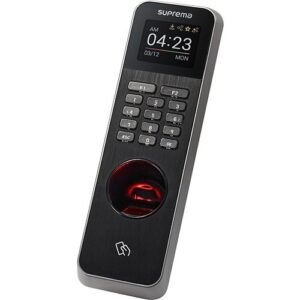
The BioStation L2 features a 2-inch colour TFT LCD display presenting an intuitive graphical user interface. The display provides real-time authentication feedback, time and attendance function prompts, and administrative menu access directly from the device. Users can access time and attendance functions using the dedicated programmable TA function keys without requiring interaction with a separate management terminal.
The full capacitive touch keypad supports PIN entry for multi-factor authentication and administrative configuration. The ESC button navigates menus and cancels inputs; the OK button confirms selections and manages T&A mode switching. Together, these controls allow administrators to add, remove, and modify user data or access permissions directly at the device when needed.
Access Control and Door Interface
The BSL2-OM includes an integrated relay output for direct door lock control in standalone configurations. It supports both fail-safe (normally energised) and fail-secure (normally de-energised) lock types, with the relay wired directly to the electric strike or magnetic lock.
Suprema’s installation documentation advises against using the internal relay in high-security applications due to physical tamper vulnerability at the reader mounting point. For secure deployments, Suprema recommends pairing the BioStation L2 with a separate relay unit — such as Suprema’s Secure I/O 2, DM-20, or CoreStation — installed on the secure side of the door. This architecture keeps the lock control hardware inaccessible from the reader’s mounting location.
Additional I/O provisions include:
- TTL inputs — For door sensor and exit button connections (4-pin)
- RS-485 — For multi-device daisy-chain communication and connection to access control panels (4-pin)
- Wiegand input/output — Configurable as either a Wiegand input device or output device for integration with third-party access control panels (4-pin)
- Ethernet (TCP/IP) — Primary network communication for BioStar platform integration
Platform Integration — Suprema BioStar
The BSL2-OM is fully integrated with Suprema’s BioStar access control and time attendance management platform (BioStar 1.9 and BioStar 2). BioStar provides centralised user enrolment, credential management, access rule configuration, and event log management across multi-device installations. Administrators can enrol fingerprints and card credentials remotely via BioStar rather than at each device individually — a significant operational advantage in enterprise and multi-site deployments.
The BioStar 2 platform supports real-time event monitoring, zone-based access rules, anti-passback, interlock, and scheduled access control policies applied across BioStation L2 devices on the network. Additionally, the Wiegand interface enables integration with third-party access control systems — allowing the BSL2-OM to function as a credential reader feeding into existing panel-based infrastructure.
Power and Installation
The BSL2-OM operates on 12V DC at a maximum of 0.5A, drawing up to 600mA at peak. It is powered via a dedicated 2-pin power connector, and Suprema specifies that the door lock and BioStation L2 should be powered from separate supplies to prevent relay switching from causing voltage fluctuations that affect the terminal’s operation.
The unit is surface-mounted using a supplied wall bracket and drilling template. Installation requires maintaining minimum separation distances from other RF-emitting devices to prevent mutual interference — the installation guide specifies separation distances based on wall thickness at the mounting point. The cable cover and bracket assembly provide a clean, tamper-indicating installation profile on both plasterboard and masonry surfaces.
Ideal Users
- Corporate and Enterprise Security Managers — The BSL2-OM’s dual-factor authentication — fingerprint plus smart card — raises the credential assurance level above single-factor card-only deployments. LFD 2.0 biometric liveness detection addresses spoofing risk at high-value access points including server rooms, executive floors, and R&D areas. BioStar platform integration enables centralised management across multi-door, multi-site installations from a single administrative console.
- Time and Attendance Administrators in Medium to Large Organisations — The dedicated TA function keys, colour LCD, and BioStar integration support accurate, identity-verified time recording that eliminates buddy-punching. Up to 10 fingerprints per user and multi-credential support reduce authentication failures at shift changeover peaks. The on-device display provides immediate feedback without requiring a separate T&A terminal.
- Healthcare and Education Facilities Teams — DESFire EV2/EV3 and MIFARE Plus support enables deployment within high-security card schemes common in healthcare identity programmes and campus smart card environments. NFC mobile credential support reduces the physical card management overhead in environments with high staff turnover or frequent visitor access requirements.
- Systems Integrators on Multi-Technology Credential Projects — The BSL2-OM’s support for MIFARE, DESFire, FeliCa, and NFC within a single reader head accommodates mixed credential environments and migration projects where card standards are transitioning. Wiegand output enables integration with legacy panel-based access control infrastructure without replacing the existing control layer.
- Government and Regulated Industry Access Control Specifiers — Hardware crypto chip integration, DESFire EV3 smart card support, and LFD 2.0 biometric anti-spoofing address the layered security requirements of government, defence, financial services, and critical infrastructure access control specifications. BioStar’s audit log and zone-based access rule engine supports compliance reporting requirements in regulated environments.
Credential Specifications
| Attribute | Detail |
|---|---|
| Biometric | Optical Fingerprint Sensor (OP6) |
| Fingerprints per User | Up to 10 |
| RFID Frequency | 13.56 MHz |
| Supported Card Types | MIFARE Classic, MIFARE Plus, DESFire EV1/EV2/EV3, FeliCa, NFC |
| RF Read Range (MIFARE/DESFire) | Up to 50mm |
| RF Read Range (FeliCa) | Up to 30mm |
| Mobile Credential | NFC (BSL2-OM) |
| Card Mode | CSN and Smart Card Application |
| Live Finger Detection | LFD 2.0 (Dual Light Source — IR + White Light) |
Hardware Specifications
| Attribute | Detail |
|---|---|
| CPU | 1.2 GHz Quad-Core |
| Memory | 2 GB Flash + 256 MB RAM |
| Crypto Chip | Supported (hardware-based) |
| Display | 2-inch Colour TFT LCD |
| Keypad | Full Capacitive Touch |
| Function Buttons | Programmable T&A Function Keys |
Interface and Connectivity
| Attribute | Detail |
|---|---|
| Network | Ethernet (TCP/IP) |
| RS-485 | 4-pin (multi-device daisy chain) |
| Wiegand | 4-pin, configurable input or output |
| TTL Input | 4-pin (door sensor, exit button) |
| Relay Output | 3-pin (NO/COM/NC) — fail-safe and fail-secure |
| Platform | Suprema BioStar 1.9 / BioStar 2 |
Power Specifications
| Attribute | Detail |
|---|---|
| Input Voltage | 12V DC |
| Maximum Current | 0.5A (600mA peak) |
| Power Connector | 2-pin dedicated |
| Recommended Supply | Separate PSU from door lock supply |
Physical Specifications
| Attribute | Detail |
|---|---|
| Mounting | Wall-mount via supplied bracket |
| Installation Accessories | Drilling template, PVC anchors, fixing screws, ferrite core |
| Operating Temperature | -20°C to +50°C |
| Country of Origin | Republic of Korea |
Certifications and Compliance
| Certification | Detail |
|---|---|
| FCC | FCC ID: TKWBSL2-OM |
| CE | EU Declaration of Conformity |
| RF Frequency | 13.56 MHz (ASK modulation) |
| Platform Compatibility | BioStar 1.9 and BioStar 2 (from v1.9) |
| Operating System | Linux Kernel 3.x |
 No products in the cart.
Reviews
There are no reviews yet.