
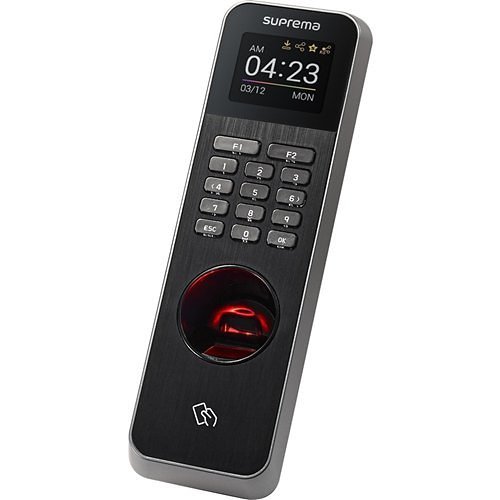

Suprema BEW2-ODPB BioEntry W2 — Outdoor Fingerprint Reader With Dual RFID Authentication
What Is the Suprema BEW2-ODPB BioEntry W2?
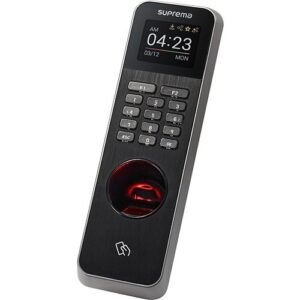
The Suprema BEW2-ODPB BioEntry W2 is a premium, outdoor-rated fingerprint access control reader that fuses cutting-edge biometric authentication with dual-frequency RFID card reading into a single, elegantly engineered device. Designed for organizations that demand the highest levels of perimeter security without sacrificing installation flexibility or user convenience, the BioEntry W2 represents the pinnacle of Suprema’s reader-class hardware lineup.
Unlike standalone terminals that operate independently, the BioEntry W2 functions as a highly intelligent peripheral reader — connecting to your existing access control panel via OSDP or Wiegand, inheriting the full power of your enterprise security infrastructure while dramatically elevating the sophistication of credentials it can read and verify at every door, gate, and barrier it guards.
Whether you’re retrofitting an aging card-only perimeter with biometric capability, building a greenfield high-security campus from the ground up, or deploying multi-layered authentication at critical infrastructure sites, the BioEntry W2 delivers the credential versatility, weather resilience, and recognition accuracy that modern security demands — without compromise.
Why the BioEntry W2 Stands Apart From Ordinary Access Readers
The Gap Between a Card Reader and a BioEntry W2 Is Not Small — It’s Enormous
Walk into any commercial building today and you’ll find the same decades-old access control paradigm: a proximity card reader mounted by the door, an employee taps a plastic card, and the door opens. It’s familiar. It’s also fundamentally broken as a security model.
Proximity cards get cloned in under 10 seconds with off-the-shelf equipment available for under $50. MIFARE cards, once considered secure, have well-documented vulnerabilities. And the card itself proves nothing about who is actually holding it — only that someone possesses a piece of plastic.
The Suprema BEW2-ODPB BioEntry W2 collapses this vulnerability entirely. By combining dual-frequency RFID reading with on-reader fingerprint verification, it ensures that every access event is authenticated by something you have (your card) AND something you are (your fingerprint) — simultaneously. The result is a credential system that cannot be cloned, shared, lost, or stolen without the attacker also needing your irreplaceable biological fingerprint.
This is not an upgrade. This is a generational leap in perimeter security philosophy.
Suprema BEW2-ODPB BioEntry W2 Key Features & Technical Specifications
Precision Engineering for Mission-Critical Access Points
- 🌧️ IP67 Ingress Protection Rating — Completely dust-tight and fully protected against temporary immersion in water up to 1 meter depth for 30 minutes, exceeding the IP66 standard of most competitors
- 🌡️ Extended Operating Temperature Range: -40°C to 70°C (-40°F to 158°F) — one of the widest thermal operating ranges in its class, enabling reliable deployment from Siberian winters to Middle Eastern summers
- 📡 Dual RFID Frequency Support:
- 125kHz — Compatible with EM4100, HID Prox, and all legacy proximity card ecosystems
- 13.56MHz — Compatible with MIFARE Classic, MIFARE DESFire EV1/EV2, iCLASS, iCLASS SE, and NFC-enabled mobile credentials
- 👆 Advanced Optical Fingerprint Sensor — 500 DPI resolution optical sensor with Suprema’s industry-leading fingerprint recognition algorithm delivering sub-1-second 1:1 verification
- 🛡️ Fake Fingerprint Detection (LFD) — Hardware-level liveness detection rejects spoofed biometric artifacts including silicone, gelatin, and latex fingerprint replicas
- 👥 On-Reader User Capacity: Up to 10,000 users with fingerprint templates stored locally for offline authentication resilience
- 📋 Event Log Capacity: Up to 50,000 timestamped access event logs stored on-device
- 🔗 Communication Interfaces:
- OSDP v2 — Encrypted, bidirectional communication for maximum security and diagnostics
- Wiegand — Industry-standard output for compatibility with virtually all legacy access control panels
- RS-485 — Reliable long-distance multi-drop wiring for cost-efficient large installations
- ☁️ BioStar 2 Integration — Native compatibility with Suprema’s enterprise access control and time-attendance management platform
- 💡 Multi-Color LED Status Indicators — Clear, intuitive visual feedback visible in all lighting conditions including direct sunlight
- 🔊 Built-In Buzzer — Audible authentication feedback for high-noise industrial environments
- 🔒 Tamper Detection Switch — Instant alarm trigger upon any enclosure interference attempt
- 📐 Sleek, Low-Profile Industrial Design — Mounts flush on walls, posts, gate columns, and turnstile frames
Understanding IP67: Why One Rating Point Changes Everything
The Difference Between IP66 and IP67 Is Not Incremental — It’s Categorical
Many access control readers on the market carry an IP66 rating — protection against powerful water jets. This is sufficient for most outdoor deployments. But certain environments demand more:
- Coastal installations exposed to wave splash and salt spray
- Underground parking structures prone to flooding during heavy rain events
- Washdown environments in food processing facilities and pharmaceutical plants where equipment is regularly hosed down
- Flood-prone geographic regions where surface water regularly accumulates around access points
- Below-grade installations at basement entrances, loading dock pits, and below-street-level access points
The BioEntry W2’s IP67 rating guarantees full protection against complete temporary submersion — a threshold that IP66 explicitly does not cover. In these environments, IP67 isn’t a specification luxury; it’s the difference between a reader that survives the next major rain event and one that doesn’t.
Dual RFID Technology: Bridging Legacy Systems and Modern Credentials
One Reader. Every Card Technology Your Organization Has Ever Issued.
One of the most painful challenges in enterprise access control is credential fragmentation — different buildings running different card technologies, acquired companies with incompatible legacy systems, and the perpetual cost of re-issuing cards during technology transitions. The BioEntry W2’s dual-frequency RFID engine resolves this complexity permanently.
125kHz Legacy Compatibility
- EM4100 / EM Proximity — The most widely deployed proximity card format globally
- HID Prox — Ubiquitous in North American commercial real estate
- Compatible with virtually every legacy proximity card system deployed over the past three decades
13.56MHz Smart Card & Mobile Credential Support
- MIFARE Classic — Widely deployed in transit, hospitality, and commercial access systems
- MIFARE DESFire EV1 / EV2 — AES-128 encrypted smart cards meeting the most demanding government and enterprise security standards
- HID iCLASS & iCLASS SE — Secure, encrypted credentials for high-assurance environments
- NFC Mobile Credentials — Smartphone-based access for organizations transitioning to digital credential ecosystems
This means the BioEntry W2 can simultaneously serve employees carrying 10-year-old proximity cards and those using NFC credentials on their smartphones — within the same deployment, at the same reader, without any additional hardware.
Who Needs the Suprema BioEntry W2 BEW2-ODPB?
Every Organization With a Perimeter Worthy of Real Protection
- 🏛️ Government Buildings & Embassies — Classified zone access control requiring multi-factor authentication that meets sovereign security standards
- ⚡ Critical Infrastructure — Power generation facilities, water treatment plants, oil refineries, and telecommunications nodes where unauthorized access could have national-scale consequences
- 💊 Pharmaceutical & Life Sciences — cGMP-compliant access control for clean rooms, controlled substance storage, and research laboratories where access audit trails carry regulatory weight
- 🏦 Financial Institutions — Vault rooms, server rooms, and trading floors demanding the highest credential assurance available in a reader-class device
- 🔬 Research & Development Facilities — Protecting intellectual property in spaces where even trusted employees must be constrained to authorized zones
- 🏭 High-Value Manufacturing — Semiconductor fabs, aerospace assembly, and defense manufacturing where supply chain integrity begins at the door
- 🏥 Healthcare Campuses — Pharmacy storage, medical records rooms, and restricted clinical areas governed by HIPAA access control requirements
- 🚢 Port & Maritime Facilities — ISPS Code-compliant vessel and terminal access control in environments exposed to salt air, extreme humidity, and heavy precipitation
- 🏢 Data Centers — Multi-layer physical security protecting server infrastructure where every access event must be biometrically non-repudiable
OSDP v2: The Communication Protocol That Changes What a Reader Can Do
Most Security Teams Don’t Know What They’re Missing Without OSDP
The majority of access control readers deployed globally still communicate via Wiegand — a protocol developed in the 1980s that transmits credential data in clear text, with no encryption, no tamper detection, and no ability to send information back from the reader to the panel.
The BioEntry W2’s OSDP v2 support represents a fundamental architectural upgrade:
- AES-128 Encrypted Communication — Credential data between the reader and panel is fully encrypted in transit, eliminating the interception attacks that plague Wiegand installations
- Bidirectional Communication — The panel can send commands to the reader (LED control, sound feedback, configuration updates) and receive rich status data in return — something Wiegand physically cannot do
- Reader Health Monitoring — Real-time tamper detection, communication fault alerts, and reader status reporting to your access control panel
- Secure Channel Establishment — Mutual authentication between reader and panel prevents rogue device substitution attacks
- Future-Proof Architecture — As OSDP continues to be adopted as the industry standard for high-security installations, your BioEntry W2 investment is already aligned with the trajectory of enterprise physical security
For organizations operating under FICAM, HSPD-12, or ICD 705 compliance requirements, OSDP support is no longer optional — it’s mandatory. The BioEntry W2 delivers it natively.
Fake Fingerprint Detection: The Invisible Guardian at Every Door
Your Outer Perimeter Is Exactly Where Spoofing Attacks Are Most Likely to Occur
Perimeter readers operate with minimal human supervision. Unlike a reception desk where a security officer observes credential presentation, an outdoor reader mounted on a gate column processes authentications in complete isolation — which is precisely why sophisticated adversaries target them.
The BioEntry W2’s hardware-integrated Liveness Detection (LFD) doesn’t rely on software heuristics alone. It analyzes the optical and physiological characteristics of the presented finger at the sensor level, in real time, regardless of environmental lighting or temperature conditions. Attacks that defeat lesser readers — including:
- 🖨️ High-resolution printed fingerprint overlays on transparent film
- 🧤 Silicone and rubber mold replicas cast from lifted latent prints
- 🍮 Gelatin fingerprint casts — the attack method most commonly demonstrated in academic spoofing research
- 🪡 Latex fingertip replicas constructed from crime scene evidence
…are detected and rejected before a single access event is logged as granted. Every spoofing attempt is flagged, timestamped, and reportable — giving your security operations team the forensic record they need to investigate and respond.
On-Reader Intelligence: Autonomous Operation During Network Disruptions
A Reader That Goes Offline Is a Security Gap. The BioEntry W2 Refuses to Go Offline.
Network-dependent access control creates a single point of failure that sophisticated physical security adversaries understand and exploit. Cut the network cable — or simply wait for the inevitable infrastructure outage — and card-only readers that depend on server-side lookups either fail open (catastrophic) or fail closed (operationally disruptive).
The BioEntry W2 stores up to 10,000 user fingerprint templates and 50,000 event logs directly on the device, enabling completely autonomous authentication operation regardless of network status. When connectivity is restored:
- All access events sync automatically to BioStar 2 or your connected access control platform
- No manual reconciliation required — the on-device log is the authoritative record
- No access interruption during the outage period — authorized users experience zero disruption
- Security is maintained — the biometric verification requirement never lapses, even offline
This is particularly critical for remote site deployments — utility substations, communications towers, unmanned storage facilities — where network reliability cannot be guaranteed and a human operator is not present to manage a door-held-open situation.
BioStar 2 Integration: Centralized Control Over Every Reader on Your Network
Your BioEntry W2 Deployment Is Only as Powerful as the Platform Behind It
The BioEntry W2 is natively designed to operate within Suprema’s BioStar 2 ecosystem — a powerful, web-based access control and time-attendance management platform that transforms individual readers into nodes in an intelligent, centrally managed security network.
Through BioStar 2, your security team gains:
- Unified dashboard showing real-time access events across every BioEntry W2 and Suprema device on your network
- Centralized user enrollment — enroll a fingerprint once, deploy it to every authorized reader automatically
- Zone-based access policies — define which credentials are valid at which readers, at which times, under which conditions
- Video integration — correlate access events with camera footage for complete incident investigation workflows
- Elevator control — extend biometric authentication to floor-by-floor elevator access in multi-tenant buildings
- Anti-passback enforcement — prevent credential sharing by ensuring a user must exit before they can re-enter
- Time-attendance reporting — generate shift, overtime, and attendance compliance reports directly from biometric event data
- Remote firmware updates — keep every deployed BioEntry W2 current without dispatching a technician to each location
For organizations running multi-site deployments across geographically distributed facilities, BioStar 2 delivers a single pane of glass that makes managing hundreds of BioEntry W2 readers as straightforward as managing one.
The True Security Case for Biometric + Dual RFID Multi-Factor Authentication
Defense in Depth Starts at the First Door
Modern physical security doctrine — aligned with NIST SP 800-116, ISO 27001, and IEC 62443 — is built on the principle of defense in depth: layering multiple independent security controls so that the failure or defeat of any single layer does not result in a breach. The BioEntry W2 embodies this principle at the reader level:
- Layer 1 — Dual RFID: The presented card must be a valid, recognized credential in the correct frequency range and encryption scheme. Cloned or expired cards are rejected instantly.
- Layer 2 — Fingerprint Biometric: The person presenting the card must also provide a matching fingerprint, verified against the stored template in under one second.
- Layer 3 — Liveness Detection: The fingerprint presented must be from a live human finger — not a replica, mold, or overlay.
- Layer 4 — OSDP Encrypted Communication: Even if an attacker intercepts the reader-to-panel communication, AES-128 encryption makes the captured data cryptographically useless.
- Layer 5 — Tamper Detection: Any physical interference with the reader triggers an immediate alarm — preventing the “reader swap” attack where an attacker replaces a legitimate reader with a credential-harvesting clone.
Five independent security layers. One compact outdoor reader. This is what serious perimeter security looks like.
Frequently Asked Questions About the Suprema BEW2-ODPB BioEntry W2
Q: What is the difference between the BioEntry W2 and the BioLite N2 — which do I need? The BioLite N2 is a standalone terminal with its own keypad, display, and on-device access control logic — ideal for smaller installations or deployments without a central access control panel. The BioEntry W2 is a reader designed to connect to an existing access control controller or panel, making it ideal for enterprise deployments where centralized policy management, advanced integrations, and larger user databases are required.
Q: Can the BioEntry W2 read both 125kHz and 13.56MHz cards at the same reader simultaneously? Yes. The dual-frequency RFID engine can read either card type at the same reader without any configuration change — the reader automatically detects and processes whichever credential type is presented.
Q: Does the BioEntry W2 work with third-party access control panels, or only Suprema hardware? The BioEntry W2 is fully compatible with any access control panel that supports Wiegand input or OSDP v2 — including panels from Lenel, Software House, Genetec, Honeywell, Bosch, and virtually all other major manufacturers. It does not require a Suprema controller.
Q: What happens to stored fingerprint templates if the reader loses power? Fingerprint templates, user records, and event logs are stored in non-volatile flash memory — they are fully preserved through power interruptions, restarts, and firmware updates without any data loss.
Q: Is the BioEntry W2 suitable for saltwater and coastal environments? Yes. The IP67 rating provides complete protection against dust ingress and temporary water immersion. For coastal deployments, we additionally recommend periodic cleaning of the enclosure exterior to prevent salt crystal accumulation on the optical sensor window.
Q: Can mobile smartphones be used as credentials with the BioEntry W2? Yes. The 13.56MHz RFID engine supports NFC-based mobile credentials from compatible platforms, enabling smartphone-as-credential deployments for organizations transitioning away from physical card issuance.
What Happens When You Deploy the Wrong Reader at the Wrong Door?
The consequences of under-specifying access control hardware are rarely immediate. They accumulate — quietly, invisibly — until the moment they aren’t quiet at all:
- 🔓 A cloned proximity card grants a terminated employee access to your server room six months after their departure
- 🌧️ A weather-damaged reader at your loading dock fails silently, holding the door open through the night
- 📋 An incomplete audit log caused by an offline, non-resilient reader leaves you unable to account for who accessed a secure area during an incident investigation
- 🤝 A credential-sharing employee clocks in for three absent colleagues at an unmonitored outdoor terminal every Friday afternoon
None of these scenarios are hypothetical. They happen daily in organizations that treat access control hardware as a commodity purchase rather than a security infrastructure decision.
The Suprema BEW2-ODPB BioEntry W2 is the answer to every one of these failure modes — deployed in a single, elegant outdoor reader that costs a fraction of what any single one of these incidents would.
Why Suprema. Why Now. Why the BioEntry W2.
Suprema has spent over two decades achieving what few biometric manufacturers can claim: consistent top rankings in NIST biometric algorithm benchmarks, real-world deployments protecting critical infrastructure on every inhabited continent, and a product portfolio trusted by governments, militaries, and Fortune 500 enterprises who cannot afford to be wrong about who they let through their doors.
The BioEntry W2 inherits this legacy completely — carrying the certifications, the recognition algorithms, and the engineering philosophy that has made Suprema the brand that serious security professionals specify by name:
- 🏆 CE, FCC Certified
- 🌿 RoHS Compliant
- 💧 IP67 Rated
- 🔐 OSDP v2 Certified
- 📋 BioStar 2 Native Integration
Invest Once. Secure for the Long Term.
Access control hardware that fails, gets cloned, or becomes obsolete forces organizations into a painful cycle of emergency replacement, re-installation costs, and the security gaps that exist during every transition period. The Suprema BEW2-ODPB BioEntry W2 breaks this cycle.
With IP67 weather resilience built to outlast the installation, dual RFID compatibility that bridges your past and your future credential ecosystems, and fingerprint biometrics that make every access event non-repudiable, the BioEntry W2 is a reader you install once — and rely on for the operational lifespan of your facility.
Your perimeter deserves hardware that was engineered for it. Not adapted to it. Not compromised for it. Built for it.
Reviews
There are no reviews yet.