
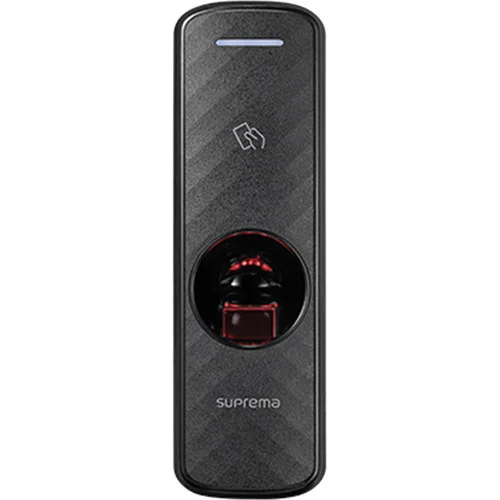
Suprema BioEntry P2 BEP2-OD — Compact IP Fingerprint Reader & Controller With Dual RFID
What Is the Suprema BioEntry P2 BEP2-OD?
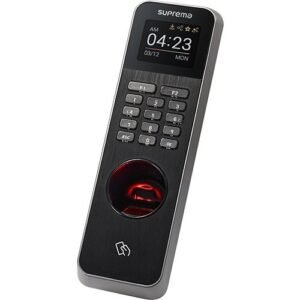
The Suprema BioEntry P2 BEP2-OD is a compact, IP-rated fingerprint reader and standalone controller that redefines what a small-form-factor access control device can accomplish. Engineered for organizations that demand enterprise-grade biometric authentication in tight installation spaces, the BioEntry P2 delivers a remarkable combination of on-device processing intelligence, industry-leading optical fingerprint sensing, and the most comprehensive RFID card compatibility portfolio ever integrated into a reader of its class.
This is not simply a reader waiting for instructions from a distant controller. The BioEntry P2 is itself a controller — capable of making real-time access decisions autonomously, managing its own user database, enforcing customizable access policies, and logging every credential event with full timestamp fidelity. It is simultaneously the most compact and most capable device in its category.
Where competing solutions force a choice between physical size and functional depth, the BioEntry P2 refuses the compromise. Its OP6 optical sensor platform captures fingerprint images of exceptional clarity from a sensor surface smaller than your thumbnail, while its dual-frequency RFID engine reads virtually every card technology your organization has ever issued or is likely to issue in the future — from decade-old 125kHz proximity cards to cutting-edge FeliCa, NFC, ISO14443A/B, and ISO15693 smart credentials.
Whether you’re deploying access control at interior office doors, laboratory entry points, server room perimeters, elevator lobbies, or any space where installation real estate is constrained but security requirements are not, the BioEntry P2 is the device that fits where others don’t — and performs where others can’t.
Why Compact Does Not Mean Compromised — The BioEntry P2 Design Philosophy
Small Enough to Fit Anywhere. Powerful Enough to Secure Everything.
The physical security industry has long operated under an implicit assumption: serious access control requires serious-sized hardware. Large readers with prominent form factors, separate controller boxes mounted in nearby closets, and complex multi-component installations have been the default architecture for high-assurance access control for decades.
The Suprema BioEntry P2 dismantles this assumption with precision engineering. By integrating the full access control decision stack — fingerprint sensor, RFID reader, processing intelligence, user database, and event logging — into a single compact enclosure, it achieves something architecturally significant:
- Fewer components mean fewer failure points, fewer cable runs, and fewer installation labor hours
- On-device intelligence means no dependency on a remote controller for access decisions — the BioEntry P2 acts, it doesn’t wait
- Compact form factor opens installation locations that were previously impossible — narrow door frames, glass partitions, furniture-integrated access points, and space-constrained kiosk environments
- IP-rated outdoor enclosure means the compactness comes without any weather vulnerability trade-off
The result is an access control device that fits the architecture of your building rather than forcing your building’s architecture to accommodate it.
Suprema BioEntry P2 BEP2-OD Key Features & Technical Specifications
Every Capability Your Access Point Demands, Engineered Into One Elegant Device
- 🌧️ IP65 Ingress Protection Rating — Fully dust-tight with protection against low-pressure water jets from any direction, enabling reliable outdoor and semi-outdoor deployment
- 🌡️ Operating Temperature Range: -20°C to 50°C (-4°F to 122°F) — robust thermal performance across the full range of real-world outdoor and indoor deployment environments
- 👆 OP6 Advanced Optical Fingerprint Sensor — Suprema’s sixth-generation optical sensing platform delivering exceptional image quality, fast capture, and reliable performance across diverse fingerprint conditions including dry, wet, aged, and calloused fingers
- 🛡️ Fake Fingerprint Detection (LFD) — Hardware-integrated liveness detection rejects spoofed fingerprint artifacts at the point of capture, before any access decision is made
- ⚡ Sub-1-Second Authentication Speed — 1:1 fingerprint verification completed in under one second for frictionless throughput at high-traffic access points
- 📡 Comprehensive Dual RFID Engine:
- 125kHz: EM4100, HID Prox, and all legacy proximity card formats
- 13.56MHz: MIFARE Classic, MIFARE DESFire / DESFire EV1, FeliCa, NFC, ISO14443A, ISO14443B, ISO15693
- 👥 On-Device User Capacity: Up to 500 users with fingerprint templates stored locally for autonomous offline operation
- 📋 Event Log Capacity: Up to 50,000 timestamped access event logs stored on-device with automatic sync on network restoration
- 🔗 Communication Interfaces:
- TCP/IP (Ethernet) — Full network connectivity for centralized management and real-time event reporting
- RS-485 — Cost-effective multi-drop wiring for distributed reader networks
- Wiegand Input/Output — Bidirectional compatibility with virtually all legacy access control panels and peripherals
- ☁️ BioStar 2 Native Integration — First-class support for Suprema’s enterprise access control and time-attendance management platform
- 🔒 Tamper Detection Switch — Immediate alarm trigger upon any enclosure interference, with event log entry for forensic documentation
- 💡 Multi-Color LED Status Indicators — Intuitive visual authentication feedback clearly visible across varied lighting conditions
- 🔊 Built-In Buzzer — Audible credential feedback essential for noisy environments where visual indicators alone are insufficient
- 🔋 PoE (Power over Ethernet) Support — Single-cable installation carrying both power and data, eliminating separate power conduit requirements
- 🖥️ Standalone Controller Mode — Full access control decision-making capability without requiring an external controller panel
The OP6 Optical Sensor: Sixth-Generation Fingerprint Intelligence
When the Sensor Is Smarter, Every Fingerprint Becomes Readable
At the heart of the BioEntry P2’s biometric capability is the OP6 — Suprema’s sixth-generation optical fingerprint sensing platform, representing the cumulative refinement of over two decades of real-world fingerprint capture engineering. This isn’t incremental iteration — each generation of Suprema’s optical sensor platform has addressed the specific failure modes that preceding generations revealed in deployment, producing a sensor that performs reliably across precisely the fingerprint conditions that cause competing sensors to struggle.
What Makes the OP6 Exceptional:
Superior Image Acquisition Across Challenging Fingerprint Conditions The OP6’s optical architecture and illumination design are specifically engineered to capture high-contrast fingerprint images from fingers that defeat lesser sensors — including:
- Dry and dehydrated fingers common in air-conditioned office environments and cold outdoor settings
- Wet fingers from rain exposure, hand washing, or high-humidity environments
- Aged fingerprints with reduced ridge definition, common in elderly users
- Calloused and worn fingerprints from manual labor, construction, and industrial work
- Partial fingerprints where only a portion of the finger contacts the sensor surface
Enhanced Resistance to Environmental Contamination The OP6 sensor window is engineered to maintain performance even when exposed to dust accumulation, fingerprint oils, and surface debris — reducing false rejection rates in real-world deployment conditions that laboratory-tested sensors never anticipate.
Optimized for Suprema’s Recognition Algorithm The OP6’s image output characteristics are precisely calibrated to feed Suprema’s proprietary fingerprint matching algorithm — the same algorithm that has achieved top rankings in NIST benchmark evaluations — ensuring that the sensor and the matcher operate as a unified system rather than two independently optimized components bolted together.
The Most Comprehensive RFID Compatibility Portfolio in Its Class
One Reader. Every Card Your Organization Has Issued, Is Issuing, or Will Ever Issue.
The BioEntry P2’s dual-frequency RFID engine represents the most exhaustive credential compatibility matrix available in a compact reader — deliberately engineered to eliminate the “but will it read our cards?” conversation from every procurement and deployment discussion.
125kHz — Your Legacy Card Infrastructure, Fully Supported
- EM4100 / EM Proximity — The most globally prevalent proximity card format, deployed across hundreds of millions of access control installations worldwide
- HID Prox — The dominant proximity format in North American commercial real estate and corporate access control
- All compatible 125kHz proximity formats — If your organization has been issuing access cards for more than a decade, the BioEntry P2 reads them
13.56MHz — The Full Spectrum of Modern Smart Credentials
MIFARE Classic The most widely deployed smart card format globally, used across transit systems, hospitality, education, and commercial access control ecosystems on every continent.
MIFARE DESFire / DESFire EV1 AES-128 encrypted smart cards that meet the most demanding government, defense, and enterprise security requirements. DESFire’s multi-application architecture allows a single card to carry access credentials, logical identity, transit entitlements, and payment applications simultaneously.
FeliCa Sony’s high-speed contactless smart card technology, dominant in Japanese transit and access control infrastructure and increasingly adopted across Asia-Pacific enterprise environments. The BioEntry P2 is one of the few access control readers outside Japan to offer native FeliCa support — making it the definitive choice for multinational organizations with Asia-Pacific facilities.
NFC (Near Field Communication) Smartphone-based mobile credentials via NFC enable the BioEntry P2 to participate in digital-first credential ecosystems where physical card issuance is being reduced or eliminated entirely. Employees can use compatible smartphones as their access credentials — a capability that reduces card issuance costs, eliminates card loss events, and enables instant remote credential provisioning and revocation.
ISO14443A The international standard underlying MIFARE and most modern contactless smart cards. ISO14443A compatibility ensures the BioEntry P2 can read any conformant card regardless of specific manufacturer or application encoding.
ISO14443B The alternative contactless smart card standard used in electronic passports (e-Passports), national ID cards, and government-issued identity documents in numerous countries. ISO14443B support makes the BioEntry P2 capable of reading government identity credentials directly — valuable for regulated industries where verified government ID must serve as an access credential.
ISO15693 The vicinity card standard supporting read ranges greater than standard proximity cards — used in asset tracking, library systems, and specialized access control applications requiring longer read distances. ISO15693 compatibility extends the BioEntry P2’s versatility into hybrid access-and-asset-tracking deployment scenarios.
This credential portfolio is not theoretical breadth for marketing purposes. It is the practical answer to every RFID compatibility question your security team, your IT team, and your procurement team will ever raise about this device.
Standalone Controller Architecture: Intelligence at the Door, Not in the Closet
Why On-Device Control Is a Security Architecture Advantage
Traditional access control architectures route every credential presentation from a door reader back to a central controller panel — which makes the access decision and sends a door-open signal back to the reader. This architecture creates several structural vulnerabilities:
- Network-dependent access decisions mean a network outage disables every door simultaneously
- Communication interception between reader and controller is possible on poorly secured wiring runs
- Controller panel as single point of failure — damage, power loss, or compromise of the central controller affects every connected door
- Scalability bottlenecks as controller panel capacity limits the number of doors the system can manage
The BioEntry P2’s standalone controller mode fundamentally restructures this architecture:
- Access decisions are made at the door — no round-trip to a central controller required
- Local fingerprint template storage enables authentication even during complete network outages
- Distributed intelligence means a failure at one door doesn’t propagate to others
- Reduced wiring complexity — no separate controller box requires its own power, housing, and cable runs
For small to medium deployments of up to 500 users, the BioEntry P2 can serve as the entire access control system — reader, controller, and event logger — in a single compact enclosure. For larger enterprise deployments, it functions as an intelligent edge node within a BioStar 2-managed network, contributing its local processing capability to a centrally orchestrated security architecture.
Who Needs the Suprema BioEntry P2 BEP2-OD?
Precision-Fit for Every Environment Where Space Is Constrained but Security Is Not
- 🏢 Corporate Office Interiors — Individual office doors, conference rooms, executive suites, and HR record rooms where narrow door frames and aesthetic requirements demand a compact, elegant reader profile
- 🔬 Laboratory & Research Environments — Clean room entries, chemical storage access points, and intellectual property protection zones where the reader must fit within strict spatial and contamination control parameters
- 🖥️ Data Centers & Server Rooms — Rack room entries, network operations centers, and colocation facility access points where biometric authentication creates non-repudiable access records essential for SOC 2 and ISO 27001 compliance
- 🏥 Healthcare Facilities — Pharmacy storage, controlled substance cabinets, patient record rooms, and restricted clinical areas where HIPAA-mandated access control must fit within clinical interior design constraints
- 🏫 Educational Institutions — Faculty offices, examination repositories, financial aid records rooms, and IT infrastructure spaces requiring access control that doesn’t overwhelm the aesthetic of educational interiors
- 🏨 Hospitality & Hotels — Back-of-house access control for cash handling areas, reservation systems, and VIP areas where the reader must be unobtrusive without being unsecured
- 🏛️ Government Offices — Departmental access control in space-constrained historic buildings where surface-mounted hardware must meet both security and architectural preservation requirements
- 🔒 Retail & Commercial — Safe rooms, stockrooms, and cash management areas where compact installation is essential and multi-factor authentication prevents internal theft
- 🚀 Technology Startups & SMEs — Complete standalone access control for growing organizations that need enterprise-grade security without enterprise-scale infrastructure investment
Compact Form Factor, Enterprise-Grade Compliance Capabilities
The BioEntry P2 and Your Regulatory Obligations
For organizations operating under regulatory frameworks that mandate specific access control capabilities, the BioEntry P2 delivers compliance-relevant functionality that many compact readers simply cannot match:
HIPAA Physical Safeguard Compliance Healthcare organizations must implement technical controls ensuring that only authorized personnel access areas containing PHI (Protected Health Information). The BioEntry P2’s biometric authentication creates the non-repudiable, timestamped access records that HIPAA auditors require — demonstrating exactly who accessed protected areas and precisely when.
SOC 2 Type II Physical Access Controls Data centers and cloud service providers undergoing SOC 2 audits must demonstrate that physical access to infrastructure is controlled and monitored. The BioEntry P2’s on-device event logging and BioStar 2 integration provide the comprehensive audit trail that SOC 2 Type II physical security criteria demand.
ISO 27001 Access Control Policy Implementation ISO 27001’s A.9 domain requires organizations to implement and document physical access controls aligned with information security policy. The BioEntry P2’s multi-factor authentication capability and centralized management through BioStar 2 directly satisfy the asset protection and access restriction requirements of ISO 27001 Annex A.
PCI DSS Physical Access Requirements Payment Card Industry standards mandate that access to cardholder data environments is restricted to authorized individuals with documented justification. The BioEntry P2’s biometric audit trail provides the individual accountability that card-only systems cannot — a named fingerprint match is categorically more defensible than a card swipe that could have been performed by any card holder.
PoE Installation: The Single-Cable Access Control Deployment
Simplify Your Infrastructure. Reduce Your Installation Cost. Eliminate a Failure Point.
Power over Ethernet (PoE) support in the BioEntry P2 is not a minor convenience feature — it is a fundamental installation architecture advantage that compounds across every unit deployed:
Traditional access reader installation requires:
- Data cable run to reader location
- Separate power cable run to reader location
- Junction box or conduit for power cable
- Electrical work permits and licensed electrician involvement in many jurisdictions
- Separate power supply unit or transformer
BioEntry P2 PoE installation requires:
- Single CAT5e or CAT6 cable run to reader location
- PoE-capable network switch or PoE injector at the IDF/MDF
The cost differential — in materials, labor, and permitting — across a multi-door deployment is substantial and immediate. For a 20-door deployment, the installation cost savings from PoE alone can offset a significant portion of the hardware investment. And beyond cost, fewer components mean fewer failure points, fewer maintenance interventions, and a simpler infrastructure footprint that your facilities team will appreciate for the operational lifetime of the installation.
BioStar 2: The Platform That Transforms Individual Readers Into a Unified Security Network
Centralized Intelligence for Distributed Access Control
Each BioEntry P2 deployed as a standalone controller is powerful. But when every BioEntry P2 on your network is managed through Suprema’s BioStar 2 platform, the combined capability of your access control infrastructure becomes exponentially greater than the sum of its individual parts.
BioStar 2 delivers centralized control capabilities that transform your BioEntry P2 deployment:
- Single-point user enrollment — Enroll a user’s fingerprint and credentials once; BioStar 2 automatically distributes the template to every authorized reader across your network
- Granular access level management — Define precisely which doors each user or user group can access, during which time periods, under which conditions
- Real-time event monitoring — Every access grant, access denial, tamper attempt, and system event appears on a unified dashboard with zero delay
- Automated alerts and escalations — Configure instant notification workflows for specific event types — unauthorized access attempts, tamper alarms, and door-held-open events
- Comprehensive reporting suite — Generate access history, attendance compliance, and security incident reports on demand or on schedule
- Remote device management — Update firmware, modify access policies, and reconfigure reader behavior from a central console without dispatching technicians to each physical location
- Multi-site federation — Manage access control across geographically distributed facilities from a single BioStar 2 instance with site-level administrative delegation
Anti-Spoofing Architecture: Five Layers of Credential Defense
The BioEntry P2 Treats Every Authentication as a Potential Attack
Because it should. The organizations that deploy biometric access control at sensitive locations are precisely the organizations sophisticated adversaries target. The BioEntry P2 responds with layered credential defense that makes successful spoofing extraordinarily difficult:
Layer 1 — Dual RFID Encryption Verification DESFire EV1 cards are verified using AES-128 mutual authentication — both the card and the reader confirm each other’s legitimacy before any credential data is exchanged. A cloned or emulated card cannot complete this handshake.
Layer 2 — Biometric Matching The presented fingerprint must match a stored template for the credential holder within the reader’s local database or network-verified user record. A valid card presented by an unauthorized individual is rejected at this layer.
Layer 3 — Liveness Detection (LFD) The OP6 sensor’s integrated liveness detection analyzes the physical and optical characteristics of the presented fingerprint to confirm it originates from live human tissue — rejecting silicone replicas, printed overlays, and gelatin casts before they reach the matching algorithm.
Layer 4 — Tamper Detection Any physical attempt to interfere with the reader enclosure — prying, drilling, or forced removal — triggers the tamper alarm instantly, logs the event with timestamp, and signals your security monitoring infrastructure.
Layer 5 — Centralized Anomaly Detection via BioStar 2 BioStar 2’s access pattern analysis identifies behavioral anomalies — unusual access times, rapid multi-door traversal, geographic impossibilities — and triggers automated alerts for human security review.
Frequently Asked Questions About the Suprema BioEntry P2 BEP2-OD
Q: What makes the BioEntry P2 different from the BioEntry W2? The BioEntry W2 is optimized for high-capacity enterprise deployments with IP67 weather rating and a larger user database. The BioEntry P2 prioritizes compact form factor and comprehensive RFID credential compatibility — including FeliCa, ISO14443B, and ISO15693 — making it the superior choice when installation space is constrained, credential diversity is high, or a fully self-contained standalone controller in a small package is required.
Q: Can the BioEntry P2 read e-Passport chips for government ID verification? Yes. ISO14443B support enables the BioEntry P2 to read contactless chips embedded in electronic passports and government-issued national identity documents that conform to the ISO14443B standard — a unique capability in this device class.
Q: Does FeliCa support require any special configuration or licensing? No. FeliCa reading capability is natively integrated into the BioEntry P2’s RFID engine and is available without additional licensing, configuration files, or firmware modifications. Present a FeliCa card; the BioEntry P2 reads it.
Q: Can the BioEntry P2 operate as both a standalone controller and a network-managed reader simultaneously? Yes. In BioStar 2-connected deployments, the BioEntry P2 receives centralized policy updates and transmits event data to the platform in real time, while simultaneously maintaining its local user database and decision-making capability for offline resilience. The two modes are architecturally complementary, not mutually exclusive.
Q: What is the maximum cable distance for RS-485 connections? RS-485 supports reliable communication distances of up to 1,200 meters (approximately 4,000 feet) in a multi-drop topology — enabling the BioEntry P2 to be deployed in remote locations on large campuses, industrial facilities, and perimeter installations without signal degradation.
Q: How many BioEntry P2 units can be connected in a single RS-485 multi-drop network? Up to 32 devices can share a single RS-485 bus, enabling cost-effective distributed deployment across a facility with minimal cabling infrastructure.
Q: Is NFC mobile credential support available for all smartphones? The BioEntry P2 supports NFC-based mobile credentials on NFC-enabled Android and iOS devices running compatible credential management applications. Specific mobile credential application compatibility should be confirmed with your credential management platform vendor.
The Compact Device That Closes the Security Gap Between Small Doors and Big Threats
The physical security reality facing modern organizations is that threats do not proportionally scale their ambition to the size of the door they’re targeting. A server room with a narrow door frame is no less valuable a target than a vault with a wide entrance. A laboratory with space-constrained walls contains intellectual property no less worth protecting than any facility with room for large readers.
The Suprema BioEntry P2 BEP2-OD was built with this reality in mind — delivering the full depth of enterprise biometric access control into the compact form factor that fits where threats don’t expect serious security to be waiting.
- 500 user capacity across 50,000 logged events — sufficient for the majority of real-world single-facility deployments without any external infrastructure
- The widest RFID compatibility portfolio in its class — ensuring your credential investment is never stranded by a reader that can’t keep up
- OP6 optical sensing that reads the fingerprints other sensors reject — wet, dry, aged, calloused, and partial
- Standalone controller intelligence that keeps the door secure even when the network goes down
- PoE simplicity that cuts installation cost and complexity without cutting capability
Certified. Trusted. Suprema.
The BioEntry P2 carries the full weight of Suprema’s two-decade commitment to biometric excellence — including certifications that matter to your procurement, legal, and compliance teams:
- 🏆 CE Certified
- 📡 FCC Certified
- 🌿 RoHS Compliant
- 💧 IP65 Rated
- ☁️ BioStar 2 Native Integration
- 📋 Wiegand, RS-485, TCP/IP Interface Certified

 No products in the cart.
Reviews
There are no reviews yet.