
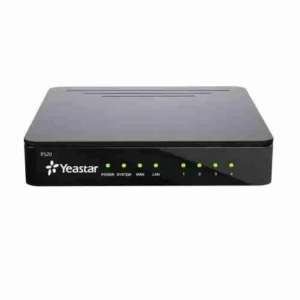
Yeastar TG400 4-Port GSM VoIP Gateway | Quad-Channel Cellular Power for High-Volume Business Communication
There comes a defining moment in every growing business’s communication journey — the moment when two GSM channels are no longer enough. When the dispatch desk is handling three simultaneous driver calls. When the support team is burning through mobile minutes faster than a two-port gateway can process them. When your on-net savings strategy demands coverage across four carrier networks, not two. When your business continuity plan requires cellular redundancy so deep that a single carrier outage barely registers as an inconvenience.
That moment calls for the Yeastar TG400 4-Port GSM VoIP Gateway.
Four independent GSM channels. Four simultaneous calls. Four SIM cards from the same carrier, different carriers, or any combination your cost optimization strategy demands. One compact, professionally engineered device that transforms your mobile network connectivity from a two-lane road into a four-lane highway — delivering the throughput, redundancy, and on-net savings that serious business communication requires.
If the TG100 was your introduction to GSM gateway technology and the TG200 doubled your capability, the TG400 is where GSM gateway strategy reaches its full operational potential for small-to-medium enterprise deployments.
What Is the Yeastar TG400 4-Port GSM VoIP Gateway?
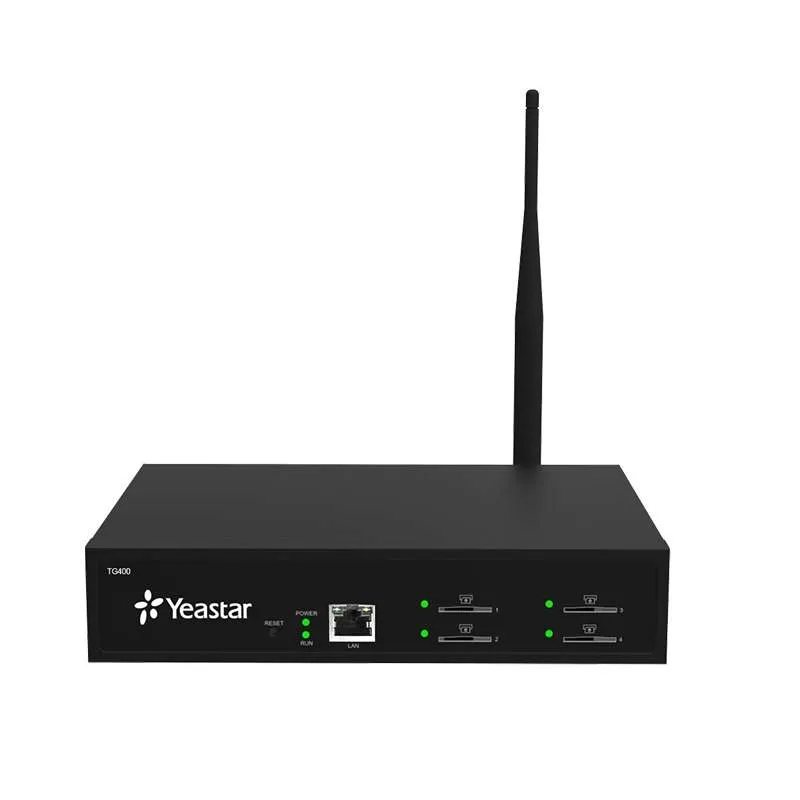
The Yeastar TG400 is a professional-grade, 4-port GSM VoIP Gateway that simultaneously connects four independent GSM cellular channels to your IP PBX or VoIP phone system via fully standards-compliant SIP protocol. Each of the four ports accommodates its own independent SIM card — creating four live, concurrent cellular trunks that your PBX manages, routes, monitors, and reports on exactly as it would any other trunk infrastructure.
The TG400 sits at the high-performance tier of Yeastar’s TG gateway series — the natural destination for businesses that have outgrown two-channel solutions, organizations building serious multi-carrier cost optimization strategies, call centers managing high concurrent mobile call volumes, and IT administrators deploying cellular trunk infrastructure that needs to scale, perform, and endure.
Four channels change the game entirely. Four channels mean your GSM gateway is never a bottleneck. Four channels mean on-net savings across four carrier networks. Four channels mean simultaneous inbound, outbound, and failover capacity that makes your cellular trunk infrastructure genuinely enterprise-capable.
The Yeastar TG400 Is the Definitive Solution For:
- Medium-to-large businesses with consistently high mobile call volumes requiring four simultaneous GSM channels
- Call centers and customer support operations where multiple agents make mobile calls concurrently throughout the workday
- Organizations operating across four major mobile carrier networks wanting maximum on-net savings coverage
- Logistics, dispatch, and field service companies coordinating large mobile workforces with constant simultaneous call demands
- Businesses requiring deep cellular redundancy with four independent failover channels across multiple carriers
- Healthcare organizations managing high-volume patient communication across multiple mobile networks
- Hospitality and property management groups coordinating staff, guests, and suppliers across busy operational environments
- IT administrators and MSPs delivering scalable multi-channel GSM trunk solutions to medium enterprise clients
- High-volume SMS operations requiring quad-channel cellular messaging throughput for notifications, alerts, and business automation
- Multi-branch businesses centralizing cellular trunk resources at headquarters to serve multiple office locations via IP
- Businesses in emerging markets where GSM infrastructure delivers more consistent connectivity than fixed-line alternatives
How the Yeastar TG400 Works — Four Channels, One Unified Architecture
The TG400 extends the proven Yeastar TG gateway integration model to its four-channel configuration — adding layers of routing intelligence, redundancy depth, and cost optimization breadth that two-port solutions simply cannot replicate.
Stage 1 — Quad SIM Configuration Insert up to four standard GSM SIM cards across the TG400’s four independent SIM slots. Design your SIM configuration around your business strategy — four SIMs from a single carrier for maximum volume on the dominant network, two SIMs each from two carriers for balanced dual-network coverage, or four SIMs from four different carriers for the ultimate in on-net reach and redundancy depth. Every combination is valid, every configuration serves a distinct business purpose.
Stage 2 — Four-Trunk PBX Registration Connect the TG400 to your local network via its Ethernet port. Register each of the four GSM ports as an independent SIP trunk on your IP PBX. Your PBX now manages four live cellular connections simultaneously — each available for inbound calls, outbound calls, failover routing, or SMS gateway operations according to your dial plan configuration.
Stage 3 — Advanced Quad-Channel Routing Strategy Deploy your four channels with the full sophistication that quad-port architecture enables. Route calls to Network A subscribers through Port 1, Network B subscribers through Port 2, Network C through Port 3, and Network D through Port 4 — covering on-net rates across the four largest mobile carriers in your market simultaneously. Dedicate two ports to inbound and two to outbound. Configure progressive failover cascading across all four channels. Implement load balancing across all active ports. The four-channel architecture gives your dial plan a depth of intelligence, flexibility, and resilience that fundamentally transforms what your cellular trunk infrastructure can accomplish.
Yeastar TG400 Key Features — Four Channels That Redefine What a GSM Gateway Can Do
📡 4 Fully Independent GSM Ports — Genuine Quad-Channel Performance
The TG400’s four GSM ports are not shared resources, not pooled bandwidth, and not virtual channels carved from a single physical connection. They are four genuinely independent, hardware-level GSM modules — each maintaining its own cellular registration, its own active call state, and its own SIM account management completely autonomously from the other three ports.
This true independence delivers critical operational advantages:
- A call on Port 1 has zero impact on the availability or audio quality of Ports 2, 3, or 4
- Each port independently manages its own network registration — if one carrier experiences a temporary registration drop, the other three ports continue operating without interruption
- Each port independently handles USSD commands, SMS operations, and call state without any cross-port interference
- All four ports can be simultaneously active on four separate calls with full audio quality maintained across every channel
- Supports GSM 850/900/1800/1900 MHz frequency bands across all four ports for universal global carrier compatibility
- Each port accepts a standard Mini SIM (2FF) card from any GSM network operator worldwide
- All four ports operate simultaneously at full performance with no bandwidth contention or quality degradation
- Complete feature parity across all four ports — every port supports voice calls, SMS, USSD, and real-time monitoring equally
💰 Quad-Carrier On-Net Optimization — The Maximum Possible Mobile Savings
The Yeastar TG400 enables the most comprehensive on-net mobile calling cost optimization available from a single gateway device. With four independent SIM slots, businesses can simultaneously cover the four most significant mobile carrier networks in their market — ensuring that virtually every mobile call their PBX makes routes to a same-network subscriber at on-net rates.
Consider the financial impact in a market with four major mobile carriers where a business makes 500 mobile calls per day:
- Without a GSM gateway — all 500 calls route through SIP trunks at fixed-to-mobile premium rates
- With TG100 (1 SIM) — calls to one carrier’s subscribers route at on-net rates; roughly 25% coverage
- With TG200 (2 SIMs) — calls to two carriers’ subscribers at on-net rates; roughly 50% coverage
- With TG400 (4 SIMs) — calls to four carriers’ subscribers at on-net rates; up to near-complete coverage of mobile call destinations
The TG400’s four-carrier strategy doesn’t just reduce mobile calling costs — it systematically eliminates premium fixed-to-mobile rates across the vast majority of your mobile call destinations. For organizations with high daily mobile call volumes, this translates directly into thousands of dollars in annual savings that compound with every passing month.
🔄 Four-Layer Carrier Redundancy — Communication Continuity at Its Deepest
Business continuity planning for communication infrastructure typically focuses on internet redundancy — backup ISP connections, failover routing between SIP trunk providers. But what about cellular redundancy? The TG400 introduces four independent layers of cellular failover protection that no single or dual-port gateway can approach:
- Primary SIP trunks fail → automatic failover to TG400 Port 1
- Port 1 carrier disruption → automatic failover to Port 2 (different carrier)
- Port 2 also disrupted → automatic failover to Port 3 (third carrier)
- Port 3 unavailable → automatic failover to Port 4 (fourth carrier)
The mathematical probability of all four independent carriers experiencing simultaneous outages is effectively negligible. For businesses where communication downtime carries severe operational or financial consequences — emergency services support, financial trading desks, healthcare facilities, critical logistics operations — the TG400’s four-layer cellular redundancy architecture provides a level of communication continuity assurance that no other single gateway device can match.
📞 Four Simultaneous Calls — Zero Bottleneck, Maximum Throughput
In any environment where mobile calling is a core operational activity rather than an occasional task, the limiting factor of a single or dual-port gateway becomes apparent quickly. The TG400 handles four simultaneous GSM calls — ensuring that your cellular trunk infrastructure is never the reason a call routes to a more expensive trunk, fails to connect, or keeps a customer waiting.
- Four agents can simultaneously make mobile calls through the gateway without any channel contention
- Inbound and outbound calls share the four channels without competing for priority
- Peak-hour call volumes that regularly exhaust two-port gateways flow effortlessly through four channels
- Load balancing distributes concurrent calls across all four active ports automatically for optimal efficiency
For call centers, dispatch operations, customer service teams, and any business environment where mobile calls are constant rather than occasional, four simultaneous channels transforms the TG400 from a cost-saving tool into a genuine operational asset.
📊 Advanced Port Management — Granular Four-Channel Control
Managing four GSM ports independently could be complex. Yeastar makes it effortless. The TG400’s unified web management interface provides granular, port-level control over every aspect of each channel’s operation — all from a single, intuitive browser-based dashboard:
- Individual port status panels — network carrier name, signal strength indicator, SIM registration status, and active call state displayed simultaneously for all four ports
- Per-port call routing configuration — assign completely different routing rules, dial patterns, and PBX trunk registrations to each port independently
- Port-level USSD management — send carrier USSD commands to any individual SIM for balance checks, data package activation, or account management without affecting other ports
- Independent SMS console — send and receive SMS on any or all ports simultaneously from the unified messaging interface
- Port grouping — logically group ports for load balancing, round-robin routing, or failover cascading configurations
- Per-port call logs — filter system-wide call history by individual port for granular traffic analysis and cost reporting
- Unified firmware management — update all four ports simultaneously with a single firmware deployment operation
📩 Quad-Channel SMS Gateway — Enterprise-Scale Business Messaging
With four independent GSM ports, the TG400 delivers SMS gateway throughput that approaches enterprise messaging platform capability — at a fraction of the cost of dedicated SMS platform subscriptions:
- Four simultaneous inbound SMS channels — receive messages on four separate mobile numbers concurrently, supporting multiple departments, customer lines, or service identities
- Distributed outbound SMS delivery — spread large outbound SMS campaigns across all four channels simultaneously for maximum throughput and minimum per-channel send rates
- Carrier-diverse delivery — route SMS to different carrier networks through their respective on-network SIMs for optimal delivery rates and reduced carrier filtering
- Dedicated SMS port allocation — assign one or two ports exclusively to SMS operations while remaining ports handle voice calls, ensuring voice and messaging never compete for channel access
- High-volume API integration — connect CRM systems, marketing platforms, appointment booking tools, and business automation workflows to four SMS channels simultaneously via Yeastar’s SMS API
- Four-number business identity — operate four distinct mobile numbers for different business functions — customer service, sales, logistics, and emergency contact — all managed from one device
For businesses running appointment reminder campaigns, delivery notification systems, customer alert workflows, or any high-volume SMS operation, the TG400’s quad-channel SMS capability delivers performance that single and dual-port alternatives simply cannot match.
Full Technical Specifications
| Specification | Detail |
|---|---|
| GSM Ports | 4 (Fully Independent) |
| SIM Card Format | Mini SIM (2FF) per port |
| GSM Frequency Bands | 850 / 900 / 1800 / 1900 MHz |
| Simultaneous Calls | 4 (1 per port) |
| Network Interface | 1 × RJ45 10/100 Mbps Ethernet |
| VoIP Protocol | SIP (RFC 3261) |
| Audio Codecs | G.711 (a/μ-law), G.729, G.723 |
| DTMF Mode | RFC 2833, SIP INFO, In-band |
| SMS Support | Yes — Send and Receive (All 4 Ports) |
| USSD Support | Yes (All 4 Ports Independently) |
| Management Interface | Web GUI (HTTP/HTTPS) |
| Configuration | Web browser — no software required |
| Firmware Updates | Remote, web-based |
| Port Grouping | Yes — load balancing and failover groups |
| Power Supply | 12V DC Adapter (included) |
| Power Consumption | ≤ 12W |
| Operating Temperature | 0°C to 40°C (32°F to 104°F) |
| Dimensions | Compact desktop/rack-adjacent form factor |
| Compatibility | Any SIP RFC 3261-compliant IP PBX |
| Regulatory | CE, FCC certified |
Yeastar TG Series Comparison — Choosing the Right Channel Count
| Feature | TG100 | TG200 | TG400 | TG800 |
|---|---|---|---|---|
| GSM Ports | 1 | 2 | 4 | 8 |
| Simultaneous Calls | 1 | 2 | 4 | 8 |
| Max Carrier Coverage | 1 Network | 2 Networks | 4 Networks | 8 Networks |
| Carrier Redundancy Layers | None | 1 | 3 | 7 |
| SMS Throughput | Single Channel | Dual Channel | Quad Channel | Octa Channel |
| Best Deployment | Single-site, low volume | Branch office, medium volume | SME, high volume | Enterprise, very high volume |
| Inbound/Outbound Split | Limited | Basic | Advanced | Full |
| On-Net Coverage | ~25% of market | ~50% of market | ~85-100% of market | Complete |
The TG400 occupies the sweet spot for most medium business and active SME deployments — delivering comprehensive on-net coverage, genuine simultaneous call capacity, deep redundancy, and high SMS throughput at a hardware investment that delivers rapid, measurable return.
Advanced Routing Strategies — Unlocking the Full Power of Four Channels
The TG400’s four-port architecture enables routing configurations that fundamentally transform how your business manages cellular communication costs and reliability. Here are the most impactful deployment strategies:
Strategy 1 — Quad-Carrier On-Net Maximization
Insert one SIM each from the four largest mobile carriers in your market. Configure your PBX dial plan to analyze outbound call destination numbers and automatically route each call through the port whose SIM shares the same carrier network as the destination. On-net rates apply to virtually every mobile call your business makes. This is the maximum possible cost reduction configuration for a four-port gateway — and for most markets, it delivers near-complete on-net coverage of all mobile call destinations.
Strategy 2 — Dedicated Inbound and Outbound Split
Assign Ports 1 and 2 exclusively to inbound call handling — publish the SIM numbers on your website, business cards, and marketing materials as dedicated contact numbers. Assign Ports 3 and 4 exclusively to outbound dialing for agent-initiated calls. This clean separation ensures inbound customer calls never compete with outbound agent calls for channel access, eliminating the possibility of a channel-busy condition during high-traffic periods.
Strategy 3 — Progressive Failover Cascade
Configure all four ports as a cascading failover chain: Port 1 (primary carrier) → Port 2 (secondary carrier) → Port 3 (tertiary carrier) → Port 4 (quaternary carrier). Your PBX attempts the primary port first; if unavailable due to network issues, it cascades to Port 2, then Port 3, then Port 4. Four-level failover across independent carrier networks delivers cellular trunk availability that approaches 100% uptime in any realistic operating environment.
Strategy 4 — Load-Balanced Round Robin
Configure all four ports in a round-robin load balancing group. Your PBX distributes outbound calls evenly across all four channels — Port 1 gets Call 1, Port 2 gets Call 2, Port 3 gets Call 3, Port 4 gets Call 4, back to Port 1 for Call 5. Even SIM plan usage, even wear distribution across all four ports, and maximum utilization of available GSM capacity throughout the business day.
Strategy 5 — Voice and SMS Hybrid Configuration
Assign two ports to voice call handling and two ports exclusively to SMS gateway operations. High-volume SMS campaigns run through the dedicated SMS ports without ever competing with active voice calls for channel access. Your customer service team makes mobile calls through the voice ports while your marketing automation platform simultaneously sends appointment reminders through the SMS ports — completely independently and without resource contention.
Real-World Deployment Scenarios — The TG400 Delivering Results
🚚 Logistics and Fleet Management Company
A logistics operation coordinating 50 delivery drivers across a metropolitan area deploys the TG400 at their central dispatch hub. Dispatch staff make up to four simultaneous calls to drivers across four different mobile carriers constantly throughout the day. Four ports cover all four major carrier networks in the region — every driver call is on-net, every call is logged and recorded in the PBX, and the dispatch team never encounters a busy GSM channel regardless of how many calls are active simultaneously. Monthly mobile calling costs drop by more than half compared to the previous fixed-to-mobile SIP trunk arrangement.
🏥 Multi-Specialty Medical Center
A busy medical center with appointment scheduling, patient callback, prescription reminder, and emergency contact teams deploys the TG400 with four SIMs across the region’s four major mobile carriers. Patient callbacks route automatically through the on-net port for each patient’s carrier. The SMS ports send appointment reminders and prescription collection alerts at high volume through the two dedicated SMS channels. Every patient interaction is logged, recorded, and visible in the PBX reporting dashboard for compliance and quality management purposes.
🏨 Hotel Group With Multi-Property Operations
A hotel group operating three properties in the same city centralizes their GSM gateway infrastructure at the head office, deploying a TG400 with four SIMs. Guest-facing calls from all three properties route through the gateway via the inter-property IP network, with each property’s communications managed as independent extensions on the central PBX. Four ports ensure that peak check-in and check-out periods — when multiple properties simultaneously need GSM channels for guest mobile calls — are handled without contention.
🏢 BPO and Outsourced Contact Center
A business process outsourcing operation handling customer service for four client brands deploys the TG400 with one SIM per port — each SIM dedicated to a specific client brand’s mobile number. Inbound customer calls to each brand’s mobile number arrive on the corresponding port and route directly to the appropriate agent queue in the PBX. Outbound callbacks are made through the brand-specific port, ensuring correct caller ID presentation for each client. Four brands, four dedicated channels, one gateway.
🔌 Multi-Site Enterprise With Distributed Failover
A professional services firm with offices across four cities deploys a TG400 at their headquarters, configured as the failover trunk for their entire multi-site SIP trunk infrastructure. Each of the four ports carries a SIM from a different carrier — distributed across the country’s four major mobile networks. When any site’s primary internet connection or SIP trunk fails, that site’s calls automatically route through the TG400’s GSM connection most appropriate for the destination carrier. Four-carrier failover coverage ensures that no single carrier outage can disrupt the organization’s communication continuity.
Frequently Asked Questions About the Yeastar TG400
Can I mix SIM cards from different carriers across the four ports?
Absolutely — and this is the TG400’s most powerful feature. Each port operates entirely independently with its own SIM card from any carrier you choose. You can install SIMs from four different carriers, two SIMs each from two carriers, all four from the same carrier, or any other combination that serves your cost optimization and redundancy strategy. The flexibility to mix carriers across four ports is precisely what enables the TG400’s comprehensive on-net savings coverage.
How does the TG400 handle call routing across four ports in FreePBX or 3CX?
In FreePBX, create four separate SIP trunks — one per TG400 port — and configure outbound routes with dial pattern matching to direct specific call types through each trunk. For example, route calls to numbers beginning with specific carrier prefixes through the corresponding on-net SIM’s trunk. In 3CX, register each port as an independent SIP trunk provider and configure outbound rules accordingly. Yeastar provides detailed integration guides for all major PBX platforms, and the configuration process is well-documented with step-by-step instructions.
Is the Yeastar TG400 suitable for use as a primary trunk in a location without reliable broadband?
Yes. In locations where fixed-line broadband is unreliable or unavailable, the TG400 can serve as the primary SIP trunk source for a local IP PBX — providing four independent GSM channels for all inbound and outbound calling without any dependency on fixed-line internet connectivity. The PBX itself requires local network connectivity to the TG400, but the trunk connections to the outside world travel entirely over the cellular network.
How many simultaneous SMS messages can the TG400 send?
SMS throughput depends on carrier-imposed sending rate limits per SIM, which vary by carrier and SIM plan. With four independent SMS-capable ports, the TG400 can distribute outbound SMS load across all four SIMs simultaneously — effectively quadrupling the per-device SMS throughput compared to a single-port gateway. For high-volume SMS campaigns, distributing the send load across four carrier-diverse SIMs also reduces the risk of any single carrier applying throttling to high-volume sending.
What is the difference between the Yeastar TG400 and the TG800?
The TG400 provides 4 GSM ports and 4 simultaneous calls, making it the ideal solution for medium-to-high volume SME deployments where four channels provides sufficient capacity. The TG800 doubles this to 8 GSM ports and 8 simultaneous calls, targeting high-volume call center environments, large enterprise deployments, and businesses requiring eight-carrier on-net coverage or eight-layer cellular redundancy. If your peak simultaneous mobile call requirement reliably stays within four channels, the TG400 delivers the full Yeastar TG feature set at the most appropriate capacity and price point.
Does the Yeastar TG400 support wall or rack mounting?
The TG400 is designed as a compact desktop unit that fits neatly on any network shelf or equipment surface. While not a standard rack-mount device, it can be mounted in telecommunications enclosures or on wall surfaces using appropriate mounting accessories. For rack-dense environments managing multiple TG gateways, Yeastar’s larger TG800 and TG series chassis offer more structured mounting options.
Can the TG400 ports be individually disabled without affecting other ports?
Yes. Each port can be independently enabled, disabled, or placed in maintenance mode from the web management interface without affecting the operation of any other port. This allows administrators to perform SIM card changes, carrier account maintenance, or troubleshooting on individual ports while the remaining three channels continue handling calls normally — minimizing any operational disruption during maintenance activities.
The Investment Case — TG400 ROI in Real Numbers
The financial case for the Yeastar TG400 is compelling precisely because it is concrete, calculable, and immediate. Consider a typical medium business scenario:
- Daily mobile calls: 200 outbound calls to mobile numbers
- Average call duration: 3 minutes
- Fixed-to-mobile SIP trunk rate: $0.08 per minute
- On-net GSM rate (unlimited plan): Effectively $0 per minute above SIM plan cost
- Daily cost without TG400: 200 × 3 × $0.08 = $48.00 per day
- Monthly cost without TG400: $1,440 per month
- Monthly SIM plan cost (4 SIMs, unlimited on-net): Approximately $80-$120 per month (market dependent)
- Monthly saving with TG400: Approximately $1,320-$1,360 per month
- Annual saving: Approximately $15,840-$16,320 per year
Against this backdrop, the TG400’s hardware cost represents a return on investment measured in days to weeks — not months or years. Every day the gateway operates, it pays for itself many times over. Every month it runs, it funds its own replacement and generates pure operational savings.
The exact figures vary by market, carrier plan, call volume, and call pattern — but the fundamental economics of on-net GSM gateway savings are consistent and powerful across virtually every business context where mobile calling is a significant operational activity.
The Yeastar TG400 — Where Four Channels Meet Unlimited Potential
The Yeastar TG400 is the gateway that growing businesses arrive at when they are serious about mobile communication cost management, when two channels have become a constraint rather than a solution, and when the depth of redundancy a four-carrier architecture provides becomes a business necessity rather than a luxury.
It is the device that enables your IT team to confidently tell management that mobile calling costs have been systematically optimized across all four major carrier networks. The gateway that allows your operations director to guarantee that a single carrier outage will never take your cellular trunk offline. The tool that empowers your marketing team to run high-volume SMS campaigns through four simultaneous channels without competing with the customer service team’s voice calls.
Compact enough for any network shelf. Powerful enough for four simultaneous carrier-diverse cellular trunks. Smart enough to route every call through the most cost-effective path available. Reliable enough to serve as the foundation of your business continuity cellular strategy. Flexible enough to evolve with your business as call volumes grow and carrier strategies change.

Reviews
There are no reviews yet.