
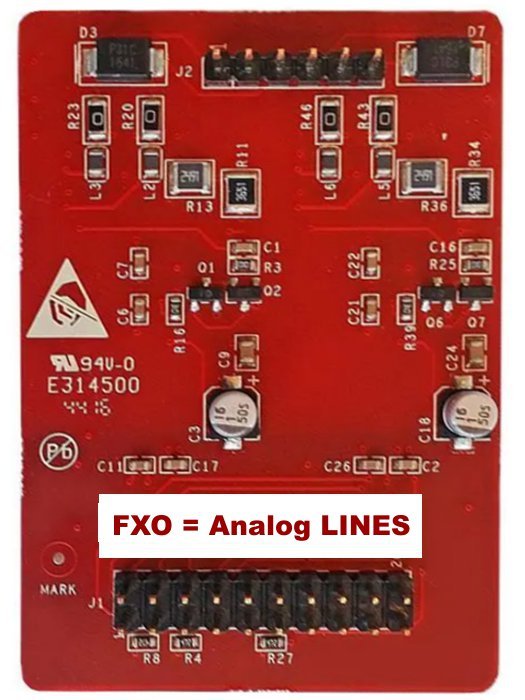

Yeastar O2 Module (2FXO) YST-O2 | The Bridge Between Your Legacy Phone Lines and Modern IP PBX
In every business communication upgrade story, there is a chapter that rarely gets told — the chapter about the phone lines that cannot simply be switched off overnight. The analog PSTN lines that suppliers call. The fax lines embedded in supplier contracts. The emergency lines required by building regulations. The backup connections that have quietly ensured business continuity for years. The Yeastar O2 Module (2FXO) YST-O2 is written specifically for that chapter — the module that makes your modern IP PBX system speak fluent analog, preserving every investment in existing telephone infrastructure while you build the future of your business communications around it.
This is not a workaround. This is not a temporary patch. The YST-O2 is a precision-engineered, purpose-built 2-port FXO expansion module that integrates cleanly into your Yeastar PBX system — delivering two fully managed, feature-rich analog trunk connections that your IP phone system treats with the same intelligence, routing capability, and visibility it applies to every SIP trunk in your infrastructure.
Legacy and modern. Analog and IP. The past and the future of your business telephony — unified in one elegant module.
What Is the Yeastar O2 Module (2FXO) YST-O2?
The Yeastar YST-O2 is a 2-port Foreign Exchange Office (FXO) expansion module designed for installation in compatible Yeastar PBX systems. FXO — Foreign Exchange Office — is the interface that allows a PBX or telephone device to connect to the Public Switched Telephone Network (PSTN) via standard analog telephone lines delivered by your telecommunications carrier.
In practical terms, the YST-O2 module accepts two standard RJ11 analog telephone line connections — the same type of line that has delivered dial tone to businesses for decades — and presents those connections to your Yeastar PBX as fully managed trunk channels. Your PBX routes inbound calls arriving on those analog lines to extensions, IVR menus, ring groups, or call queues exactly as it would any SIP trunk. Outbound calls from your IP extensions can be routed through those analog lines to reach the PSTN exactly as they would through any other trunk type.
The result is a seamlessly integrated hybrid telephony environment — your modern IP PBX infrastructure coexisting intelligently with your existing analog line investment, with neither compromising the other.
The Yeastar O2 Module Is the Essential Solution For:
- Businesses transitioning from analog to VoIP who need to retain existing PSTN lines during a phased migration
- Organizations with legacy telecom contracts on fixed-term analog line agreements that cannot be exited without financial penalty
- Businesses requiring PSTN backup trunks for failover when SIP trunk or internet connectivity is disrupted
- Facilities with regulatory requirements for analog line connectivity — building emergency lines, elevator communication circuits, alarm monitoring lines
- Offices with active fax lines that must remain operational alongside the modern IP phone system
- Small businesses and branch offices where one or two analog lines represent the complete or supplementary trunk infrastructure
- IT administrators building hybrid telephony environments that bridge legacy and modern communication infrastructure
- Businesses in areas with unreliable broadband where analog PSTN lines provide more consistent connectivity than SIP over variable internet connections
- Organizations with Yeastar S-Series or compatible PBX systems requiring modular analog trunk expansion without replacing core infrastructure
- Cost-conscious businesses extending the useful life of existing analog infrastructure while building toward a fully IP telephony future
Understanding FXO — The Technology That Connects Your PBX to the Phone Network
To fully appreciate the value the YST-O2 module delivers, it helps to understand the FXO interface and why it remains a critical component in modern hybrid telephony environments.
What Does FXO Mean?
FXO — Foreign Exchange Office — defines the interface that receives line power and dial tone from a telephone exchange or carrier. In a traditional telephony setup, your telephone company’s exchange is the FXS side (Foreign Exchange Station — the side that provides dial tone and ring voltage), and your telephone equipment — phones, PBXes, modems — is the FXO side (the side that receives and uses that dial tone).
When you install the YST-O2 module in your Yeastar PBX, each FXO port behaves exactly as a telephone device would to your analog carrier — going off-hook to make calls, detecting ring signals for inbound calls, generating DTMF tones for IVR navigation, and signaling the carrier when calls are complete. Your PBX handles all of this signaling automatically and transparently.
Why Does FXO Still Matter in the VoIP Era?
The migration from analog telephony to IP-based VoIP is not an event — it is a process. Businesses across every industry are at different stages of that process, and the reality of that journey involves:
- Multi-year analog line contracts with early termination fees that make immediate abandonment financially irrational
- Carrier service areas where SIP trunk provision is limited, expensive, or simply not yet available
- Regulatory and compliance requirements that mandate physical PSTN connectivity for certain line types
- Business continuity planning that demands analog backup trunks for operation during internet outages
- Fax infrastructure that continues serving legal, healthcare, and compliance functions through analog transmission
The YST-O2 module acknowledges this reality and addresses it directly — providing the bridge that allows businesses to modernize their telephony infrastructure at their own pace, on their own terms, without sacrificing continuity, compliance, or cost efficiency.
Yeastar O2 Module Key Features — Analog Trunk Integration Done Properly
🔌 2 FXO Ports — Dual Analog Line Connectivity in One Compact Module
The YST-O2 delivers two fully independent FXO ports — each capable of connecting to a separate analog PSTN telephone line from your carrier. Both ports operate independently and simultaneously, meaning:
- Inbound calls can arrive simultaneously on both analog lines without conflict
- Outbound calls can be made through either or both ports concurrently
- Each port maintains its own independent line status, call state, and signaling management
- One port can be handling an active call while the other is simultaneously available for inbound or outbound use
For businesses with two analog lines — a common configuration for small offices that have long used one line for voice and one for fax or backup — the YST-O2 consolidates both connections into a single, cleanly managed module within the PBX chassis.
🔗 Seamless Yeastar PBX Integration — Modular Expansion Without Compromise
The YST-O2 is designed from the ground up as a native Yeastar expansion module — not a third-party adapter, not a SIP gateway workaround, not an externally connected box requiring additional configuration complexity. It slots directly into the compatible expansion bay of your Yeastar PBX and is immediately recognized and managed through the same web-based management interface that controls every other aspect of your system.
This native integration delivers critical operational advantages:
- Unified management — analog trunk configuration, call routing, and monitoring handled entirely within the Yeastar PBX web interface alongside SIP trunks, extensions, IVR, and all other system components
- Consistent routing intelligence — analog line calls benefit from the same advanced dial plan routing, time-based routing, IVR, call recording, and reporting features available to all other trunk types
- Simplified troubleshooting — call logs, trunk status, and diagnostic tools for the analog ports are accessible through the same interface as all other system components — no separate gateway management, no separate log system, no separate diagnostic approach
- Single-vendor support path — hardware, firmware, and software support for the entire system — including the FXO module — flows through a single Yeastar-certified support channel
📞 Full Telephony Feature Access on Analog Trunks — No Feature Compromise
One of the most significant advantages of integrating analog lines through the YST-O2 module rather than through an external SIP-to-analog gateway is that calls on the analog trunks enjoy the complete feature set of your Yeastar PBX — not a reduced subset filtered through an intermediary device:
- Inbound IVR routing — analog line inbound calls route through your full multi-level IVR menu structure
- Time-based call routing — route analog inbound calls to different destinations based on business hours, day of week, and holiday schedules
- Ring group distribution — distribute analog inbound calls across agent groups with your chosen ring strategy
- Call queue integration — queue analog inbound calls with hold music, position announcements, and callback options
- Call recording — record analog trunk calls automatically or on-demand, stored with full CDR metadata
- Call transfer — transfer calls received on analog lines to any extension, external number, or queue seamlessly
- Caller ID presentation — display analog line caller ID information on IP desk phones exactly as SIP trunk caller ID is presented
- Outbound caller ID — present the analog line number as the outgoing caller ID for calls routed through that port
- Voicemail — analog trunk inbound calls route to extension voicemail with full message management
🛡️ PSTN Failover Trunk — Analog Resilience for Business Continuity
In an IP telephony environment, the single most common business continuity vulnerability is the internet connection that the entire VoIP infrastructure depends on. SIP trunks, cloud PBX connectivity, remote worker communication — all of it flows through the internet connection. When that connection fails, without a backup, your phone system goes silent.
The YST-O2 module transforms your analog PSTN lines into a professional-grade failover trunk for exactly this scenario:
- Configure your Yeastar PBX to automatically route outbound calls through the analog FXO ports when primary SIP trunks become unavailable
- Inbound calls arriving on the analog lines continue reaching extensions and IVR menus regardless of internet connectivity status — because the analog signal path is completely independent of IP infrastructure
- Emergency calls can always be made through the PSTN connection even during complete internet outages — a critical capability for workplace safety compliance
- Business continuity is maintained for essential voice communication even during prolonged ISP outages that would otherwise silence an IP-only phone system
For businesses in areas with variable broadband reliability, or for any organization where communication continuity is a regulatory or operational requirement, the YST-O2 as a failover module delivers insurance value that far exceeds its hardware cost.
📠 Fax Line Integration — Keep Legacy Fax Operational Alongside Modern IP
Fax communication persists with remarkable resilience in legal, healthcare, financial, and logistics industries — driven by regulatory requirements, established workflows, and the legal standing of fax transmission in many jurisdictions. The YST-O2 module integrates your existing fax lines into the Yeastar PBX infrastructure without disrupting fax operations:
- Connect your analog fax line to one of the YST-O2’s FXO ports
- Configure the PBX to route inbound calls on that port directly to a connected fax machine, analog telephone adapter (ATA), or fax server
- Fax transmissions travel over the native analog PSTN connection — no T.38 fax-over-IP conversion required, no fax quality compromise
- The fax line becomes a visible, managed component of your PBX infrastructure rather than a disconnected analog silo operating outside your system’s visibility
🌐 Caller ID and DTMF Detection — Complete Analog Signaling Intelligence
The YST-O2 module supports the full range of analog signaling intelligence that professional telephony requires:
- Caller ID detection — FSK and DTMF-based caller ID formats supported, presenting inbound caller information to the PBX for display on desk phones and logging in call records
- DTMF detection and generation — reliable DTMF tone detection for IVR navigation on inbound analog calls, and accurate DTMF tone generation for outbound PSTN interactions including automated systems, call forwarding activation, and voicemail access
- Busy tone detection — accurate detection of PSTN busy signals to properly terminate outbound call attempts and free the port for subsequent use
- Ring detection — reliable inbound ring signal detection ensuring no inbound calls are missed on either analog port
- Echo cancellation — built-in echo cancellation for clean, professional audio quality on analog trunk calls
Compatible Yeastar PBX Systems — Where the YST-O2 Module Fits
The Yeastar YST-O2 module is designed for installation in compatible Yeastar PBX systems that feature modular expansion bay support. Primary compatible platforms include:
Yeastar S-Series VoIP PBX
The Yeastar S-Series — including the S20, S50, S100, and S300 — features dedicated module expansion bays that accept the YST-O2 alongside other Yeastar expansion modules. The number of available expansion slots varies by S-Series model, with larger models accommodating more simultaneous modules for greater trunk capacity flexibility.
Compatibility Verification
Module compatibility should always be verified against the specific Yeastar PBX model and current firmware version before purchase. Contact your authorized Yeastar reseller or consult the current Yeastar compatibility matrix to confirm YST-O2 compatibility with your specific PBX hardware revision and software version. Yeastar’s modular architecture is designed for broad module compatibility across compatible S-Series models, but hardware generation and slot type verification is recommended for certainty.
Full Technical Specifications
| Specification | Detail |
|---|---|
| Module Type | FXO (Foreign Exchange Office) |
| Number of Ports | 2 |
| Connector Type | RJ11 |
| Line Type | Analog PSTN / POTS |
| Caller ID Support | FSK / DTMF |
| DTMF Detection | Yes |
| Echo Cancellation | Yes |
| Busy Tone Detection | Yes |
| Ring Detection | Yes |
| Compatible PBX | Yeastar S-Series (S20, S50, S100, S300) |
| Module Form Factor | Internal expansion module |
| Installation | Tool-free module bay insertion |
| Management | Via Yeastar PBX Web GUI |
| Power | Powered via PBX expansion bus |
| Operating Temperature | 0°C to 40°C (32°F to 104°F) |
| Compliance | CE, FCC certified |
YST-O2 vs. External SIP-to-Analog Gateway — The Integrated Module Advantage
Businesses evaluating how to connect analog PSTN lines to their Yeastar PBX typically face a choice between the YST-O2 internal module and an external SIP-to-analog gateway device. The comparison consistently favors the internal module approach for most deployments:
| Dimension | YST-O2 Internal Module | External SIP-to-Analog Gateway |
|---|---|---|
| Physical Footprint | Zero — installed inside PBX | Additional device on network shelf |
| Power Requirements | Powered by PBX — no additional power | Requires separate power adapter |
| Network Ports Used | None — internal bus connection | 1 × Ethernet port consumed |
| Management Interface | Unified within Yeastar PBX GUI | Separate device web interface |
| Configuration Complexity | Native — single system | Two-device configuration and maintenance |
| Call Feature Access | Full Yeastar PBX feature set | Features limited by gateway capability |
| Audio Quality Path | Direct — no SIP re-encoding | SIP encoding/decoding introduces latency |
| Troubleshooting | Single system, unified logs | Two separate log systems to correlate |
| Firmware Management | Single PBX firmware update | Separate gateway firmware updates |
| Total Cost of Ownership | Lower — no additional hardware | Higher — additional hardware and management |
| Reliability | Single-device architecture | Two-device failure points |
For Yeastar PBX owners, the YST-O2’s native integration delivers demonstrably superior operational simplicity, feature completeness, and management efficiency compared to external gateway alternatives — at a total cost of ownership that makes the choice straightforward.
Building a Complete Hybrid Trunk Strategy With the YST-O2
The YST-O2 module reaches its full strategic value when understood as one component of a comprehensive hybrid trunk architecture — working alongside SIP trunks, GSM gateways, and other trunk types within your Yeastar PBX to create a resilient, cost-optimized, feature-rich telephony infrastructure that serves your business across every scenario.
The Recommended Hybrid Trunk Architecture
Primary Trunks — SIP/VoIP Your main call traffic flows through SIP trunks from your chosen VoIP provider — delivering cost-effective calling, geographic flexibility, and the full feature integration of IP telephony. SIP trunks handle the majority of daily inbound and outbound call volume.
Secondary Trunks — YST-O2 FXO (Analog PSTN) The two analog lines connected through the YST-O2 module serve multiple simultaneous strategic purposes:
- Failover trunk — automatically activated when SIP trunk or internet connectivity fails
- Fax line — dedicated to fax transmission without disrupting voice call capacity
- Emergency line — always-available PSTN connectivity for emergency calls regardless of IP infrastructure status
- Overflow trunk — handles call volume overflow during peak periods when SIP trunk capacity is fully utilized
Tertiary Trunks — GSM Gateway (Optional) A Yeastar TG series GSM gateway adds cellular trunk capability for on-net mobile calling cost optimization and additional failover depth.
This three-layer trunk architecture delivers a communication infrastructure with multiple independent redundancy paths, diverse cost optimization strategies, and comprehensive compliance coverage — and the YST-O2 is the module that anchors the analog PSTN layer of that architecture.
Expanding Beyond Two Analog Lines — Yeastar’s Modular FXO Ecosystem
The YST-O2 is the starting point for analog trunk integration in the Yeastar modular ecosystem — not the limit. For businesses requiring more than two analog PSTN connections, Yeastar’s modular expansion architecture accommodates growth:
Yeastar FXO Module Range
| Module | FXO Ports | Analog Lines Supported |
|---|---|---|
| YST-O2 | 2 | 2 analog PSTN lines |
| YST-O4 | 4 | 4 analog PSTN lines |
| YST-O8 | 8 | 8 analog PSTN lines |
Multiple modules can be combined within a compatible Yeastar PBX chassis — subject to available expansion slots — to build the precise analog trunk capacity your specific infrastructure requires. Start with the YST-O2 for two lines and expand with additional modules as your analog line requirements evolve, without replacing the PBX or disrupting existing configuration.
Beyond FXO modules, the same expansion architecture accommodates FXS modules for connecting analog telephone devices and fax machines as extensions, BRI modules for ISDN Basic Rate Interface digital trunk connectivity, and E1/T1 modules for primary rate digital trunk connections — all managed through the same unified Yeastar PBX interface.
Installation and Configuration — Simplicity by Design
The YST-O2 module’s installation experience reflects Yeastar’s commitment to operational simplicity — a design philosophy that makes sophisticated telephony capabilities accessible without demanding specialist installation expertise.
Physical Installation
Module installation is a straightforward physical process — power down the compatible Yeastar PBX, insert the YST-O2 into an available expansion bay following the documented slot assignment guidance, secure the module, and restore power. The PBX automatically detects the installed module on startup and makes it available for configuration in the management interface. No tools are required for module insertion in most compatible PBX models.
Software Configuration
Once installed and detected, the YST-O2’s ports appear as configurable analog trunk channels within the Yeastar PBX web management interface. Configuration follows the same workflow as any other trunk type:
- Assign analog trunk numbers and configure port-level settings including caller ID method, busy detection sensitivity, and echo cancellation parameters
- Create inbound routes defining how calls arriving on each analog line are handled — direct to extension, IVR menu, ring group, or call queue
- Create outbound routes specifying which extensions or extension groups can use the analog lines for outbound calls, and in what priority order
- Configure failover routing to activate analog trunk use automatically when primary SIP trunks become unavailable
- Set up call recording for analog trunk calls according to your recording policy
For a Yeastar-familiar administrator, the complete installation and configuration process — from physical module insertion to fully operational analog trunks with inbound routing and outbound failover configuration — is typically achievable within a single work session.
Frequently Asked Questions About the Yeastar O2 Module (YST-O2)
What is the difference between FXO and FXS, and which do I need?
FXO (Foreign Exchange Office) ports connect to incoming telephone lines from your carrier — standard analog PSTN lines that deliver dial tone. Use FXO ports (the YST-O2 module) when you need to connect traditional phone company lines to your PBX. FXS (Foreign Exchange Station) ports provide dial tone to connected analog devices — standard telephones, fax machines, or analog telephone adapters. Use FXS ports (the Yeastar YST-S2 or similar FXS modules) when you need to connect legacy analog telephone handsets or fax machines as extensions on your PBX. If you have a phone line coming from the wall that you want to connect to your PBX, you need FXO — the YST-O2.
Can I use the YST-O2 module for fax line integration?
Yes — and this is one of the most common deployment scenarios. Connect your analog fax line to one of the YST-O2’s FXO ports and configure an inbound route on that port to direct calls directly to your fax machine (connected via an FXS port on the same PBX or an external ATA device). Fax transmissions travel over the native analog PSTN connection — no T.38 fax-over-IP conversion is required, and fax reliability is maintained at full analog quality. The fax line becomes a visible, managed component of your PBX infrastructure while continuing to function exactly as it always has for fax senders and recipients.
How many YST-O2 modules can I install in my Yeastar PBX?
The number of YST-O2 modules you can install depends on the number of available expansion slots in your specific Yeastar PBX model. The S20 typically accommodates 1 module slot, the S50 accommodates 2 slots, the S100 accommodates 4 slots, and the S300 accommodates more slots for larger configurations. Each slot can accommodate one module — so a Yeastar S100 with four slots could theoretically accommodate four YST-O2 modules for a total of eight analog FXO ports, mixed with other module types as the expansion strategy requires. Always verify available slots in your specific PBX model before ordering multiple modules.
Does the YST-O2 support caller ID from the analog phone company?
Yes. The YST-O2 module supports both FSK (Frequency Shift Keying) and DTMF-based caller ID detection — the two standard methods used by analog carriers to deliver caller ID information between the first and second ring on incoming calls. Configure the appropriate caller ID method for your carrier in the Yeastar PBX trunk settings, and inbound caller ID information will appear on your IP desk phones and be captured in call records exactly as SIP trunk caller ID information is handled.
Can the YST-O2 analog trunks be used as automatic failover when internet goes down?
Absolutely — and this is one of the most strategically valuable applications of the YST-O2 module. Configure your Yeastar PBX outbound routes to include the analog FXO trunks as failover options in the trunk sequence after your primary SIP trunks. When the PBX detects that SIP trunks are unavailable — due to internet outage, ISP disruption, or SIP provider issues — it automatically routes outbound calls through the analog PSTN lines without manual intervention. Inbound calls on the analog lines continue reaching extensions and IVR menus throughout any internet outage because the analog PSTN path is completely independent of IP connectivity.
Is the YST-O2 compatible with ISDN or digital phone lines?
No — the YST-O2 module is designed specifically for standard analog PSTN lines (POTS — Plain Old Telephone Service). It is not compatible with ISDN BRI, ISDN PRI, E1, T1, or digital line types. For ISDN BRI connectivity, Yeastar offers the YST-B2 BRI module. For E1/T1/PRI digital trunk connectivity, Yeastar offers the YST-E1 module. Ensure you identify your line type correctly before selecting the appropriate module — if you are unsure whether your lines are analog or digital, contact your telecommunications carrier for clarification.
Does installing the YST-O2 require any special tools or technical expertise?
Physical installation is tool-free and straightforward — the module slides into the compatible expansion bay following basic electrostatic discharge precautions (handle the module by its edges, avoid touching circuit components). The PBX should be powered down before module insertion. Software configuration is handled entirely through the standard Yeastar PBX web management interface — no command-line access, no specialist programming tools, and no external configuration utilities required. An IT administrator familiar with the Yeastar PBX management interface can complete the full installation and configuration process without specialized telephony expertise beyond basic PBX administration knowledge.
The Yeastar O2 Module — Where Analog and IP Telephony Coexist Perfectly
The transition from analog to IP telephony is one of the most consequential infrastructure decisions a business makes — and the organizations that navigate it most successfully are those that plan it as a managed migration rather than a forced cutover. The Yeastar O2 Module (2FXO) YST-O2 is the component that makes that managed migration possible — protecting the investments already made in analog infrastructure while unlocking the full capability of modern IP telephony for every user on the system.
It is the module that tells your two existing analog phone lines: you still matter here. Your inbound calls will be routed intelligently. Your outbound capacity will be available when needed. Your failover value will be realized when the internet goes down. Your fax function will continue serving the departments that depend on it. And all of it will be visible, managed, and reported within the same unified interface that manages every other aspect of the modern phone system around you.
Two ports. Two analog lines. Complete Yeastar PBX integration. Unified management. Full feature access. PSTN failover protection. Fax line support. Regulatory compliance capability. And a price point that makes the decision to integrate rather than abandon your existing analog infrastructure the obvious, rational, commercially sensible choice.
Reviews
There are no reviews yet.