
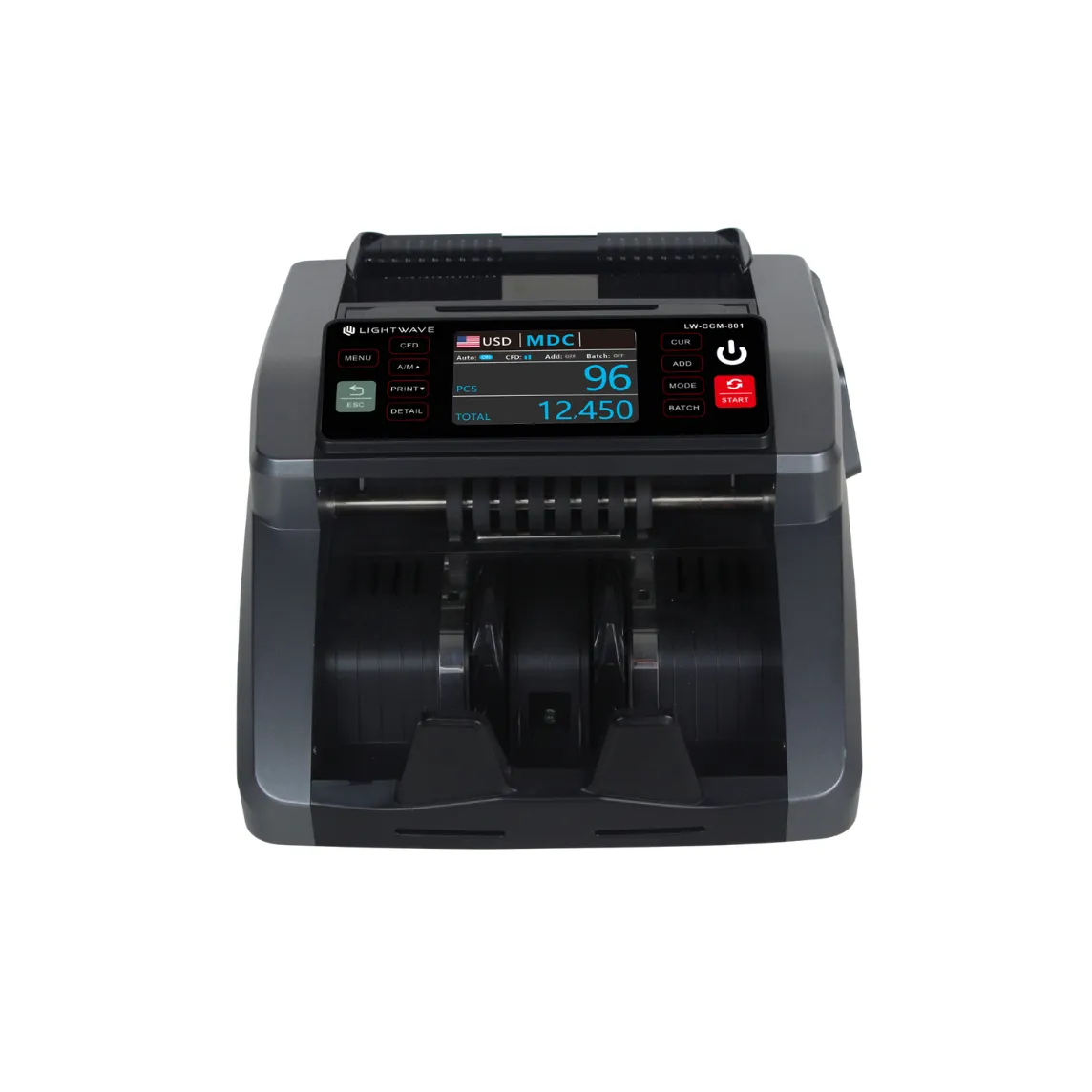
Lightwave LW-CCM-901 — Touchscreen Cash Counting Machine with Dual CIS, Double Pocket & External Display
The Lightwave LW-CCM-901 is a professional-grade banknote counting and authentication machine designed for high-volume cash handling environments. It combines a touchscreen interface, dual CIS (Contact Image Sensor) detection, triple-level counterfeit verification, automatic multi-currency recognition, a 500-note hopper, a double pocket design with separate reject compartment, and an external customer-facing display — positioning it at the upper tier of the Lightwave CCM range for retail, banking, foreign exchange, and institutional cash management applications.
The dual CIS sensor architecture is the defining technical differentiator of the LW-CCM-901 within the Lightwave range. CIS sensors capture a full image of each banknote as it passes through the transport mechanism, enabling image-based authentication — detecting the printed security features, colour profiles, and dimensional characteristics of genuine banknotes — rather than relying solely on physical property detection methods. Combining two CIS sensors with UV, magnetic ink (MG), infrared (IR), and dimensional (DD) detection creates a layered authentication framework that addresses multiple counterfeit construction methods simultaneously.
Dual CIS Detection System
CIS (Contact Image Sensor) technology captures a high-resolution optical image of each banknote during transport. The LW-CCM-901’s dual CIS configuration positions sensors on both faces of the banknote simultaneously, capturing front and back images in a single pass. This dual-face imaging provides two specific verification advantages over single-CIS designs:
Front and back pattern verification — Security features on both faces of a banknote — including the printed design, colour-shifting inks, microprinting, and security thread positioning — are captured and compared against stored reference data for the detected currency. A counterfeit that passes front-face inspection may fail on the reverse; dual CIS eliminates this gap.
Completeness and dimensional verification — The combined front and back images allow the machine to verify note dimensions and the relative positioning of security elements across both faces — catching fold counterfeit techniques and partial-note presentations that single-face sensors may pass.
Counterfeit Detection — Triple Detection Levels
The LW-CCM-901 applies three independently configurable detection levels, combining four sensor types:
UV (Ultraviolet) — Genuine banknotes incorporate UV-fluorescent security fibres, markings, and inks that are visible under UV illumination but invisible under normal light. UV detection identifies notes lacking these genuine fluorescent security elements.
MG (Magnetic Ink) — Authentic banknotes are printed with magnetically detectable inks in specific patterns. The magnetic ink sensor reads the magnetic signature of each note, identifying those that do not carry the correct magnetic pattern — a characteristic that is difficult to replicate in basic counterfeit production.
IR (Infrared) — Infrared sensors detect the transmission and reflection properties of genuine banknote security inks under IR wavelengths. IR detection identifies inconsistencies in ink composition that are invisible to the human eye and under UV light.
DD (Dimensional Detection) — Physical banknote dimensions — length, width, and thickness — are verified against the known dimensions for the identified currency denomination. Notes outside dimensional tolerance are flagged as damaged, mutilated, or potentially counterfeit.
The three detection levels allow the operator to adjust the machine’s sensitivity — a higher detection level applies more stringent thresholds across all sensor types, reducing the risk of passing a near-match counterfeit at the cost of potentially flagging worn genuine notes. This adjustability is relevant in environments handling aged or heavily circulated currency.
Automatic Currency Detection and Multi-Currency Support
The LW-CCM-901 automatically identifies the currency denomination of banknotes as they are fed, without requiring manual currency selection for the first four configured currencies. The machine supports up to 10 currencies simultaneously, covering a broad range of currencies relevant to the East African market and international business:
- Kenyan Shilling (KES)
- US Dollar (USD)
- Euro (EUR)
- UAE Dirham (AED)
- British Pound (GBP)
- CFA Franc West Africa
- CFA Franc Central Africa
- Nigerian Naira (NGN)
- Zambian Kwacha (ZMW)
- Congolese Franc (CDF)
In mixed-currency counting mode, the LW-CCM-901 counts multiple denominations and currencies in a single pass, generating a detailed denomination-by-denomination and currency-by-currency report of the total — eliminating the need to sort notes by denomination or currency before counting.
Touchscreen Interface
The LW-CCM-901’s touchscreen display provides direct-touch access to all machine functions — currency selection, counting mode, detection level, batch settings, and report display — without requiring a separate keypad. The touchscreen interface supports both button keypad and touch input, providing operational flexibility for users who prefer physical key confirmation in high-transaction environments.
Double Pocket Design
The LW-CCM-901 incorporates a double pocket configuration — a main output pocket for accepted notes and a separate reject pocket for notes flagged by the detection system. This physical separation of accepted and suspect notes is a critical operational feature in professional cash handling environments:
- Flagged notes are delivered to a distinct reject pocket, preventing them from being mixed with verified notes in the main stack
- The operator can review the reject pocket’s contents without interrupting the counting cycle for the accepted notes
- End-of-session reconciliation distinguishes clearly between verified note counts and rejected note counts without manual re-sorting
Without a double pocket, suspect notes require manual extraction from the main output stack, introducing the risk of re-mixing flagged and verified notes and creating reconciliation ambiguity.
External Display
The LW-CCM-901 includes an external customer-facing display that shows the count total, denomination breakdown, and transaction value simultaneously to both the operator and the customer. In retail, banking, and foreign exchange environments, the external display serves two functions:
Transaction transparency — The customer can observe the count in real time, eliminating disputes about counted amounts and building confidence in the transaction process.
Dual verification — Both the operator and the customer simultaneously verify the count total before the transaction is completed — removing the ambiguity of single-display machines where the customer must rely on the operator’s verbal confirmation of the count.
Counting Modes
The LW-CCM-901 supports the following counting operations:
Count mode — Counts all notes fed through the hopper and displays the total piece count.
Batch mode — Counts to a preset quantity and stops, allowing notes to be prepared in consistent bundles of a specified amount (e.g., batches of 50, 100, or 200 notes for cashier preparation or deposit packaging).
Add mode — Accumulates totals across multiple hopper loads into a running total, allowing large quantities of notes to be counted in multiple feeds without losing the running count.
Mix value mode — Counts mixed denominations and currencies in a single pass, generating a denomination-by-denomination breakdown and total value calculation for each currency.
Note Fault Detection
Beyond counterfeit detection, the LW-CCM-901 automatically identifies and rejects the following note handling faults:
- Double note — Two notes fed together, detected and counted as separate items
- Half note — A torn or mutilated note that does not meet minimum dimensional requirements
- Chained note — Two notes connected by tape or foreign material
- Damaged note — Notes outside dimensional tolerance due to wear or physical damage
Automatic fault detection reduces counting errors caused by note handling defects and prevents double-counting or under-counting caused by stuck or partially-fed notes.
Serial Number Recognition
The LW-CCM-901 supports serial number reading and recording for USD, EUR, and GBP banknotes. Serial number capture creates a per-note audit trail within the count session, enabling post-count verification that specific banknotes were present in a counted batch — relevant for regulatory compliance, high-value transaction records, and dispute resolution in banking and foreign exchange environments.
Connectivity
The machine provides the following interface connections:
- 2 × USB — For data export of count records and denomination reports to PC
- RS-232 — For connection to external devices including thermal receipt printers and point-of-sale systems
- RJ-11 — For external display or printer connection
The PC connection enables count data to be logged and exported to cash management software, supporting end-of-day reconciliation and audit reporting workflows.
Ideal Users
- Banks, Microfinance Institutions, and SACCOs — The dual CIS authentication, triple detection levels, and serial number recording provide the banknote verification depth required in financial institution cash handling. Mixed-currency counting with denomination breakdown supports foreign currency transactions. The external display supports the counter-to-customer transparency standard in financial transaction environments.
- Foreign Exchange Bureaus — Multi-currency automatic recognition covering the major African and international currencies processed in Kenyan forex operations reduces manual currency selection time and counting errors on mixed-currency note batches. The denomination report per currency supports transaction reconciliation and margin calculation.
- Retail Chains and Supermarkets — High-volume end-of-day and shift cash reconciliation across multiple cashier tills benefits from the 500-note hopper capacity, batch mode for deposit bundle preparation, and add mode for accumulating multiple drawer totals. Detection levels protect against counterfeit notes in high-transaction retail environments.
- Betting Companies and Gaming Operators — High cash turnover environments with rapid transaction cycles require fast, accurate counting with reliable counterfeit detection. The double pocket reject separation and touchscreen interface support high-throughput cash handling with minimal operator intervention.
- Hotels, Casinos, and Hospitality Finance Offices — Multi-currency capability and the external display suit hospitality environments handling mixed international currencies from guests, where transaction transparency and currency verification are operational requirements.
Technical Specifications
| Attribute | Detail |
|---|---|
| Model | LW-CCM-901 |
| Detection System | Dual CIS + UV + MG (Magnetic) + IR (Infrared) + DD (Dimensional) |
| Detection Levels | 3 (adjustable sensitivity) |
| Hopper Capacity | 500 notes |
| Pocket Configuration | Double pocket (accepted + reject) |
| Display | Touchscreen (operator) + External display (customer-facing) |
| Interface | Touchscreen + button keypad |
| Counting Modes | Count, Batch, Add, Mix Value |
| Currency Support | Up to 10 currencies (auto-detect first 4) |
| Auto-Currency Detection | Yes |
| Serial Number Recognition | USD, EUR, GBP |
| Note Fault Detection | Double note, half note, chained note, damaged note |
| Self-Check Function | Yes — automatic startup self-diagnosis |
| Connectivity | 2 × USB, RS-232, RJ-11 |
| Package Dimensions | 27 × 32 × 22 cm |
| Operating Temperature | Standard indoor commercial environment |
Supported Currencies (Sample)
| Currency | Code |
|---|---|
| Kenyan Shilling | KES |
| US Dollar | USD |
| Euro | EUR |
| UAE Dirham | AED |
| British Pound | GBP |
| CFA Franc West Africa | XOF |
| CFA Franc Central Africa | XAF |
| Nigerian Naira | NGN |
| Zambian Kwacha | ZMW |
| Congolese Franc | CDF |

Reviews
There are no reviews yet.