
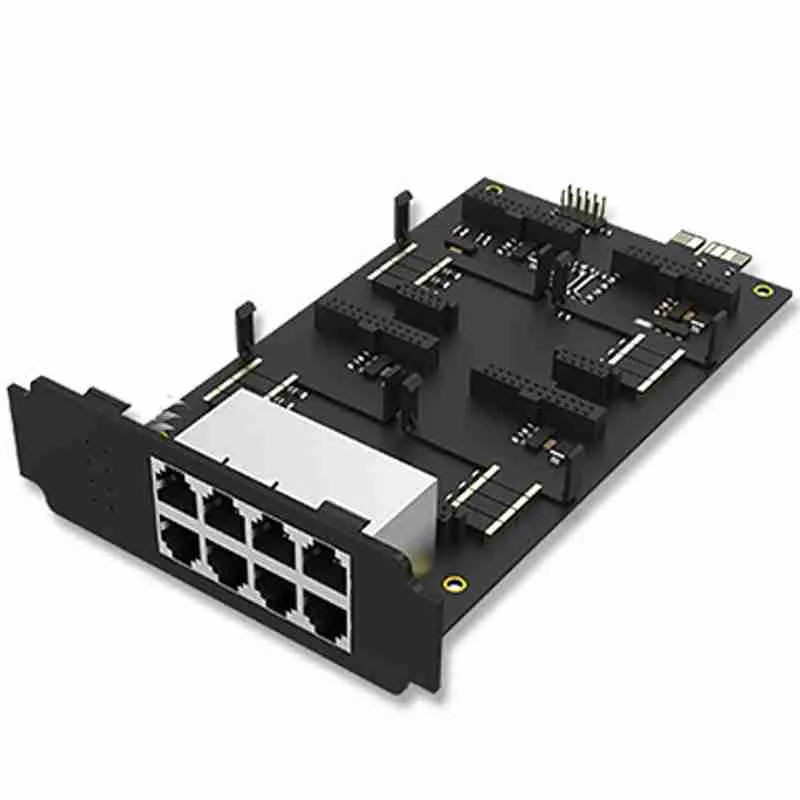
Yeastar EX08 Expansion Card — 8-Port Modular Expansion for Yeastar S-Series IP PBX Systems
Your business communications infrastructure shouldn’t hit a ceiling the moment your team starts growing. The Yeastar EX08 tears that ceiling off entirely — delivering eight additional ports of pure connectivity flexibility exactly when and where your PBX needs it most.
What Is the Yeastar EX08 Expansion Card?
The Yeastar EX08 is an 8-port modular expansion card engineered exclusively for the Yeastar S-Series VoIP PBX platform — the intelligent, scalable answer to the universal business communications challenge of growing beyond your current infrastructure without ripping it out and starting over.
At its core, the EX08 is a future-proofing investment masquerading as a hardware upgrade. Rather than forcing organizations to replace their entire PBX system the moment their analog line, FXS extension, BRI channel, or GSM trunk requirements outgrow the base unit’s capacity, the EX08 slots directly into compatible S-Series systems and immediately expands their connectivity universe with eight additional ports that can be populated with virtually any combination of interface modules the business demands.
This is modular PBX architecture working exactly as it should — adding capacity without adding complexity, extending your existing investment without obsoleting it, and giving your communications infrastructure the room to grow at precisely the pace your business does.
Whether your organization needs more analog telephone lines for legacy PSTN connectivity, additional FXS ports for analog desk phones and fax machines, BRI channels for ISDN digital trunk expansion, or GSM/3G ports for mobile network gateway functionality, the EX08 delivers all of these capabilities from a single, elegantly engineered expansion card that installs in minutes and operates transparently within your existing Yeastar ecosystem.
Why PBX Expandability Is a Strategic Business Decision, Not Just a Technical One
The Hidden Cost of a PBX That Can’t Grow With You
Every telecommunications manager who has ever managed a PBX refresh cycle understands the frustration intimately: a system that was perfectly sized at deployment becomes a bottleneck within eighteen months as the organization grows, acquires new locations, adds staff, or changes its trunk connectivity mix. The traditional response — full system replacement — carries costs that extend far beyond the hardware invoice:
- 💸 Full system replacement costs including hardware, licensing, installation, configuration, and staff retraining
- ⏱️ Operational downtime during migration that disrupts customer-facing communications at the worst possible moment
- 🔄 Configuration rework rebuilding dial plans, IVR trees, ring groups, and call routing logic from scratch
- 📉 Productivity impact as staff adapt to new interfaces and workflows during transition periods
- 🗑️ Stranded investment in hardware that still has years of useful operational life but can’t grow with the organization
The Yeastar EX08 eliminates this replacement cycle entirely for organizations running compatible S-Series PBX systems. Instead of a rip-and-replace event, capacity expansion becomes a slot-and-configure operation — measured in minutes of installation time rather than days of migration disruption.
This is the economic logic that makes modular PBX architecture — and specifically the EX08 — a financially sound strategic decision rather than a simple hardware purchase.
Yeastar EX08 Key Features & Technical Specifications
Eight Ports of Pure Connectivity Potential, Ready for Any Interface Combination
- 🔌 8 Expansion Ports — Fully modular port architecture accepting any compatible Yeastar interface module in any combination across all eight slots
- 🔄 Universal Module Compatibility — Supports the full Yeastar S-Series module ecosystem:
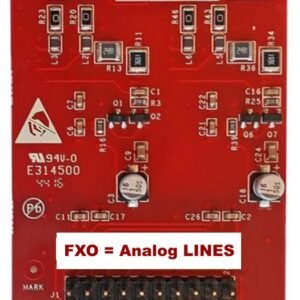
- FXO Modules — Analog PSTN trunk line connectivity for legacy telephone network integration
- FXS Modules — Analog extension ports for desk phones, fax machines, door phones, and paging systems
- BRI Modules — ISDN Basic Rate Interface digital trunk connectivity for European and Asia-Pacific ISDN infrastructure
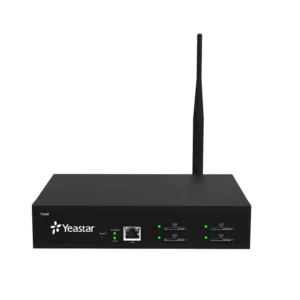
- GSM/3G Modules — Mobile network gateway ports enabling direct SIM card-based cellular trunk connectivity
- 🖥️ Compatible S-Series Platforms:
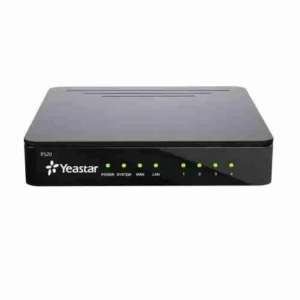
- Yeastar S20 — Expansion capability for small business PBX deployments
- Yeastar S50 — Mid-market PBX expansion for growing organizations
- Yeastar S100 — Enterprise PBX capacity extension for large deployments
- Yeastar S300 — Maximum-scale enterprise PBX expansion for complex multi-trunk environments
- ⚡ Hot-Configuration Support — Module population and system reconfiguration without full system restart in compatible deployment scenarios
- 🔧 Tool-Free Module Installation — Interface modules seat and lock without specialized tooling, minimizing installation time and technical skill requirements
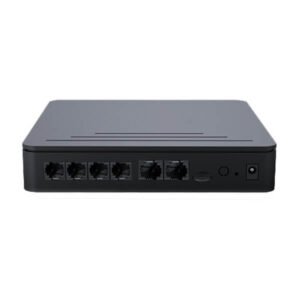
- 📐 Internal Card Form Factor — Installs directly inside the S-Series PBX chassis, maintaining the system’s unified physical footprint without external expansion boxes or additional rack space
- 🌡️ Enterprise-Grade Operating Specifications — Designed to meet the thermal and electrical reliability standards of 24/7 business communications environments
- 🔒 Seamless Yeastar Ecosystem Integration — Recognized and managed natively by the S-Series web management interface without additional drivers, firmware, or configuration overhead
Understanding the EX08’s Modular Port Architecture
Eight Ports. Infinite Configuration Possibilities. One Strategic Investment.
The defining characteristic of the EX08 — the feature that separates it from fixed-capacity expansion solutions — is its completely modular port architecture. Each of the eight ports is an independent, hot-swappable module slot that accepts any compatible Yeastar interface module. This means the EX08’s capability profile is not fixed at purchase — it is defined and redefined by the modules installed in it, making it adaptable to business requirements that change over time.
FXO Modules: Keeping Legacy PSTN Connectivity Alive and Economical
For organizations that maintain analog PSTN trunk lines from their telephone service provider — either as primary trunks, PSTN failover for SIP infrastructure, or regulatory-mandated analog backup — FXO (Foreign Exchange Office) modules in the EX08 provide clean, reliable interface between those analog lines and the S-Series PBX’s digital switching fabric.
Each FXO module port terminates one analog trunk line, allowing the PBX to:
- Place and receive calls over the public switched telephone network
- Maintain PSTN connectivity during internet outages for SIP trunk failover
- Support fax transmission over analog lines where SIP fax (T.38) is unreliable
- Comply with emergency services requirements mandating analog PSTN connectivity in certain regulated environments
FXO modules in the EX08 are the bridge between the legacy telecommunications infrastructure your service providers still deliver and the modern IP PBX intelligence your organization has invested in.
FXS Modules: Extending Analog Device Connectivity Into the IP Era
Not every endpoint in a modern business communications environment is an IP desk phone or a softclient on a laptop. Analog endpoints remain essential in virtually every organization — from the fax machine in the accounting department and the door phone at the reception desk to the analog phone in the elevator emergency panel and the overhead paging amplifier in the warehouse.
FXS (Foreign Exchange Station) modules in the EX08 provide the analog extension ports that connect these devices to your S-Series PBX, giving them full participation in your dial plan — extensions, call transfer, voicemail, ring group membership, and call recording — without requiring replacement with IP alternatives.
For organizations managing mixed analog-and-IP device environments during a phased technology transition, FXS modules in the EX08 make that transition financially manageable by eliminating the requirement to replace all analog endpoints simultaneously.
BRI Modules: ISDN Digital Trunk Connectivity for European and Global Deployments
Organizations operating in Europe, Australia, Japan, and other markets where ISDN BRI (Basic Rate Interface) remains prevalent in telecommunications infrastructure — either as primary digital trunks or as supplementary channels — require BRI interface capability that SIP-only PBX systems cannot provide.
BRI modules in the EX08 deliver native ISDN BRI connectivity, with each module providing one BRI interface carrying two B-channels (voice/data) and one D-channel (signaling) — the standard 2B+D ISDN BRI configuration. For organizations with existing ISDN BRI service contracts, BRI modules in the EX08 protect that investment by integrating ISDN capacity directly into the S-Series PBX without requiring trunk migration or service cancellation.
GSM/3G Modules: Mobile Network Gateway Capability at the PBX Level
Perhaps the most strategically distinctive module type compatible with the EX08 is the GSM/3G gateway module — a capability that transforms individual EX08 ports into direct cellular network interfaces, each hosting a physical SIM card that connects the PBX directly to mobile carrier networks.
This capability unlocks several high-value use cases that traditional PSTN and SIP trunking cannot address:
- Mobile number DDI presentation — Outbound calls route through GSM modules and present as mobile numbers, improving answer rates from customers who screen unknown landline numbers
- Mobile termination cost elimination — Calls to mobile numbers route through GSM modules at mobile-to-mobile rates rather than landline-to-mobile rates, generating measurable monthly savings in markets with significant mobile termination cost differentials
- PSTN and SIP trunk independence — GSM modules provide cellular backup connectivity that operates entirely independently of both analog PSTN lines and internet-dependent SIP trunks
- Geographic number presence — SIM cards from local carriers in different markets enable the PBX to present local mobile numbers across multiple geographic regions from a single centralized system
Who Needs the Yeastar EX08 Expansion Card?
Every Organization Whose Communications Needs Have Outgrown Their Original PBX Sizing
- 🏢 Growing SMEs on Yeastar S-Series — Organizations that selected an S-Series PBX at the right size for their business at deployment and now need more trunk or extension capacity to match their growth without replacing the system
- 🌍 Multinational Operations — Companies with offices in ISDN-prevalent markets needing BRI trunk connectivity integrated into a unified S-Series PBX platform alongside SIP and analog connectivity
- 🏭 Industrial & Manufacturing Facilities — Operations maintaining extensive analog device infrastructure — PA systems, emergency phones, industrial intercoms, and legacy process control interfaces — requiring FXS expansion beyond the base PBX unit’s capacity
- 📠 Professional Services Firms — Accounting, legal, and financial services organizations maintaining analog fax lines for client document exchange and regulatory compliance requiring dedicated FXO trunk ports
- 🏨 Hospitality Properties — Hotels, serviced apartments, and resorts with analog room phones, analog amenity devices, and PSTN trunk requirements that exceed the base S-Series unit’s built-in port capacity
- 📞 Call Centers & Contact Operations — High-volume inbound and outbound operations requiring maximum trunk capacity across multiple connectivity types for redundancy and cost optimization
- 🏗️ Construction & Field Operations — Organizations using GSM modules to route calls through mobile networks where reliable internet connectivity for SIP trunking cannot be guaranteed at operational sites
- 🏥 Healthcare Facilities — Clinics and medical practices maintaining analog infrastructure for nurse call systems, medical alert devices, and PSTN trunk failover mandated by healthcare continuity requirements
Mixed Module Configurations: The EX08’s Greatest Practical Advantage
Real-World Business Communications Don’t Come in Single Flavors
One of the most practically valuable but underappreciated capabilities of the EX08 is its ability to host completely mixed module configurations — combining FXO, FXS, BRI, and GSM modules within the same eight-slot card in any proportion the deployment requires.
Consider these real-world deployment scenarios:
Scenario 1 — The Growing Professional Services Firm A law firm’s S50 PBX has exhausted its built-in FXO and FXS capacity as the practice has grown. The EX08 is populated with 4× FXO modules (adding four additional PSTN trunk lines for client call capacity) and 4× FXS modules (adding four additional analog ports for fax machines and the reception desk analog phone) — all in a single expansion card.
Scenario 2 — The European Mid-Market Business A German manufacturer’s S100 PBX needs to add both ISDN BRI trunk capacity and mobile gateway capability. The EX08 is configured with 4× BRI modules (adding eight additional ISDN B-channels) and 4× GSM modules (adding four cellular SIM slots for mobile cost optimization and backup connectivity).
Scenario 3 — The Multi-Site Hospitality Operation A hotel group’s S300 PBX needs analog room phone extensions, PSTN trunk backup, and mobile trunk capability for their mobile concierge team. The EX08 serves all three requirements with a 3× FXS + 3× FXO + 2× GSM configuration — one card, three connectivity problems solved.
This configuration flexibility is precisely why the EX08 is not simply an expansion card — it is a communications infrastructure problem-solver that adapts its solution profile to the specific connectivity challenge at hand.
Seamless Integration With Yeastar S-Series Management
The EX08 Works With Your PBX, Not Against Your Administrator
One of the most frustrating experiences in enterprise hardware deployment is expansion hardware that requires entirely separate management interfaces, proprietary configuration tools, or complex driver installation procedures. The Yeastar EX08 eliminates this frustration by design.
Once physically installed in a compatible S-Series PBX, the EX08 and its populated modules are:
- Automatically recognized by the S-Series operating system without manual driver installation or firmware deployment
- Natively visible in the S-Series web-based management interface alongside the base unit’s built-in ports — appearing as a unified port pool rather than as a separate managed subsystem
- Configurable through the same familiar interface your administrators already use for trunk configuration, extension management, and dial plan design
- Fully participatory in BizStream and Linkus integrations — the additional ports appear as fully functional participants in Yeastar’s unified communications ecosystem
For organizations with existing Yeastar S-Series administrative expertise, deploying the EX08 requires zero additional training investment — your team already knows how to configure everything the EX08 exposes.
The Total Cost of Ownership Calculation That Makes the EX08 Obvious
What Does PBX Expansion Actually Cost? Less Than You Think, With the Right Architecture.
When evaluating the EX08 against alternative approaches to PBX capacity expansion, the complete financial picture consistently favors the modular expansion path:
Alternative 1 — Full PBX System Replacement
- New PBX hardware + licensing: Full system cost
- Professional installation and configuration: Significant labor cost
- Operational downtime during migration: Lost productivity
- Staff retraining on new system: Time and productivity cost
- Disposal or secondary market value of replaced system: Partial offset at best
- Total cost: Substantial, disruptive, and wasteful of remaining useful life in existing hardware
Alternative 2 — External Gateway Device
- Separate gateway hardware for additional trunk types
- Additional rack space, power, and cabling requirements
- Separate management interface requiring parallel administration
- Integration complexity between gateway and PBX
- Additional failure points in the communications path
- Total cost: Moderate hardware cost plus significant ongoing management overhead
The EX08 Path:
- Single expansion card acquisition
- Minutes of physical installation
- Zero additional rack space, power feeds, or management interfaces
- Immediate capacity availability through familiar management interface
- Full integration with existing system configuration, dial plans, and UC features
- Total cost: Hardware acquisition only — all other cost categories are eliminated
The financial case is not subtle. For any organization running a compatible Yeastar S-Series PBX that has outgrown its built-in port capacity, the EX08 is the economically dominant choice by a significant margin.
Protecting Your Yeastar Investment for the Long Term
The PBX You Bought Should Be the PBX You Keep Growing
The telecommunications infrastructure decisions organizations make today carry financial and operational consequences for five to seven years — the typical enterprise PBX lifecycle. Within that timeframe, most businesses will experience:
- Staff growth requiring additional extension capacity
- Office expansion or relocation requiring trunk capacity reconfiguration
- Acquisition or merger requiring integration of disparate telecommunications infrastructure
- Carrier contract changes requiring support for new or different trunk connectivity types
- Technology evolution from legacy PSTN toward SIP and mobile-first connectivity
The Yeastar EX08 is the mechanism by which your S-Series PBX navigates all of these changes without replacement — adapting its port profile to match the organization’s evolving connectivity requirements through module substitution and addition rather than system-level change.
This is the promise of modular architecture realized in practical telecommunications hardware: an investment that compounds in value as the business grows, rather than depreciating toward obsolescence.
Frequently Asked Questions About the Yeastar EX08 Expansion Card
Q: How many EX08 cards can be installed in a single Yeastar S-Series PBX? The number of EX08 cards supported varies by S-Series model. The S20 supports up to 1 expansion card, the S50 supports up to 2, the S100 supports up to 4, and the S300 supports up to 8 — enabling substantial total port expansion in larger deployments. Always verify current expansion slot specifications with your Yeastar reseller for the specific S-Series model in your deployment.
Q: Can different module types be mixed within a single EX08 card? Yes, absolutely. The EX08’s eight slots are fully independent and accept any compatible module type in any combination. A single EX08 can simultaneously host FXO, FXS, BRI, and GSM modules across its eight slots in whatever proportion the deployment requires.
Q: Does installing the EX08 require a system restart or communications downtime? Physical installation of the EX08 card typically requires the S-Series PBX to be powered down momentarily for card seating. However, the configuration of newly added ports through the management interface can proceed immediately upon system restart, with minimal communications disruption.
Q: Are the modules that populate the EX08 slots sold separately? Yes. The EX08 card itself is sold as a chassis providing eight module slots. The individual FXO, FXS, BRI, and GSM/3G modules that populate those slots are purchased separately, allowing organizations to acquire precisely the module types and quantities their deployment requires without paying for unused port types.
Q: Is the EX08 compatible with the Yeastar P-Series PBX platform? The EX08 is specifically designed for the Yeastar S-Series PBX platform (S20, S50, S100, S300). Compatibility with the P-Series or other Yeastar platforms should be confirmed with Yeastar or an authorized reseller, as the P-Series uses a different hardware architecture.
Q: What happens to EX08-connected ports during a PBX software update? EX08-connected ports and their configured modules are maintained through S-Series firmware updates, as the expansion card is natively recognized as part of the unified system hardware profile. Post-update reconfiguration is not required under normal update circumstances.
Q: Can GSM modules in the EX08 support 4G LTE connectivity? Current Yeastar GSM module offerings for the S-Series platform support GSM (2G) and 3G connectivity. For 4G LTE trunk connectivity, Yeastar’s external TG-Series VoIP GSM gateway products may be more appropriate. Confirm current module specifications with your Yeastar reseller for the most up-to-date cellular connectivity options.
The Bottom Line: Expansion That Pays for Itself
In telecommunications infrastructure, the most expensive decision is often not the purchase you make — it’s the purchase you’re forced to make prematurely because your current system couldn’t grow with your organization.
The Yeastar EX08 Expansion Card is the architectural answer to that premature obsolescence risk — a modular, flexible, ecosystem-native expansion mechanism that extends the useful life of your S-Series PBX investment, adds connectivity capacity precisely calibrated to your actual requirements, and does so without the disruption, cost, and operational risk of full system replacement.
Eight ports. Unlimited configuration potential. Complete Yeastar ecosystem integration. And the peace of mind that comes from knowing your communications infrastructure can grow as fast as your business demands it to.
Why Yeastar. Why the EX08. Why Now.
Yeastar has spent over fifteen years building communications infrastructure that serves more than 300,000 customers across 100+ countries — from single-location SMEs to multinational enterprises with complex, multi-site telecommunications requirements. The S-Series PBX platform’s modular architecture — enabled by expansion hardware like the EX08 — is a direct expression of Yeastar’s core design philosophy: communications infrastructure should adapt to your business, not constrain it.
The EX08 carries forward this philosophy in hardware form — a precision-engineered expansion mechanism that respects your existing investment, amplifies your existing capability, and positions your organization’s communications infrastructure for whatever growth challenges the next five years bring.
- 🏆 Yeastar Certified Compatible Hardware
- 🔧 S20 / S50 / S100 / S300 Platform Support
- 📋 BizStream & Linkus UC Integration Native
- 🌍 Global Telecommunications Standards Compliance
- 🔄 Full S-Series Module Ecosystem Compatible
 No products in the cart.
Reviews
There are no reviews yet.