
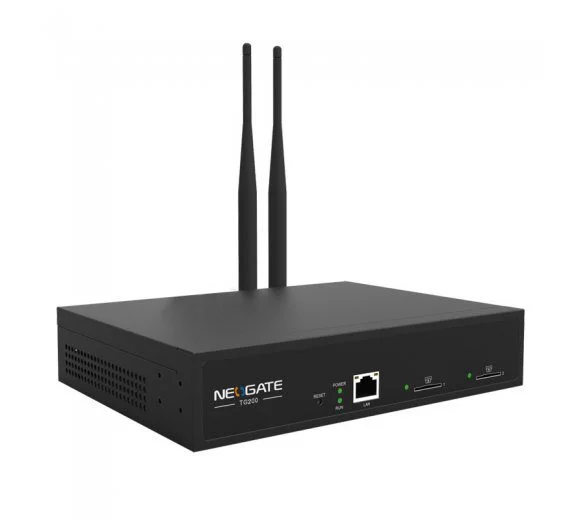
Yeastar TG200 2-Port GSM VoIP Gateway | Double the Channels, Double the Savings, Zero Compromises
The conversation around business communication costs always circles back to the same uncomfortable truth — mobile calling is expensive, unmanaged, and completely disconnected from the phone systems businesses invest so heavily in. For organizations that have already discovered the power of GSM gateway technology, the next question is equally important: what happens when one channel is simply not enough?
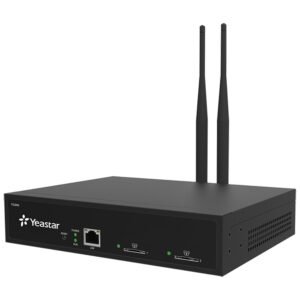
The Yeastar TG200 2-Port GSM VoIP Gateway is the answer. Building directly on the proven foundation of Yeastar’s TG gateway platform, the TG200 doubles the cellular channel capacity — delivering two independent, simultaneous GSM connections in a single compact unit, at a price point that makes the return on investment even more compelling than its single-port counterpart.
Two SIM cards. Two live cellular connections. Two simultaneous calls. One elegantly simple device that bridges your mobile network and your IP PBX with the reliability, intelligence, and cost-efficiency your business demands — at twice the throughput.
What Is the Yeastar TG200 GSM VoIP Gateway?
The Yeastar TG200 is a professional-grade, 2-port GSM VoIP Gateway that simultaneously connects two independent GSM cellular channels to your IP PBX or VoIP phone system via standard SIP protocol. Each port accommodates its own SIM card — from the same carrier or different carriers — creating two fully independent cellular trunks that your PBX can utilize concurrently for inbound calls, outbound calls, or a combination of both.
Like its single-channel sibling the TG100, the TG200 operates as a SIM-based SIP trunk gateway — presenting each GSM connection to your PBX as a standard SIP trunk line. But the two-port architecture unlocks capabilities and efficiencies that simply aren’t possible with a single-channel device: dual-carrier redundancy, simultaneous call handling, split inbound and outbound routing, and accelerated cost savings that scale directly with call volume.
The Yeastar TG200 Is Purpose-Built For:
- Growing small businesses and SMBs where mobile call volumes have outgrown a single GSM channel
- Businesses requiring carrier redundancy — using two different mobile carriers for failover protection
- Organizations splitting inbound and outbound GSM traffic across dedicated channels for optimized call management
- Call centers and support teams with simultaneous mobile calling requirements that a single port cannot satisfy
- Branch offices and remote locations needing reliable multi-channel cellular trunk connectivity without fixed-line infrastructure
- Businesses maximizing on-net calling savings across two carrier networks to cover the widest possible range of mobile numbers
- IT administrators and MSPs deploying scalable, multi-channel gateway solutions for small-to-medium client sites
- High mobile call volume environments — hospitality, healthcare, retail, logistics — where simultaneous mobile calls are routine
- Businesses in developing markets where GSM infrastructure provides more reliable connectivity than fixed broadband alternatives
- Organizations needing dual-SIM SMS gateway capability for higher-volume business messaging workflows
How the Yeastar TG200 Works — Two Channels, One Unified Solution
The TG200 operates on the same elegant, three-stage integration model as the TG100 — but with the added intelligence and flexibility that two independent channels make possible.
Stage 1 — Dual SIM Insertion Insert two standard GSM SIM cards into the TG200’s two independent SIM slots. These can be from the same carrier — maximizing on-net calling volume within a single network — or from two entirely different carriers, creating built-in cellular redundancy and coverage diversity. Each SIM operates completely independently, maintaining its own network registration, phone number, and call state.
Stage 2 — Network and PBX Integration Connect the TG200 to your local network via its Ethernet port. Register both GSM ports as SIP trunks on your IP PBX — each port presents as a separate, independent trunk line. Your PBX now has two live cellular connections it can route calls through, exactly as it would manage any other set of SIP trunk lines.
Stage 3 — Intelligent Dual-Channel Routing Configure your PBX dial plan to leverage both channels intelligently. Route outbound calls to Network A subscribers through SIM 1, and calls to Network B subscribers through SIM 2 — maximizing on-net savings across both carriers simultaneously. Or dedicate one channel to inbound calls and one to outbound. Or configure automatic failover from Channel 1 to Channel 2 when the primary SIM experiences network issues. The dual-channel architecture gives your dial plan a level of intelligence and resilience that a single-port gateway simply cannot provide.
Yeastar TG200 Key Features — Where Two Channels Change Everything
📡 2 Independent GSM Ports — Simultaneous Cellular Connectivity
The defining capability of the TG200 is its two fully independent GSM ports, each operating as a self-contained cellular trunk with its own:
- Independent SIM card and mobile number
- Independent network registration and carrier connection
- Independent call state — one port can be active on a call while the other handles a completely separate simultaneous call
- Independent routing rules within your PBX dial plan
- Independent SMS sending and receiving capability
This true independence means the two channels never interfere with each other. A call on Port 1 has absolutely no impact on the availability or performance of Port 2. For any business that has experienced the frustration of a single GSM channel being occupied when a second simultaneous call needs to be made, the TG200 eliminates that constraint entirely.
- Supports GSM 850/900/1800/1900 MHz frequency bands across both ports — broad global carrier compatibility
- Each port accepts a standard Mini SIM (2FF) card from any GSM network operator
- Both ports operate simultaneously without performance degradation on either channel
- Full feature parity between both ports — call routing, SMS, USSD, and monitoring available on each
💰 Doubled Cost Savings — Two Carriers, Maximum On-Net Efficiency
If a single GSM gateway delivers compelling mobile calling cost savings, two channels deliver those savings at twice the rate — and the TG200’s dual-SIM architecture opens up a cost optimization strategy unavailable to single-port solutions: dual-carrier on-net optimization.
Consider a business operating in a market with two dominant mobile carriers — let’s call them Network A and Network B. With a single SIM gateway using Network A, calls to Network A subscribers are on-net and cheap. But calls to Network B subscribers are still off-net and expensive. With the TG200 running a Network A SIM in Port 1 and a Network B SIM in Port 2:
- Calls to Network A mobile numbers route through Port 1’s SIM — on-net rates apply ✅
- Calls to Network B mobile numbers route through Port 2’s SIM — on-net rates apply ✅
- Both the largest mobile networks in your market are covered at on-net rates simultaneously
The result is a dramatic expansion of cost optimization coverage. Rather than saving on calls to one network’s subscribers, the TG200 enables on-net savings across the two most popular mobile networks in virtually any market — capturing the maximum possible reduction in mobile calling expenditure from a single compact device.
For businesses with high mixed-network mobile calling volumes, this dual-carrier strategy alone can deliver a return on investment in weeks.
🔄 Carrier Redundancy and Failover — Cellular Resilience Built In
Network outages, SIM card issues, and carrier-level disruptions can happen to any mobile operator at any time. With a single-port GSM gateway, a carrier outage means your cellular trunk is offline — potentially at the worst possible moment. The TG200’s dual-port architecture transforms this vulnerability into a managed risk:
- Configure your PBX to automatically failover from Port 1 to Port 2 when the primary carrier experiences disruption
- Use two different carriers to ensure that a single carrier’s network issue never takes your entire GSM trunk offline
- Maintain continuous inbound and outbound cellular calling capability even during carrier-level service disruptions
- Implement active load balancing across both ports during normal operation, shifting all traffic to the surviving port automatically during a disruption
For businesses that depend on cellular connectivity as their primary or backup trunk, this built-in redundancy is not a luxury — it is an operational necessity.
📞 Two Simultaneous Calls — Handle Concurrent Mobile Traffic Effortlessly
The business case for the TG200 over the TG100 is immediately clear in any environment where two mobile calls happen concurrently — which in most active businesses is not a rare edge case but a daily reality.
With the TG100’s single port, a second call that arrives while the first is in progress cannot use the GSM channel — it either fails over to a more expensive SIP trunk route, occupies a different trunk type, or fails entirely depending on your PBX configuration. With the TG200:
- Port 1 handles the first simultaneous call
- Port 2 handles the second simultaneous call
- Both calls route through cost-optimized GSM channels concurrently
- Neither call interferes with the other in any way
For customer-facing teams, support departments, and any business where staff regularly make or receive mobile calls simultaneously, this two-channel capacity eliminates the bottleneck and ensures every eligible call routes through the most cost-effective path available — every time.
🛡️ Dual-Channel Failover Trunk — The Ultimate Business Continuity Safety Net
The TG200 elevates business continuity protection to a new level. Where a single-port gateway provides one cellular backup channel when internet connectivity fails, the TG200 provides two independent cellular backup channels:
- Primary SIP trunks fail → calls automatically route through TG200 Port 1
- Port 1 also unavailable → calls automatically route through TG200 Port 2
- Two layers of cellular fallback protection, each on an independent carrier network
- Inbound calls to both SIM numbers continue to reach your PBX and ring through to extensions
- Full call recording, IVR, and routing rules remain active throughout any failover event
For businesses in sectors where communication availability is critical — financial services, healthcare, emergency response, logistics — this layered redundancy architecture transforms a potential crisis into a managed, invisible continuity event.
📩 Dual-Channel SMS Gateway — Higher Volume Business Messaging
The TG200’s two independent GSM ports each support full SMS gateway functionality, effectively doubling your SMS throughput capacity compared to a single-port solution:
- Inbound SMS on both SIM numbers — receive text messages from customers, suppliers, or automated systems on two separate numbers simultaneously
- Outbound SMS across two channels — send higher volumes of notifications, alerts, confirmations, and marketing messages without per-channel rate limits
- Load-balanced SMS delivery — distribute outbound SMS campaigns across both SIMs to maximize delivery speed and avoid carrier throttling
- Dedicated SMS channels — assign one port exclusively to SMS operations while the other handles voice calls, ensuring neither function competes with the other
- API-driven messaging — integrate business applications, CRM systems, and automation platforms with both SMS channels via Yeastar’s SMS API
- Two-factor authentication delivery at double the throughput of a single-port gateway
For businesses with meaningful SMS volumes — appointment reminders, delivery notifications, customer alerts, or marketing messages — the TG200’s dual-channel SMS capability delivers both higher throughput and operational flexibility that a single-port device cannot match.
⚙️ Unified Web Management Interface — One Dashboard, Complete Control
Despite managing two independent GSM channels, the TG200’s administration experience is refreshingly consolidated. A single, browser-based web management interface provides complete control over both ports from one unified dashboard:
- Per-port SIM status monitoring — network registration, signal strength, carrier name, and active call status displayed simultaneously for both ports
- Independent call routing rules — configure different routing behaviors for each port independently within the same interface
- USSD management — send carrier USSD commands to either or both SIM cards for balance checks, package activation, and account management
- SMS send and receive console — manage inbound and outbound SMS on both channels from a single messaging interface
- System-wide call logs — unified call history across both GSM ports for complete visibility and reporting
- Firmware management — update both ports simultaneously from a single firmware upload operation
- Diagnostic tools — real-time signal monitoring, SIP registration status, and network connectivity testing for both channels
The management simplicity of a single-port device, with the capability of a two-channel professional gateway.
Full Technical Specifications
| Specification | Detail |
|---|---|
| GSM Ports | 2 (Independent) |
| SIM Card Format | Mini SIM (2FF) per port |
| GSM Frequency Bands | 850 / 900 / 1800 / 1900 MHz |
| Simultaneous Calls | 2 (1 per port) |
| Network Interface | 1 × RJ45 10/100 Mbps Ethernet |
| VoIP Protocol | SIP (RFC 3261) |
| Audio Codecs | G.711 (a/μ-law), G.729, G.723 |
| DTMF Mode | RFC 2833, SIP INFO, In-band |
| SMS Support | Yes — Send and Receive (Both Ports) |
| USSD Support | Yes (Both Ports) |
| Management Interface | Web GUI (HTTP/HTTPS) |
| Configuration | Web browser — no software required |
| Firmware Updates | Remote, web-based |
| Power Supply | 12V DC Adapter (included) |
| Power Consumption | ≤ 8W |
| Operating Temperature | 0°C to 40°C (32°F to 104°F) |
| Dimensions | Compact desktop form factor |
| Compatibility | Any SIP RFC 3261-compliant IP PBX |
| Regulatory | CE, FCC certified |
Yeastar TG200 vs. TG100 — When to Choose Two Channels Over One
One of the most common purchasing questions is whether the step up from TG100 to TG200 is justified. The answer lies in understanding your business’s specific call volume, redundancy requirements, and cost optimization goals.
| Consideration | TG100 (1 Port) | TG200 (2 Ports) |
|---|---|---|
| Simultaneous GSM Calls | 1 | 2 |
| Carrier Diversity | Single carrier | Dual carrier possible |
| On-Net Optimization | One network | Two networks |
| SMS Throughput | Single channel | Dual channel |
| Carrier Redundancy | None | Built-in failover |
| Inbound/Outbound Split | Not possible | Dedicated per port |
| Best For | Low-volume, single-site | Medium-volume, resilience-focused |
| Cost Savings Scope | One carrier’s mobile numbers | Two carriers’ mobile numbers |
Choose the TG100 if: Your mobile call volume rarely requires more than one simultaneous GSM call, you work primarily with subscribers on a single mobile network, and your business continuity requirements are met by other failover mechanisms.
Choose the TG200 if: You regularly make or receive two or more simultaneous mobile calls, your staff calls subscribers across multiple carrier networks, you want built-in cellular redundancy, or you need higher SMS throughput for business messaging operations.
Yeastar TG200 vs. Competitors — The Professional Grade Advantage
✅ Standards-Based SIP — No Vendor Lock-In
Every competing GSM gateway solution that relies on proprietary protocols creates long-term dependency on a single vendor ecosystem. The TG200’s full SIP RFC 3261 compliance means it works with any SIP-capable PBX platform on the market — today, tomorrow, and when you upgrade your phone system five years from now.
✅ Yeastar Ecosystem Integration — Seamless With P-Series and S-Series PBX
For organizations already running Yeastar P-Series or S-Series IP PBX systems, the TG200 integrates with native auto-discovery and simplified trunk configuration — reducing deployment time to a fraction of what third-party gateway alternatives require. The Yeastar ecosystem advantage is real, measurable, and operationally significant.
✅ Professional Warranty and Support — Not a Gray Market Gamble
The TG200 is manufactured to professional telecommunications standards, CE and FCC certified, and backed by Yeastar’s professional warranty and technical support infrastructure. Unlike gray-market SIM box alternatives that operate outside regulatory frameworks and offer zero support when things go wrong, the TG200 is a business-grade investment with the backing to match.
✅ Proven Firmware Stability — Built for Long-Term Deployment
Yeastar’s firmware development track record across the TG gateway series is well-established — with regular updates that add features, address security vulnerabilities, and maintain compatibility with evolving carrier networks and PBX platforms. Your TG200 purchased today remains current, secure, and capable years into the future.
Real-World Deployment Scenarios — The TG200 in Action
🏥 Medical Practice With Busy Patient Communication Lines
A healthcare clinic that makes dozens of patient callback calls per day — spread across two dominant mobile carriers in their market — deploys the TG200 with one SIM from each carrier. Patient calls to Network A subscribers route through Port 1 at on-net rates. Patient calls to Network B subscribers route through Port 2 at on-net rates. The clinic’s mobile calling costs drop dramatically, and every patient call is now logged, recorded, and visible within the PBX reporting system.
🏨 Hotel and Hospitality Operations
A mid-size hotel uses the TG200 to handle front desk communications with guests on mobile numbers and supplier calls to delivery drivers and contractors. Port 1 handles inbound guest calls on a dedicated mobile number guests can save and call directly. Port 2 handles outbound calls to suppliers and contractors — routing to the carrier with the best on-net coverage for those contacts. Simultaneous calls to a delivery driver and a maintenance contractor no longer compete for the same channel.
🏭 Logistics and Warehouse Operations
A logistics company with a busy dispatch team that regularly contacts drivers, suppliers, and delivery partners on mobile numbers deploys the TG200 at their dispatch hub. Two simultaneous calls from the dispatch desk — one to a driver on Network A, one to a supplier on Network B — both route through on-net GSM channels at the lowest available rate, fully logged in the PBX call reporting dashboard.
🏢 Multi-Department Office With Internet Failover
A professional services firm with 50 employees deploys the TG200 as a dual-redundancy failover trunk. Their primary SIP trunk handles all normal call traffic. When the internet connection fails, calls automatically route through TG200 Port 1’s SIM. If Port 1’s carrier experiences disruption simultaneously, calls route through Port 2’s SIM from a different carrier. The probability of both failover channels being unavailable simultaneously is effectively negligible — communication continuity is virtually guaranteed.
📱 SMB Maximizing On-Net Savings Across Two Networks
A small business whose clients and suppliers are split roughly equally between two major mobile carriers installs the TG200 with one SIM from each network. Their PBX dial plan routes calls based on the destination number prefix — automatically selecting the port whose SIM is on the same network as the called number. On-net rates apply to virtually every mobile call the business makes, cutting mobile calling costs by a significant margin from the very first billing cycle.
Frequently Asked Questions About the Yeastar TG200
Can I use SIM cards from two different carriers in the Yeastar TG200?
Absolutely — and this is one of the most compelling reasons to choose the TG200 over a single-port gateway. Each port operates completely independently, with no requirement for the SIM cards to be from the same carrier, on the same account, or on the same pricing plan. Insert any two standard Mini SIM cards from any two GSM carriers operating on compatible frequency bands and both ports will register and operate independently.
Does the Yeastar TG200 support 3G or 4G LTE SIM cards?
The TG200 is a GSM (2G) gateway and connects to the GSM/GPRS layer of the cellular network for voice and SMS services. Most carriers continue to maintain 2G GSM network availability for voice and SMS alongside their 4G LTE data networks. For deployments requiring 3G or 4G data-based VoIP, Yeastar offers dedicated 3G and 4G gateway variants. We recommend verifying that your preferred carriers maintain active 2G GSM coverage in your deployment area.
How does the Yeastar TG200 integrate with FreePBX or Asterisk?
Integration follows the standard SIP trunk configuration process. In FreePBX or Asterisk, create two separate SIP trunks — one for each TG200 port — using the gateway’s IP address and the respective port’s SIP account credentials. In the TG200’s web interface, configure each port’s SIP settings to point to your PBX server’s IP and SIP port. Define outbound routes in FreePBX to direct the appropriate call types through each trunk. Total configuration time for an experienced administrator is typically under 45 minutes for both ports, and Yeastar provides detailed configuration guides for all major PBX platforms.
Can I configure one port for inbound calls only and the other for outbound only?
Yes — this is a common and effective configuration strategy. Configure your PBX to send all outbound GSM calls through Port 1’s trunk, and direct all inbound calls arriving on Port 2’s mobile number to the appropriate extensions or IVR. This dedicated channel approach ensures inbound calls never occupy the outbound channel and vice versa, eliminating any possibility of call conflict during high-traffic periods.
What is the maximum number of simultaneous calls the TG200 can handle?
The TG200 supports 2 simultaneous calls — one per GSM port. Each port handles exactly one active call at a time, independently of the other port. For deployments requiring more than 2 simultaneous GSM channels, Yeastar’s TG400 (4 ports) and TG800 (8 ports) extend the same platform with additional capacity while maintaining the same management interface and configuration approach.
Does the Yeastar TG200 support automated SMS for business applications?
Yes. Both ports support full SMS gateway functionality with API access for integration with business applications. Yeastar’s SMS API allows CRM systems, ticketing platforms, customer notification systems, and custom business applications to send and receive SMS messages through both of the TG200’s cellular channels — enabling higher-volume, dual-channel SMS workflows compared to a single-port solution.
Is the Yeastar TG200 compatible with hosted or cloud PBX platforms?
Yes. Provided your network firewall permits SIP traffic between the TG200 and your cloud PBX server — and most business firewalls support this with straightforward SIP ALG or port forwarding configuration — the TG200 registers its ports as standard SIP trunks with any cloud-hosted PBX platform. This enables businesses using hosted 3CX, cloud FreePBX, RingCentral, or similar platforms to benefit from local GSM termination cost savings while maintaining their cloud PBX infrastructure.
The Yeastar TG200 — Twice the Channels, Twice the Intelligence, Twice the Value
The step from one GSM channel to two is not merely a capacity upgrade — it is a fundamental enhancement of what a GSM gateway can do for your business. With the Yeastar TG200, you gain the ability to cover two carrier networks simultaneously, handle two concurrent mobile calls without compromise, build cellular redundancy directly into your trunk architecture, and scale your SMS gateway throughput to meet growing business messaging demands.
All of this is packaged in the same compact, reliable, professionally engineered hardware that has made Yeastar’s TG gateway series the trusted choice of IT professionals, managed service providers, and business communication managers across the globe.
Whether the TG200 serves as your primary cost-optimization trunk, your business continuity safety net, or the foundation of a dual-carrier on-net savings strategy — it delivers tangible, measurable value from the moment the first call routes through its GSM channels.

 No products in the cart.
Reviews
There are no reviews yet.