
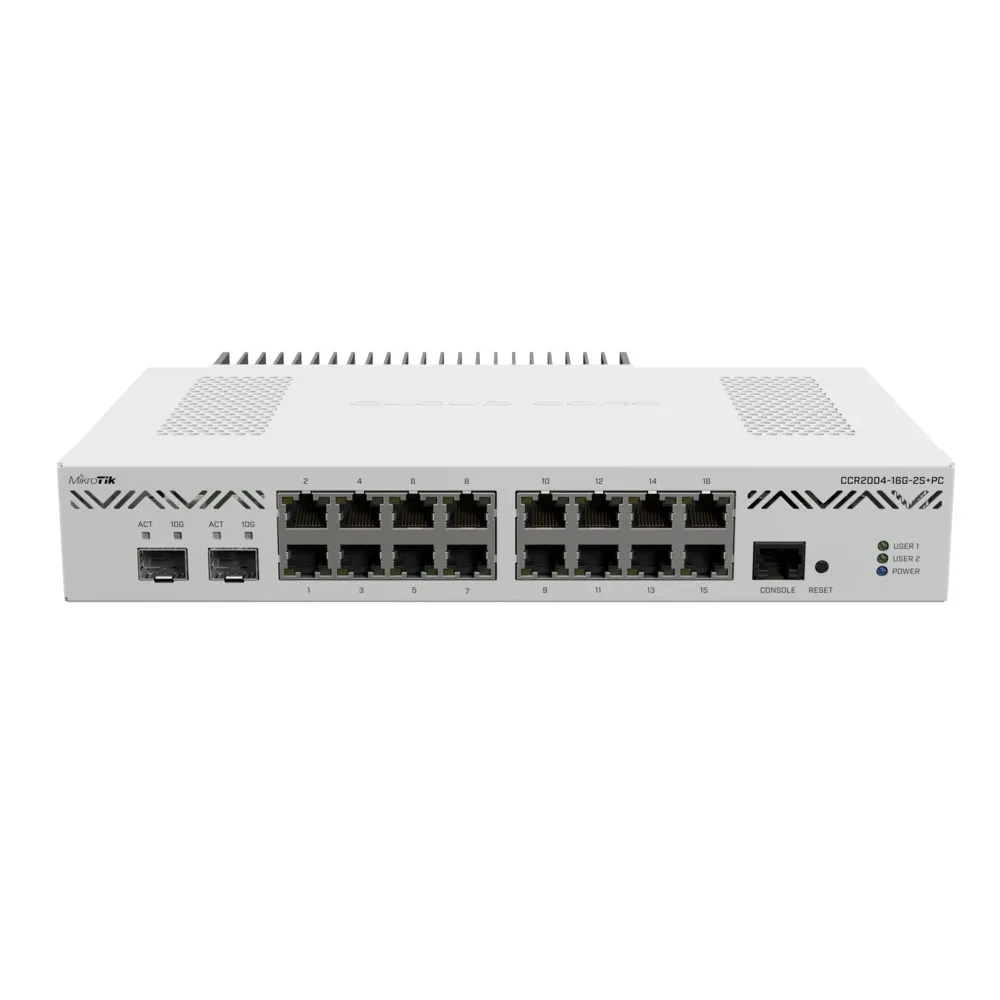
MikroTik CCR2004-16G-2S+PC — The Next-Generation ARM64 Cloud Core Router With PCIe Expansion That Redefines Enterprise Routing Performance
The benchmark has been raised. The MikroTik CCR2004-16G-2S+PC arrives as the definitive answer to the question every serious network engineer is asking in 2024 — how do I get carrier-grade routing performance, maximum port density, hardware expandability, and silent fanless operation, all in a single 1U rack unit, without the crushing price tag of traditional enterprise vendors?
The answer is here. Quad-core ARM64 processing at 1.7GHz. 4GB of DDR4 RAM. Sixteen Gigabit Ethernet ports. Two 10G SFP+ uplinks. A dedicated PCIe expansion slot. Completely fanless passive cooling. RouterOS Level 6 included. All of it, in one extraordinarily capable chassis that punches so far above its price class it makes competing products look architecturally outdated.
This is not an incremental upgrade. The CCR2004-16G-2S+PC is a generational leap in what a Cloud Core Router can be — and it was built specifically for the networks, the engineers, and the organizations that refuse to accept limitations.
What Is the MikroTik CCR2004-16G-2S+PC and What Makes It Exceptional?
The CCR2004-16G-2S+PC is the latest generation in MikroTik’s legendary Cloud Core Router family — rebuilt from the silicon up on a modern ARM64 architecture that delivers dramatically improved performance-per-watt, greater memory bandwidth, and superior multi-threaded packet processing compared to previous CCR generations.
The model designation tells the complete story:
- CCR2004 — Cloud Core Router, 2nd generation, quad-core processor
- 16G — sixteen independent Gigabit Ethernet ports
- 2S+ — two 10 Gigabit SFP+ ports
- PC — the defining feature that sets this model apart: a dedicated PCIe expansion slot for hardware-level extensibility that no comparably priced router on the market offers
That PCIe slot is not a footnote. It is a future-proofing investment — a hardware gateway that allows you to expand the CCR2004’s capabilities with additional interface cards, wireless modules, and connectivity options as your network requirements evolve. Buy the router once. Expand it indefinitely.
AL32400 Quad-Core ARM64 Processor — Modern Architecture for Modern Networks
Why the Second-Generation CCR Architecture Outperforms Its Predecessors
The CCR2004-16G-2S+PC is powered by the Annapurna Labs Alpine AL32400 — a quad-core ARM Cortex-A57 64-bit processor running at 1.7GHz — representing a significant architectural advancement over the MIPS-based processors found in earlier MikroTik CCR generations.
The shift to ARM64 is not cosmetic. It delivers fundamental performance improvements that matter in real-world routing deployments:
- 64-bit native architecture — larger addressable memory space, wider data paths, and more efficient instruction execution per clock cycle compared to 32-bit MIPS predecessors
- ARM Cortex-A57 microarchitecture — out-of-order execution, advanced branch prediction, and deep instruction pipelines deliver significantly higher instructions-per-clock than previous generation cores
- 1.7GHz per-core clock speed — higher base frequency than many competing multi-core routers, ensuring strong single-threaded performance for workloads that cannot be fully parallelized
- Hardware cryptographic acceleration — dedicated silicon for AES, SHA, and RSA operations enables IPsec and WireGuard VPN tunnels at near wire-speed without consuming general-purpose CPU cycles
- NEON SIMD instruction support — accelerates deep packet inspection, pattern matching, and application-layer traffic classification with vectorized processing
- Efficient power architecture — ARM’s inherently power-efficient design philosophy means the AL32400 delivers its performance at a fraction of the thermal output of equivalent x86 processors — enabling the fully passive, fanless cooling system that makes the CCR2004 uniquely suited to noise-sensitive and high-reliability environments
4GB DDR4 RAM — The Memory Foundation for Full Internet Routing at Scale
The CCR2004-16G-2S+PC ships with 4GB of DDR4 RAM — a specification that places it firmly in carrier and large enterprise territory and represents a significant leap over previous CCR generations.
What does 4GB of DDR4 actually enable?
- Full dual-stack BGP routing tables — comfortably accommodate complete IPv4 routing tables exceeding 950,000 prefixes AND full IPv6 routing tables simultaneously, with substantial memory remaining for routing processes and system operations
- Massive connection tracking tables — maintain state for millions of simultaneous network connections without table overflow — critical for NAT-heavy ISP and enterprise deployments
- Large-scale firewall rule sets — deploy thousands of firewall rules, address lists, and dynamic block lists without memory pressure affecting routing performance
- Extensive QoS queue hierarchies — implement complex per-subscriber, per-service, and per-application queue trees without RAM constraints limiting policy depth
- The Dude monitoring — sufficient RAM to run The Dude network monitoring server alongside full routing operations when installed as a package
- Future-proofing against table growth — as global BGP routing tables continue to expand year over year, 4GB ensures the CCR2004 remains viable for full-table BGP deployments for years to come
16 Gigabit Ethernet Ports — Unmatched Copper Connectivity Density
The Port Count That Eliminates the Need for External Switches
Sixteen independent 10/100/1000 Gigabit RJ45 Ethernet ports give the CCR2004-16G-2S+PC a level of physical copper connectivity density that is extraordinary for a routing platform at this price point — enabling direct connection of servers, switches, WAN interfaces, and network segments without additional switching hardware in many deployment scenarios.
With sixteen Gigabit ports available, a single CCR2004 can simultaneously serve as:
- Multi-WAN aggregation router — connect four, six, or eight independent ISP circuits for maximum redundancy and combined throughput, with intelligent load balancing and automatic failover between carriers
- Server direct-connect router — attach critical servers directly to the router at Gigabit speeds, eliminating the latency and complexity of intermediate switching layers
- Network segmentation hub — dedicate individual ports to separate network zones — corporate LAN, guest Wi-Fi, IoT, DMZ, management, VoIP, and security systems — with fully independent firewall and routing policies per segment
- Branch office aggregation — aggregate uplinks from multiple access-layer switches across a campus or office building into a single high-performance routing core
- Out-of-band management network — dedicate ports to a physically separate management network that remains accessible even when primary production networks experience issues
Per-Port Hardware Capabilities
Every one of the sixteen Gigabit ports on the CCR2004 supports:
- Auto-MDI/MDIX — automatic crossover detection eliminates the need for crossover cables in any connection scenario
- Auto-negotiation — seamless compatibility with 10Mbps, 100Mbps, and 1000Mbps devices
- Hardware flow control (IEEE 802.3x) — prevents packet loss under burst traffic conditions through hardware-level pause frame signaling
- VLAN tagging (802.1Q) — carry multiple logical networks over a single physical port for maximum infrastructure efficiency
- PoE passthrough on select ports — check specifications for PoE capability on specific port variants
Dual 10G SFP+ Ports — High-Speed Uplinks That Scale With Your Demands
The 10 Gigabit Backbone for Your Entire Infrastructure
The two 10 Gigabit SFP+ ports on the CCR2004-16G-2S+PC serve as the high-speed arterial connections that tie your entire network infrastructure together — carrying aggregated traffic flows from all sixteen Gigabit ports upstream to your data center core, service provider handoff, or 10G switching fabric.
What You Can Do With Two 10G SFP+ Ports
- Active/standby 10G uplink redundancy — configure one SFP+ port as the primary upstream connection and the second as automatic hot-standby — guaranteed failover in milliseconds when the primary path fails
- Active/active LACP bonded uplink — bond both SFP+ ports into a single 20Gbps logical interface for combined throughput and path redundancy simultaneously
- Dual-carrier 10G WAN connectivity — connect to two independent 10G carrier circuits for maximum WAN redundancy and traffic engineering flexibility
- 10G core switch interconnect — connect the CCR2004 directly to your 10G switching core via DAC cable or fiber transceiver for high-throughput inter-VLAN routing at wire speed
- Data center fabric integration — attach the CCR2004 to your spine-leaf switching fabric via standard 10G SFP+ connections
SFP+ Transceiver Compatibility
- MikroTik S+85DLC03D — 10G multi-mode fiber, 300m reach over OM3
- MikroTik S+23LC10D — 10G single-mode fiber, 10km reach
- MikroTik S+DA0001/S+DA0003 — direct attach copper (DAC) cables for cost-effective short-range 10G connections within racks
- Third-party SFP+ transceivers — broad compatibility with industry-standard modules from leading vendors
The PCIe Expansion Slot — The Feature That Changes Everything
Hardware Expandability in a Router — A Genuine Industry First at This Price Point
The “PC” in CCR2004-16G-2S+PC is the specification that truly distinguishes this router from every comparably priced alternative on the market — a dedicated PCIe (Peripheral Component Interconnect Express) expansion slot built directly into the chassis and accessible for hardware-level expansion.
No other router in the CCR2004’s price category offers this capability. It is an architectural decision that transforms the CCR2004 from a fixed-capability routing appliance into a platform — a foundation that evolves with your requirements rather than being replaced by them.
What the PCIe Slot Enables
- Additional interface cards — install MikroTik PCIe interface modules to add port types and connectivity options beyond the base configuration
- Wireless module expansion — add high-performance wireless cards for environments requiring integrated wireless routing capability within the CCR chassis
- Specialized connectivity — attach purpose-built PCIe cards for niche connectivity requirements unique to specific deployment environments
- Future MikroTik expansion modules — as MikroTik’s PCIe card ecosystem grows, the CCR2004 is already hardware-ready to accept new capabilities without chassis replacement
- Investment protection — the PCIe slot means the CCR2004 adapts to future requirements rather than becoming obsolete — your hardware investment compounds in value rather than depreciating
The Strategic Value of PCIe in a Router
Consider the traditional router lifecycle: purchase a router for its current capabilities, find it insufficient as requirements grow, replace the entire unit with a new model. This cycle is expensive, disruptive, and wasteful. The CCR2004’s PCIe slot breaks this cycle entirely — when your connectivity requirements expand beyond the base configuration, you expand the router itself rather than replacing it. For organizations planning multi-year infrastructure investments, this distinction has significant financial implications.
Fanless Passive Cooling — Silent, Reliable, and Maintenance-Free
The Engineering Achievement That Enables Zero-Noise Operation
The CCR2004-16G-2S+PC operates in complete silence. No fans. No airflow noise. No mechanical components spinning at thousands of RPM generating heat, sound, and eventual failure points. The entire thermal management system relies on a sophisticated passive heatsink architecture that dissipates the AL32400 processor’s thermal output through convection alone.
This engineering achievement has profound operational implications:
Reliability Implications
- Fan failure is statistically the most common cause of active network equipment failure — the CCR2004 eliminates this failure mode entirely by removing fans from the design
- No moving mechanical parts means no wear-related degradation over time — the CCR2004’s thermal system performs identically on day one and year five
- No dust accumulation in fan intakes — a chronic issue in data centers and industrial environments that progressively degrades cooling efficiency and requires regular maintenance cleaning
- Reduced vibration — fanless operation eliminates the low-frequency vibration that can, over years, loosen rack connections and affect nearby storage equipment
Operational Environment Implications
- Noise-sensitive deployments — broadcast studios, trading floors, open-plan offices, medical facilities, and educational environments where fan noise is unacceptable
- Office server closets without dedicated cooling — passive equipment generates more predictable thermal loads and doesn’t create localized hot spots from directed airflow
- High-altitude and low-air-density environments — where fan-cooled equipment struggles to maintain adequate airflow, passive cooling performs consistently
- Dusty industrial environments — where fan intakes would rapidly clog with particulate matter, passive cooling remains unaffected
Operating Temperature Range
The CCR2004-16G-2S+PC operates reliably across a -20°C to +60°C ambient temperature range — accommodating deployment environments from cold-climate outdoor cabinets to hot-running industrial server rooms without performance derating.
Hardware Specifications — Complete Technical Reference
| Specification | Detail |
|---|---|
| CPU | AL32400 Quad-Core ARM Cortex-A57 64-bit, 1.7GHz |
| RAM | 4GB DDR4 |
| Storage | 128MB NAND Flash + MicroSD slot |
| Gigabit Ethernet Ports | 16 x 10/100/1000 RJ45 |
| SFP+ Ports | 2 x 10Gbps SFP+ |
| PCIe Slot | 1 x PCIe expansion slot |
| Serial Console | 1 x RJ45 |
| USB | 1 x USB 3.0 |
| RouterOS License | Level 6 |
| Operating System | RouterOS v7 |
| Form Factor | 1U Rack-mount |
| Power Supply | Dual redundant hot-swap PSUs |
| Cooling | Passive fanless |
| Operating Temp | -20°C to +60°C |
| Power Consumption | ~38W typical |
| Dimensions | 443 x 230 x 44mm |
| Weight | 3.8kg |
RouterOS Level 6 — The Complete Professional Toolkit, Included
Every Feature. Every Protocol. No Licensing Fees. Ever.
The CCR2004-16G-2S+PC ships with RouterOS Level 6 — MikroTik’s highest, most unrestricted license tier — included as a permanent, non-expiring component of the hardware purchase. There are no annual renewal fees, no per-feature module costs, no subscriber limits, and no functionality locked behind premium tiers.
Routing and Network Architecture
- Full BGP with route reflection, communities, and policy control — peer with upstream carriers, manage full internet routing tables, and implement sophisticated traffic engineering across complex multi-homed network topologies
- OSPF v2/v3 for IPv4 and IPv6 — deploy dynamic link-state routing across enterprise and service provider interior networks with area segmentation, summarization, and rapid convergence
- IS-IS routing protocol — service provider-grade interior routing for organizations preferring IS-IS topology control
- MPLS with LDP and traffic engineering — implement label-switched paths for service isolation, traffic engineering, and service provider-grade network segmentation
- PIM sparse-mode and dense-mode multicast — deliver live video streaming, financial data feeds, and multicast applications efficiently across routed networks
- BFD for sub-second failure detection — detect link and neighbor failures in milliseconds for near-instant routing reconvergence
VPN and Encrypted Connectivity
- WireGuard — the modern, high-performance VPN protocol delivering maximum throughput with minimal overhead, accelerated by the ARM64 hardware crypto engine
- IPsec IKEv2 with hardware acceleration — enterprise-grade encrypted tunnels at near wire speed, leveraging the AL32400’s dedicated cryptographic processing
- OpenVPN — universal VPN compatibility for the broadest range of client platforms and firewall environments
- L2TP/IPsec and SSTP — native client support across Windows, macOS, iOS, and Android without additional software installation
- ZeroTier and overlay network support — modern SD-WAN and overlay network integration for cloud-connected infrastructure
Quality of Service and Traffic Management
- HTB hierarchical queuing — deliver guaranteed minimum bandwidths and enforce maximum limits for every user class, service type, and application category simultaneously
- CAKE with FQ-CoDel — modern, intelligent active queue management that eliminates bufferbloat and delivers consistent low-latency performance for real-time applications
- DSCP and 802.1p QoS marking — classify traffic at ingress and propagate QoS markings across the entire network path
- Per-subscriber queue trees via RADIUS — dynamically assign bandwidth policies to PPPoE and hotspot subscribers based on their service plan, without manual per-user configuration
ISP and Service Provider Features
- Unlimited PPPoE server sessions — terminate subscriber sessions at scale with per-session bandwidth policies, RADIUS authentication, and comprehensive session management
- Hotspot gateway with captive portal — deploy branded captive portal authentication for Wi-Fi, wired, and managed network access with unlimited concurrent user support
- RADIUS client integration — centralize subscriber authentication, authorization, and accounting through existing RADIUS infrastructure
- DHCP server with option sets — serve IP addresses with full option support for subscriber CPE auto-provisioning
Ideal Use Cases — The CCR2004-16G-2S+PC in the Real World
Regional and Tier-3 Internet Service Providers
The CCR2004-16G-2S+PC’s combination of 4GB RAM for full BGP tables, unlimited PPPoE sessions, 16 Gigabit access ports, and dual 10G uplinks makes it the ideal aggregation and border router for regional ISPs serving residential and business subscribers:
- Terminate subscriber PPPoE sessions with per-plan QoS enforcement
- Maintain full BGP peering with upstream transit providers
- Apply per-subscriber traffic shaping through RADIUS-assigned queue policies
- Monitor the entire subscriber network via The Dude package
- Connect to upstream 10G carrier handoffs via SFP+ ports
Large Enterprise Core and WAN Routing
For enterprises managing multi-site WAN architectures, complex VLAN environments, and demanding internal traffic volumes, the CCR2004 serves as the intelligent routing core:
- Aggregate multiple WAN connections from different carriers with BGP or policy-based routing
- Route inter-VLAN traffic at high throughput across campus and data center environments
- Terminate site-to-site VPN connections to branch offices and remote sites with hardware-accelerated IPsec
- Enforce comprehensive security policies across all network segments through stateful firewall and Layer 7 application detection
Data Center Edge Routing
Position the CCR2004-16G-2S+PC at the data center network boundary — handling BGP sessions with upstream providers, traffic engineering, security policy enforcement, and high-throughput routing for data center services:
- BGP peering with multiple upstream transit providers for path diversity
- ECMP load balancing across multiple 10G uplink paths
- DDoS mitigation through dynamic address list blocking and rate limiting
- Direct server connectivity via Gigabit ports for management and out-of-band access
Managed Service Provider (MSP) Central Routing Infrastructure
MSPs delivering managed network services benefit from the CCR2004’s routing depth, protocol breadth, and monitoring capabilities:
- Central VPN hub terminating client site-to-site tunnels at scale
- BGP route manipulation for client traffic engineering and path control
- The Dude monitoring server for centralized client network visibility
- PCIe expansion for specialized connectivity requirements serving specific client environments
Campus Network Core Routing
Universities, hospitals, government facilities, and large corporate campuses deploying multi-building, multi-segment network architectures find the CCR2004’s port density and routing performance ideal for core layer deployment:
- Direct connection of building distribution switches via Gigabit uplinks
- Inter-VLAN routing for department, faculty, student, guest, and IoT network segments
- Integration with identity management systems via RADIUS for policy-based access control
- 10G uplink connectivity to data center switching cores
CCR2004-16G-2S+PC vs. The Competition — Why the Choice Is Clear
| Feature | MikroTik CCR2004-16G-2S+PC | Comparable Enterprise Router |
|---|---|---|
| CPU Architecture | ARM64 Cortex-A57 Quad-Core | Varies — often older architecture |
| RAM | 4GB DDR4 | Typically 2–4GB at higher cost |
| Gigabit Ethernet Ports | 16 x GbE RJ45 | Typically 4–8 ports |
| 10G SFP+ Ports | 2 x 10G SFP+ | Often 1 or extra cost |
| PCIe Expansion Slot | ✅ Yes — unique differentiator | ❌ No |
| Fanless Passive Cooling | ✅ Yes | ❌ Rarely at this performance tier |
| Full BGP Table Support | ✅ Yes | ✅ Yes — at much higher cost |
| RouterOS Level 6 | ✅ Fully included | ❌ Tiered licensing model |
| Hardware Crypto Acceleration | ✅ Yes — ARM64 native | ❌ Often software-only |
| Annual Licensing Fees | ❌ None — ever | ✅ Mandatory recurring cost |
| Operating Temp Range | -20°C to +60°C | Typically 0°C to +40°C |
| Total Cost of Ownership | ✅ Exceptional | ❌ Significantly higher |
Frequently Asked Questions
What does the “PC” in CCR2004-16G-2S+PC stand for?
The “PC” denotes the PCIe expansion slot built into this specific variant of the CCR2004. It physically differentiates this model from the standard CCR2004-16G-2S+ and enables hardware-level expansion through compatible MikroTik PCIe cards — adding connectivity options and capabilities beyond the base configuration.
Can the CCR2004-16G-2S+PC carry a full BGP internet routing table?
Yes. With 4GB of DDR4 RAM and RouterOS Level 6, the CCR2004 comfortably maintains full IPv4 and IPv6 BGP routing tables simultaneously — with memory headroom remaining for routing processes, connection tracking, firewall state, and system operations. It is fully capable of production BGP peering with upstream internet transit providers.
How does the ARM64 architecture improve VPN performance over previous CCR generations?
The ARM Cortex-A57 processor includes hardware-native cryptographic acceleration for AES, SHA, and RSA operations — the core algorithms used in IPsec and WireGuard VPN encryption. This dedicated silicon handles encryption and decryption without consuming general-purpose CPU cores, enabling VPN tunnel throughput that approaches wire speed even under concurrent routing and firewall processing loads.
Is the fanless cooling system adequate under sustained full load?
Yes. The CCR2004’s passive heatsink is engineered for sustained full-load operation across the entire rated temperature range of -20°C to +60°C. The ARM64 architecture’s power efficiency means the AL32400 generates significantly less heat than comparable x86 or older MIPS processors — making passive cooling not just viable but highly effective.
Can I run The Dude network monitoring server on the CCR2004?
Yes. The Dude package can be installed on the CCR2004-16G-2S+PC via RouterOS package management. With 4GB of RAM and a MicroSD slot for extended storage, the CCR2004 has sufficient resources to run The Dude alongside full routing operations — monitoring hundreds to thousands of network devices from the same chassis.
What PCIe cards are compatible with the expansion slot?
The CCR2004-16G-2S+PC’s PCIe slot is compatible with MikroTik’s range of PCIe expansion cards, including wireless interface cards and additional network interface modules. Refer to MikroTik’s current PCIe accessory lineup for the latest compatible expansion options as the ecosystem continues to grow.
Does the CCR2004 support WireGuard natively?
Yes. RouterOS v7 on the CCR2004 includes native WireGuard support as a built-in feature — no additional packages or licenses required. WireGuard’s performance benefits from the ARM64 processor’s cryptographic acceleration, delivering high-throughput encrypted connectivity with minimal latency overhead.
The Router That Grows With Your Network — Today, Tomorrow, and Beyond
Every router decision is ultimately a question of longevity. Will this hardware still meet your requirements in two years? In five? The MikroTik CCR2004-16G-2S+PC was designed with that question as a foundational engineering principle — and the answers are built directly into the hardware.
The 4GB DDR4 RAM that handles today’s full BGP tables will accommodate tomorrow’s expanded routing tables. The ARM64 architecture that efficiently handles today’s encryption workloads is the platform that RouterOS v7 is optimized to run on for years to come. The PCIe expansion slot that may be unused today becomes the gateway to new capabilities when your requirements evolve. The fanless passive cooling that runs silently today will run with equal reliability in year six without a single fan replacement or maintenance cycle.
This is a router engineered not just for the network you have — but for the network you’re building toward.
Sixteen Gigabit ports. Two 10G uplinks. ARM64 power. PCIe expandability. Complete silence. RouterOS Level 6. No licensing fees. No fan failures. No compromises.
Order the MikroTik CCR2004-16G-2S+PC today — and invest in routing infrastructure that grows alongside your ambitions.
 No products in the cart.
Reviews
There are no reviews yet.